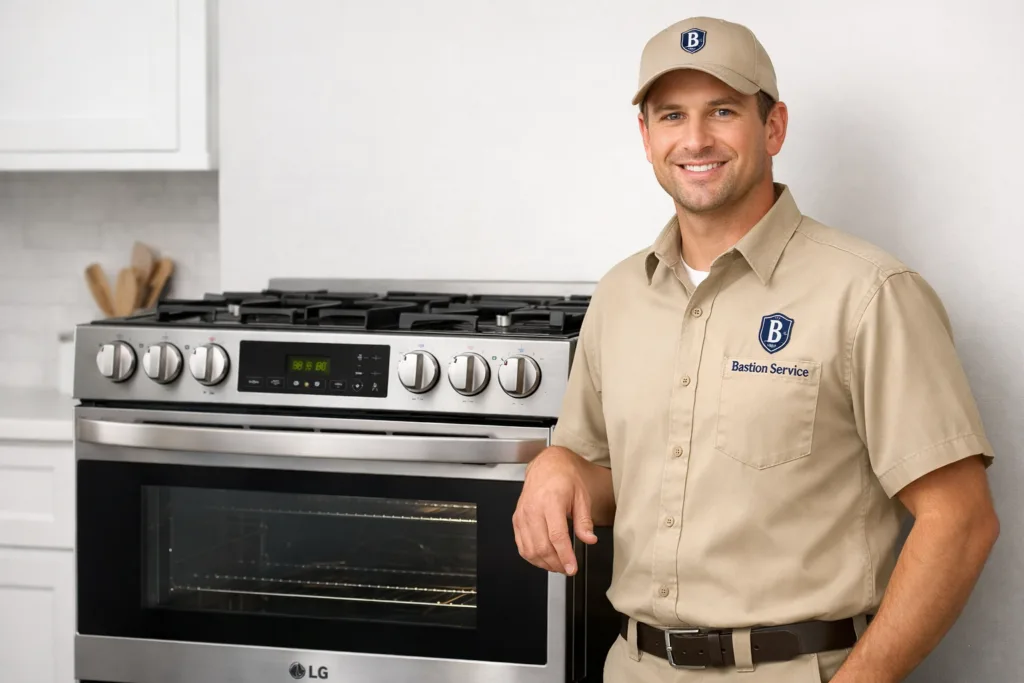
Cooking problems often show up before an oven fails completely. Cookies brown unevenly, casseroles need extra time, or the preheat tone sounds long before the cavity is actually hot enough. With LG ovens, those symptoms can come from several different components, so the most useful next step is identifying whether the issue is related to heat production, temperature sensing, control response, or power delivery.
Signs your LG oven may need service
Many Mid-City homeowners call for oven service after noticing a pattern rather than a single failure. A one-time undercooked meal can happen. Repeated temperature problems usually point to a repair issue that should be checked.
- The oven turns on but does not heat
- Preheat takes much longer than it used to
- Food cooks unevenly from front to back or rack to rack
- The display shows an error code or stops responding
- The oven shuts off during baking
- The door will not lock, unlock, or close properly
- There is clicking, buzzing, or a burning smell during use
These issues are not all caused by the same part. That is why symptom-based testing matters more than guessing based on one visible problem.
What different oven symptoms can mean
Not heating at all
If the control panel appears normal but the oven stays cold, possible causes include a failed bake element, a weak or failed igniter on gas models, a temperature sensor problem, wiring damage, a thermal protection issue, or an electronic control fault. On some units, the oven may appear to start normally even though the heat circuit is not completing.
Slow preheat
Slow preheat is one of the most common complaints because the oven still works, just badly. Electric models may have an element that is weakening or only heating partially. Gas models may have an igniter that still glows but no longer draws enough current to open the gas valve correctly. Sensor drift can also cause the control to misread actual temperature and extend cooking times.
Uneven baking
When one side of a pan browns faster than the other, or when the top cooks much faster than the center, the problem may involve inconsistent cycling, airflow issues, sensor inaccuracy, or an element that is not heating evenly. Home cooks usually notice this first with baking, because recipes that used to come out reliably start producing mixed results.
Temperature swings or overheating
An oven that overshoots the selected temperature can burn food, dry out dishes, and create frustrating results even when the timer is accurate. In some cases, the oven sensor is reading incorrectly. In others, the control may not be cycling heat off at the right time. If the cavity becomes much hotter than expected, it is smart to stop using the appliance until the problem is checked.
Display and control problems
Touch controls that do not respond, a blank display, or repeated error codes can point to interface faults, communication problems, or a failing control board. Sometimes the issue is limited to the control area. Sometimes it affects normal heating operation too, especially when the board controls relays, temperature feedback, and safety functions.
Common LG oven issues in daily household use
Oven problems are often easier to describe by what happens during dinner prep than by the failed part itself. A few real-world patterns tend to be especially helpful:
- Frozen meals come out undercooked even after the full time: often tied to low actual temperature or slow heat recovery.
- Roasted foods burn on top before the center is done: may suggest broil involvement, poor cycling, or sensor error.
- Bread and baked goods suddenly become inconsistent: often points to temperature control rather than recipe changes.
- The oven works some days and not others: can indicate intermittent wiring, relays, or heat-sensitive electronic failure.
- Self-clean problems lead to door or control issues: heat stress can affect latches, fuses, and electronic components.
When to stop using the oven
Some symptoms are more than a convenience problem. If the oven is tripping a breaker, producing a sharp electrical smell, shutting down mid-cycle, overheating badly, or failing to ignite properly, continued use can create more damage or a safety concern. The same is true if the door does not close securely or the control behaves unpredictably during operation.
For households in Mid-City, it is usually best to pause use when the appliance shows signs of unstable electrical performance or uncontrolled heating rather than trying to get through “one more meal” before scheduling service.
Repair or replace?
That decision usually depends on the exact fault, the age of the oven, and how the appliance has been performing overall. A single failed sensor, igniter, or heating component is often a reasonable repair if the rest of the unit is in solid condition. Replacement becomes more attractive when there are multiple electronic faults, recurring breakdowns, or signs of broader wear.
A good service visit should help separate a contained repair from a larger reliability issue. That matters because an older oven with one isolated failure is very different from an oven with repeated control, wiring, and temperature problems happening at the same time.
What helps speed up diagnosis
If you are arranging LG oven repair in Mid-City, a few details can make the problem easier to pinpoint:
- Whether the oven is electric or gas
- If the unit still powers on normally
- Whether the problem affects bake, broil, or both
- If the issue started suddenly or got worse over time
- Any error code shown on the display
- Whether the problem began after self-cleaning or a power interruption
Even small observations can be useful. For example, “it preheats but never seems truly hot” suggests a different path than “it is completely dead” or “it gets too hot and burns everything.”
Why symptom patterns matter with LG ovens
Modern LG ovens rely on several systems working together: heating components, sensors, relays, safety circuits, user controls, and sometimes door-lock functions tied to operating modes. Because of that, the same symptom can have more than one cause. Replacing parts too quickly can leave the original issue unresolved and add cost without restoring normal cooking performance.
For homeowners in Mid-City, the most helpful repair path is one based on how the oven is actually failing in everyday use. Whether the problem is no heat, uneven baking, slow preheat, or control trouble, matching the repair to the symptom pattern is what leads to a more confident decision about the appliance.