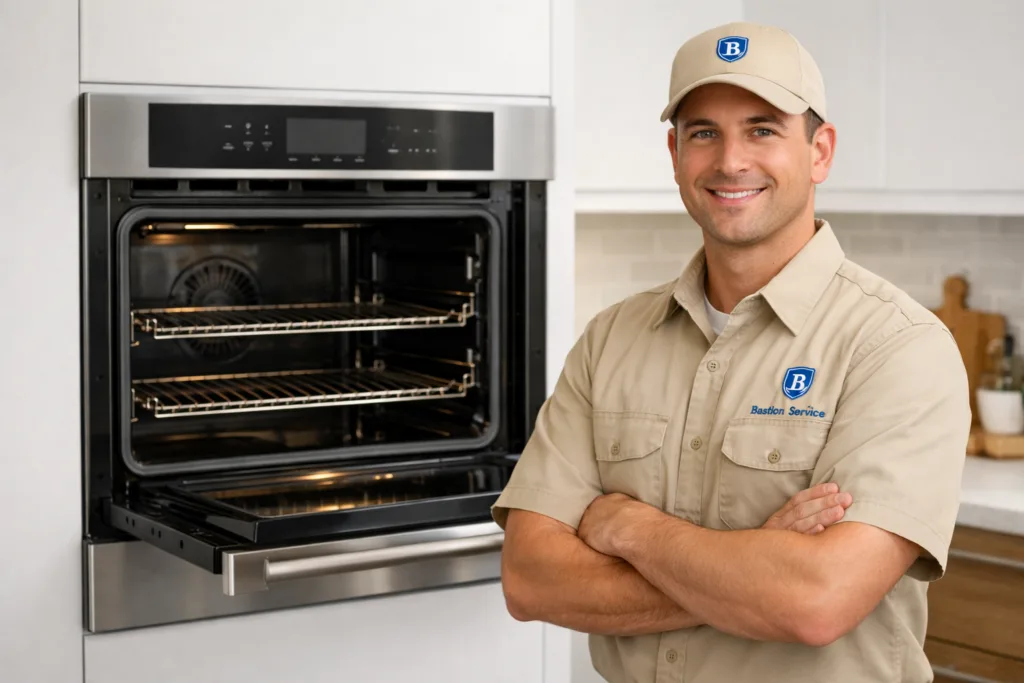
Wall oven problems tend to show up in everyday cooking before they become a complete breakdown. A preheat that drags on, a cavity that never seems to match the set temperature, or a control panel that works inconsistently can all point to different failures inside the same appliance. For Manhattan Beach homeowners, the most useful starting point is to match the symptom to the system that is likely causing it.
Common JennAir wall oven symptoms and what they may indicate
Many JennAir wall oven complaints sound similar at first, but the repair path can be very different depending on how the oven fails. An oven that never heats at all is not the same as one that heats slowly, overshoots the temperature, or bakes unevenly from rack to rack.
Oven will not heat
If the display turns on but the oven cavity stays cold, the problem may involve the bake circuit, broil circuit, sensor feedback, a relay, wiring, or the electronic control. In some cases, one heating function fails while another still works, which can help narrow down whether the issue is tied to a specific component or to the control system.
This symptom should not be judged by the display alone. A wall oven can appear normal from the outside while a heating part or control output has already failed.
Slow preheat
Slow preheat often starts as an annoyance and then becomes a larger cooking problem. Meals take longer, recipes become less predictable, and the oven may seem to run constantly without reaching the expected temperature. That can happen when a heating element is weak, when the sensor is reading inaccurately, or when the control is not cycling heat correctly.
If preheat times have changed noticeably from the way the oven used to perform, it is usually a sign that something inside the heating or temperature-management system is no longer operating as intended.
Uneven baking or temperature swings
When one tray browns too quickly while another stays pale, or when baked dishes need extra time for no obvious reason, the problem may be related to temperature sensing, heat cycling, convection-related components on applicable models, or airflow inside the oven cavity. Not every uneven result means a broken part, so it helps to separate appliance issues from cookware choices, rack position, and overloaded cooking space.
Once normal cooking variables are ruled out, repeated temperature inconsistency is a strong sign that the oven needs service rather than recalibration guesses.
Control panel problems and error codes
A JennAir wall oven may also fail through the user interface rather than through visible heating loss. Buttons may stop responding, the display may flicker, cycles may cancel unexpectedly, or fault codes may return after the power is reset. These issues can come from the touch interface, control board, communication faults, or related electrical problems.
Intermittent control behavior is especially important because it often gets worse over time. A panel that occasionally freezes today may become a full no-start condition later.
Door and latch concerns
If the oven door does not close properly, does not unlock, or feels misaligned, cooking performance and safety can both be affected. Problems after a self-clean cycle are also common because high heat can stress latches, sensors, controls, and wiring. A door or lock issue should be addressed promptly if it prevents normal use or keeps the oven from operating correctly.
Why symptom-based diagnosis matters
Wall ovens rely on several systems working together: incoming power, heating components, temperature sensing, electronic controls, safety functions, and door-related parts. The visible complaint is often only the final result. For example, no heat does not automatically mean the element is bad, and an error code does not automatically mean the main control has failed.
That is why replacing parts based on guesswork can lead to unnecessary cost without solving the original problem. A service visit should determine whether the failure is isolated, whether related components have also been affected, and whether the repair is likely to restore stable operation.
When to stop using the oven
Some wall oven issues are inconvenient but manageable for a short time. Others are a reason to stop using the appliance until it is checked. Continued operation can worsen damage when the problem involves overheating, unstable electrical behavior, or a door or latch that is not functioning correctly.
You should avoid further use if you notice any of the following:
- The oven trips a breaker or loses power during a cycle.
- There is a burning smell, overheating odor, or signs of stressed wiring.
- The oven shuts off unexpectedly while cooking.
- The cavity temperature is far above or below the selected setting.
- The control panel behaves erratically or becomes unresponsive.
- The door will not close, lock, or unlock properly.
Ignoring these warning signs can turn a smaller repair into a broader electrical or control problem.
Repair or replace?
Many JennAir wall oven issues are repairable when the problem is limited to a heating element, sensor, latch component, fan-related part, or a defined control failure. If the rest of the oven is in good condition and the repair addresses a single clear fault, repair is often the sensible choice for a household that wants to keep the existing appliance in service.
Replacement becomes more likely when the oven has multiple major failures at once, shows a pattern of repeat problems, or requires a repair cost that no longer makes sense for the appliance’s condition. Age matters, but overall condition matters just as much. An older oven with one isolated problem may still be worth fixing, while a newer unit with extensive heat-related damage may not be the best repair candidate.
What homeowners in Manhattan Beach can expect from a service evaluation
A useful wall oven service appointment starts with the actual behavior you are seeing at home: no heat, slow preheat, uneven baking, a stuck door, or a recurring code on the display. From there, the goal is to test the systems involved, confirm the failure, and explain whether the issue is limited or part of a larger problem.
For residential JennAir wall oven repair in Manhattan Beach, that kind of practical repair guidance helps homeowners make a confident decision. Instead of guessing from symptoms alone, you get a clearer picture of what failed, whether continued use risks more damage, and whether the repair path is reasonable for the appliance you have.
Signs the problem is getting worse
Wall ovens often give early warnings before they stop working completely. Paying attention to these changes can help you schedule repair before the appliance becomes unusable:
- Preheat times increase gradually over several weeks.
- Recipes that were once reliable begin finishing unevenly.
- The display resets, dims, or behaves inconsistently.
- Error codes appear occasionally, then more often.
- The oven needs repeated restarts to complete a cycle.
- The door becomes harder to open, close, or latch normally.
When these symptoms start to stack together, the issue is less likely to resolve on its own and more likely to require a proper diagnosis.
Household impact of delaying wall oven repair
In many homes, a wall oven is used often enough that even a minor temperature problem quickly affects daily routines. Meal planning becomes harder, baking becomes unreliable, and holiday or weekend cooking can become frustrating. In some cases, owners compensate by running longer cook times or using higher settings, which can place more stress on components that are already failing.
Addressing the issue early may help limit the scope of repair and reduce the chance of turning one failed part into a more complex control or wiring problem.