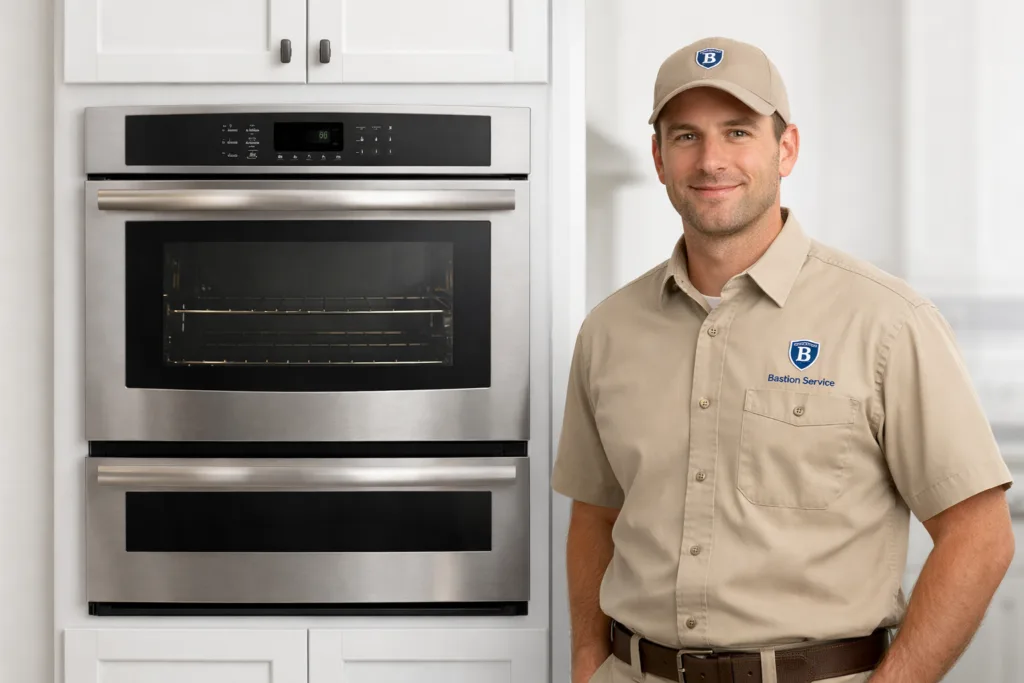
Wall ovens often give warning signs before they fail completely. If your GE unit has started baking unevenly, taking much longer to preheat, or showing intermittent control problems, the pattern matters. The same oven that underheats one day and overheats the next may have a different repair path than one that stays completely cold every time you use it.
For homeowners in Hawthorne, it helps to look at the symptom as part of a larger picture: how the oven behaves during preheat, whether broil still works, whether the display responds normally, and whether the problem happens on every cycle or only sometimes. Those details usually point much more clearly to the likely failed component.
Symptoms That Usually Point to a Repairable GE Wall Oven Problem
Many GE wall oven issues come from a specific part or circuit rather than total appliance failure. That is good news when the oven cabinet, insulation, racks, and overall condition are still solid.
- Oven not heating at all: often tied to a bake element, broil element, sensor, thermal cutoff, relay, or power issue.
- Slow preheat: commonly linked to a weak element, inaccurate sensor readings, or control output problems.
- Uneven baking: may involve temperature regulation faults, partial element failure, or poor heat cycling.
- Temperature swings: can be caused by a drifting sensor, calibration issue, or electronic control fault.
- Dead display or unresponsive controls: may indicate a power supply problem, failed keypad, or bad control board.
- Door locked after self-clean: often connected to the latch assembly, switch feedback, or control logic.
What Different Heating Problems Usually Mean
The oven turns on but never gets hot enough
If the cavity warms slightly but never reaches the set temperature, the oven may be operating on a weakened heating circuit. In some GE wall ovens, one failing element can make the unit look active while cooking performance drops sharply. This is especially noticeable with baking times that suddenly stretch much longer than normal.
A temperature sensor that reads incorrectly can create a similar symptom. The control may believe the oven has already reached the target range when it has not, which leads to undercooked food and repeated adjustments at the control panel.
The oven overheats or burns food unexpectedly
Overheating is not always a calibration issue. It can also mean the sensor is sending the wrong resistance reading or the control is not cycling the heat properly. If dishes that used to cook normally now come out overdone, especially on standard settings, it is worth treating that as a repair issue rather than a recipe problem.
Broil works, but bake does not
This symptom often helps narrow the diagnosis. When broil still heats but bake does not, attention typically shifts toward the bake element, associated wiring, or the relay that sends power to that portion of the heating system. Because each function relies on different parts of the same control process, the oven can seem only partly broken.
Uneven Baking, Hot Spots, and Inconsistent Results
Uneven cooking is one of the most frustrating wall oven complaints because the appliance still appears usable. Cookies may brown heavily in the back while staying pale in front, casseroles may need far longer than expected, and roasting results may vary from one shelf position to another.
In many cases, these performance changes happen gradually. A homeowner adapts for a while by rotating pans, lowering temperatures, or adding extra cook time. Eventually, though, the inconsistency becomes too noticeable to ignore. That usually points to declining element performance, unstable sensor feedback, or a control issue affecting how the oven cycles heat.
If the problem is recurring rather than one-time, continued use often leads to more wasted meals than convenience.
When the Display Works but the Oven Still Does Not Cook
A lit display can create the impression that the appliance is fine electrically, but the user interface is only one part of the system. The control panel may respond normally while the heating circuit, relay output, or safety component has already failed.
This is why surface-level checks do not always tell the full story. A GE wall oven can accept settings, beep, illuminate, and run its fan while still failing to produce usable heat. In that situation, replacing parts based on appearance alone often wastes time and money.
Self-Clean Problems and Door Lock Issues
Self-clean cycles place significant heat stress on an oven. If a GE wall oven starts acting up right after self-clean, the issue may involve the door latch mechanism, heat-stressed electronics, or a sensor problem that prevents the control from recognizing safe temperature conditions.
Common post-self-clean symptoms include:
- door will not unlock
- display flashes or beeps repeatedly
- oven will not start a normal bake cycle
- fault code appears after cooling down
- controls respond inconsistently
These symptoms should not be forced. Pulling on the door or repeatedly cycling power can sometimes complicate the repair if the underlying problem is electrical rather than mechanical.
Signs the Problem May Be Getting Worse
Some symptoms suggest the oven should be checked sooner rather than later. If you notice any of the following, delaying service can increase the chance of a larger failure:
- preheat times getting slower week by week
- temperature needing constant manual adjustment
- error codes that disappear and then return
- random shutdowns during cooking
- burning smells not related to spilled food
- breaker trips during oven operation
Intermittent issues are especially important to address. A wall oven that fails only occasionally is often in an early stage of component breakdown, and that can be easier to resolve than a fully escalated failure later.
Repair or Replace: How Homeowners Usually Decide
Built-in wall ovens are different from many freestanding appliances because replacement is not just about buying another unit. Cabinet fit, trim compatibility, electrical requirements, and installation access can all affect the real cost of replacing the appliance.
Repair usually makes sense when:
- the problem is isolated to a sensor, element, latch, keypad, or control-related part
- the oven is otherwise structurally sound
- the unit matches the kitchen and fits the space well
- there is no long history of repeat breakdowns
Replacement may be the better choice when the oven has multiple major faults at once, has suffered repeated electronic failures, or requires unusually expensive parts relative to its age and condition.
Helpful Details to Note Before Service
If you are scheduling GE wall oven repair in Hawthorne, a few observations can make the visit more productive. Try to note:
- whether bake, broil, or both are affected
- if the issue started suddenly or gradually
- whether the problem began after self-clean or a power outage
- any fault code shown on the display
- whether the oven trips the breaker
- if the door remains locked or unlocks normally
Even simple details like “it preheats but never gets past warm” or “the top browns but the center stays raw” can help narrow the likely cause quickly.
What Matters Most for Reliable Daily Use
Most households do not need a long technical explanation. They want to know why the oven is no longer cooking properly, whether the issue is repairable, and whether it is worth fixing. The most useful next step is a symptom-based diagnosis that identifies the actual failed part instead of guessing from one visible sign.
When a GE wall oven in Hawthorne is used regularly for family meals, even a “minor” temperature problem can become disruptive fast. Restoring reliable heating, stable temperature control, and normal operation is what makes the appliance useful again—not just getting the display to light up or the timer to respond.