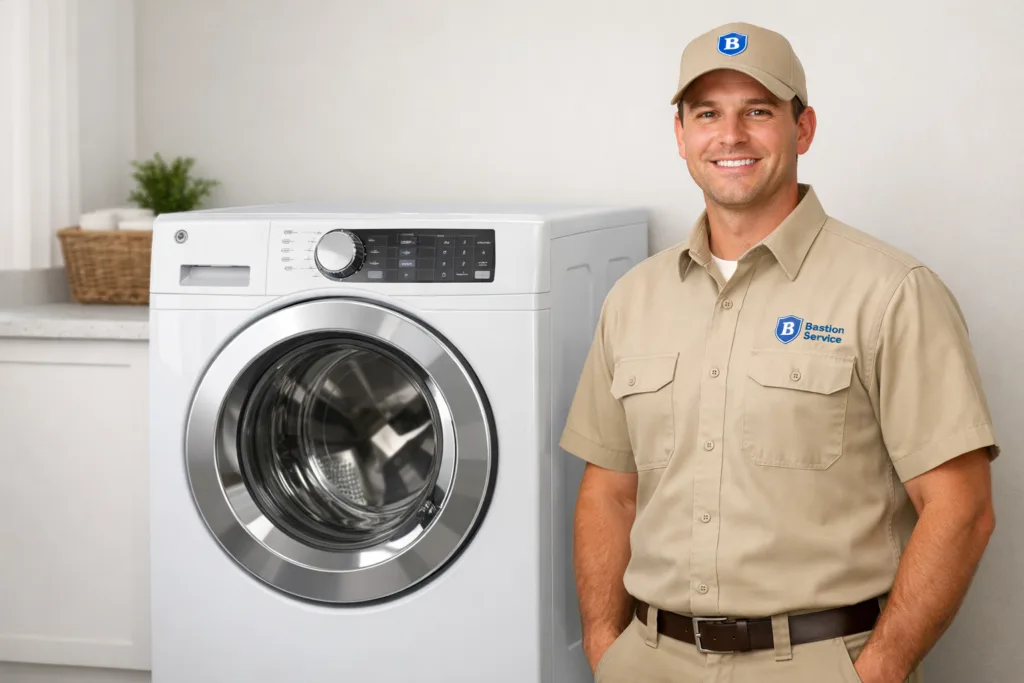
Common GE washer problems seen in Mar Vista homes

A GE washer can fail in very different ways even when the result looks similar from the outside. Clothes may come out wet, the tub may stay full, or the cycle may stop before spin. In other cases, the machine still runs but starts leaking, shaking hard, or taking much longer than usual to finish. The useful first step is to match the symptom to the part of the machine that is most likely struggling.
That symptom-based approach helps separate a simple issue from a larger mechanical or control problem. It also helps homeowners decide whether the washer should be used again before service.
Not draining or leaving clothes soaked
If the tub holds water at the end of the cycle, the problem may involve the drain pump, a restriction in the drain path, the lid lock system, or a fault that prevents the washer from entering spin. Some GE models will pause or stop if they cannot confirm the lid is locked or if water is not leaving the tub as expected.
Signs to watch for include:
- Standing water after the cycle ends
- Clothes that remain unusually heavy or dripping wet
- A humming sound without proper draining
- The washer stopping before final spin
If water remains in the machine after more than one attempt, it is best not to keep forcing cycles. Continued use can stress the pump and other components.
Won’t spin or spins weakly
A GE washer that fills and washes but will not spin properly may have a balance problem, a lid lock issue, worn drive parts, or a control-related interruption. Sometimes the basket turns slowly but never reaches full spin speed, which leaves laundry wetter than normal and increases drying time.
When this happens repeatedly, the issue is usually more than a one-time load imbalance. If the machine has also become louder, rougher, or less stable during spin, the repair path may involve both performance and wear-related components.
Leaking during fill, wash, or drain
Leaks do not always come from the same place. Water on the floor may be tied to supply hoses, internal hose connections, pump leaks, an overfill condition, or a damaged door boot on front-load models. The point in the cycle when the leak appears often matters.
- Leaks at the start of the cycle can point to fill-related issues
- Leaks while draining may suggest pump or drain hose problems
- Intermittent leaks can be caused by vibration or shifting connections
Even a small recurring leak should be taken seriously. Moisture around the washer can damage flooring, nearby cabinetry, and wall surfaces if ignored.
Loud noise, banging, or strong vibration
Some washer noise comes from an uneven load, but repeated thumping, grinding, scraping, or violent shaking usually means more is going on. GE washers can develop suspension wear, tub support problems, bearing issues, or drive-related faults that become most obvious during spin.
If the washer starts moving out of position, sounds dramatically louder than before, or feels rough when the basket turns, it is smart to stop using it until the cause is checked. A machine that is hitting hard during spin can create additional damage over time.
Won’t start, stops mid-cycle, or shows control problems
Electronic symptoms can be inconsistent, which makes them frustrating for homeowners. A washer may power on but not begin, lock and do nothing, stop partway through, or fail to respond to normal button selections. On GE units, that can involve the control board, user interface, latch system, wiring, or feedback from other components.
These problems often require testing rather than guesswork because several different failures can create the same outward behavior.
How symptom patterns help narrow the repair
One of the most useful details is when the issue appears in the cycle. A washer that fails during fill points to a different set of causes than one that washes normally but stalls before draining. Likewise, a machine that leaks only during spin tells a different story than one that leaks the moment water enters.
Helpful details include:
- Whether the problem happens on every load or only sometimes
- Whether the washer reaches spin at all
- Whether water is left in the tub
- Whether the control panel flashes, pauses, or resets
- Whether the noise is new, getting worse, or tied to one part of the cycle
Those clues make troubleshooting more efficient and reduce the chance of replacing the wrong part.
When repair is usually worth considering
Repair is often reasonable when the failure is limited to one main system and the rest of the washer is in solid condition. That is commonly true with drain pump problems, latch issues, certain fill faults, hose leaks, and some control or drive-related repairs.
It is especially worth looking into service when:
- The washer has otherwise been reliable
- The problem appeared recently rather than over many years of decline
- The cabinet, tub, and major structure are still in good shape
- The symptom points to an isolated failure instead of multiple failing systems
When replacement may make more sense
There are cases where putting more money into the machine is harder to justify. If the washer has major bearing or tub problems, repeated control failures, chronic leaking from multiple points, or a long history of repairs, replacement may be the better path. The same is true when repair costs begin stacking on top of age-related wear.
For many households in Mar Vista, the decision comes down to overall condition rather than the single symptom that finally triggered the service call.
Signs you should stop using the washer right away
Some problems can wait a short time for service, but others should prompt you to stop running loads until the unit is inspected.
- Burning smells or electrical odor
- Water leaking onto the floor
- Harsh grinding or metal-on-metal noise
- The basket failing to stop or behaving unpredictably
- Repeated breaker trips or power loss during operation
- Standing water that will not drain out
Using the washer in those conditions can increase repair scope and create added household damage.
What to note before a service visit
A few observations from the last few loads can make troubleshooting faster. Try to note whether the washer fills, agitates, drains, and spins in the expected order. If a code appeared, write it down exactly. If the machine made a new sound, think about whether it happened during wash, drain, or spin.
Other useful details include whether the problem started suddenly, whether it is getting worse, and whether it happens with every cycle setting or only certain ones. For GE Washer Repair in Mar Vista, those specifics can help identify the likely failure path and support a practical repair plan without unnecessary trial and error.
Keeping laundry disruption to a minimum
Washer issues tend to get more urgent quickly because they affect the entire household routine. If your GE unit is leaving clothes wet, leaking, stopping mid-cycle, or no longer washing normally, early attention usually gives you more options. Addressing the symptom while it is still limited often prevents a smaller repair from becoming a more expensive one.
For homeowners in Mar Vista, the goal is simple: understand what the washer is doing, identify the most likely cause, and make a smart decision about repair before the problem spreads to other components or the surrounding laundry area.