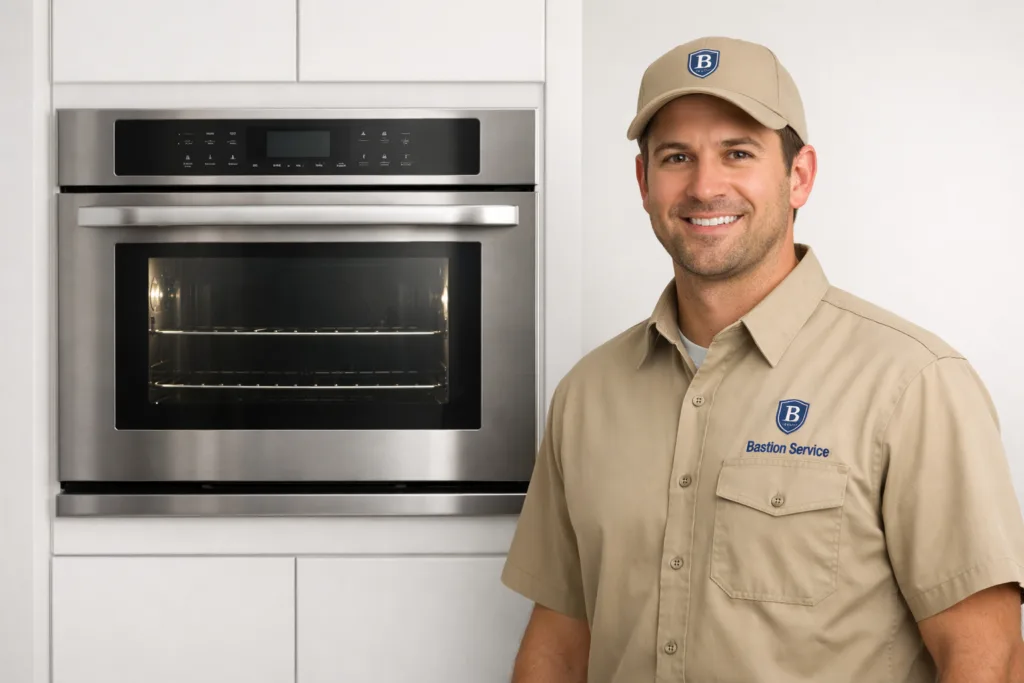
Built-in wall ovens tend to fail in ways that are easy to notice but harder to interpret. A Frigidaire unit may still power on, light up, and accept settings while struggling to reach temperature, overshooting the set point, or shutting down mid-cycle. In a household kitchen, those symptoms usually show up first as ruined meals, longer cook times, or inconsistent baking results rather than a complete breakdown.
Because the appliance is installed into cabinetry, even simple-looking problems deserve careful troubleshooting. Heating complaints can come from elements, sensors, relays, wiring, door seal issues, cooling problems, or the electronic control. The most useful approach is to match the repair path to the exact symptom pattern instead of assuming every no-heat or uneven-bake issue has the same cause.
Common Frigidaire wall oven symptoms
Frigidaire wall ovens in El Segundo homes often show a handful of repeat problems. Some are obvious right away, while others develop slowly over weeks or months.
- Oven does not heat at all
- Preheat takes much longer than normal
- Temperature runs hot, cool, or swings during baking
- Top browns too fast while the center stays undercooked
- Broil works but bake does not, or bake works but broil does not
- Display is on, but the oven will not start a cycle
- Fault codes, beeping, or random shutdowns
- Door will not close, lock, or unlock properly
- Breaker trips during preheat or high-heat cooking
- Convection fan or interior fan runs abnormally
These issues can overlap. An oven that seems slow to preheat may actually be heating with only one element. An oven that appears too hot may be cycling incorrectly because of a sensor or control problem. That is why symptom details matter.
What different heating problems usually mean
Oven will not heat
If the control panel responds but the cavity stays cold, common possibilities include a failed bake element, broil element, sensor, control relay, wiring problem, or power supply issue. On some wall ovens, the display can still function even when the unit is not receiving the power it needs for proper heating. That makes electrical testing especially important when the oven looks alive but never warms up.
Slow preheat
Slow preheat often points to a weak element, improper cycling, or a sensor that is reporting the wrong temperature. Homeowners sometimes notice this first when recipes that used to be reliable suddenly need extra time. If preheat becomes gradually slower rather than failing all at once, the issue may be developing rather than completely broken.
Uneven baking
Uneven baking can come from several sources: inconsistent element operation, faulty temperature feedback, convection fan problems, or heat loss around the door. Cookies browning unevenly, casseroles staying pale in one corner, or the top rack cooking much faster than the bottom are all useful clues. In a wall oven, airflow and temperature regulation matter just as much as whether the oven technically gets hot.
Temperature swings
All ovens cycle on and off to maintain heat, but wide swings can make baking unpredictable. If foods overbrown outside while staying underdone inside, the oven may be overshooting temperature or recovering poorly after the door opens. A drifting sensor, failing control, or weak heating circuit can all create this kind of inconsistency.
Control and display problems
Electronic symptoms on a Frigidaire wall oven can be straightforward or intermittent. Some units show an error code and stop. Others beep randomly, freeze at the keypad, lose settings, or start a cycle but fail to maintain it. When this happens, the issue may involve the control board, the touch interface, the temperature sensor circuit, latch feedback, or internal wiring connections.
Intermittent behavior is especially important not to ignore. A wall oven that works some days and fails on others is often moving toward a complete failure. If the display flickers, buttons respond unpredictably, or the oven cancels cycles on its own, continued use can become frustrating and, in some cases, unsafe.
Door, latch, and self-clean concerns
The oven door does more than open and close. A poor seal can let heat escape, disrupt baking performance, and force longer cooking times. Hinges, gasket wear, alignment problems, and latch faults can all affect performance even when the heating system itself is still working.
Self-clean complaints are also common on built-in ovens. If the door will not lock, will not unlock, or shows a latch-related fault after a cleaning cycle, the problem may be mechanical, electrical, or control-related. High-heat cleaning places extra stress on sensors, latch components, and electronics, so issues sometimes appear immediately after self-clean use.
When to stop using the oven
Some problems are inconvenient but manageable for a short time. Others are signs to stop using the appliance until it is checked. It is smart to discontinue use if you notice:
- A burning smell that does not quickly clear
- Visible sparking or arcing
- Repeated breaker trips
- The oven overheating surrounding cabinetry
- A door that will not shut securely
- Error codes that return after resetting power
- Heating that is wildly inaccurate or unstable
Wall ovens combine high heat and fixed electrical connections, so recurring electrical or overheating symptoms should be taken seriously. Waiting can turn a smaller repair into additional parts damage.
Repair or replace: how homeowners usually decide
Many Frigidaire wall oven issues are repairable, especially when the problem is limited to an element, sensor, door component, fan issue, or a single control-related fault. Repair often makes sense when the oven is otherwise in solid condition and has been performing well up to the recent symptom.
Replacement becomes a stronger option when there are multiple major failures, severe internal wiring damage, recurring electronic faults, or parts availability issues that make the repair path less practical. With a built-in appliance, replacement also involves fit, trim, electrical compatibility, and cabinet considerations, so it is not always the simpler choice.
For most households in El Segundo, the decision comes down to three things: the exact fault, the overall condition of the oven, and whether the repair is likely to restore normal daily cooking without ongoing repeat issues.
Why brand-specific troubleshooting helps
Frigidaire wall ovens can share general symptoms with other brands, but the way they heat, cycle, report errors, and route power through controls is not identical. Brand-specific troubleshooting helps narrow down whether the real problem is a failed component, a feedback issue, or a control problem mimicking another fault.
That matters most when symptoms seem to point in more than one direction, such as an oven that heats sometimes, broils but does not bake, or reaches temperature and then loses it. In those cases, replacing the first likely part without proper testing can waste time and money.
Getting better results from service
If service is needed, a few details can make diagnosis faster. Note whether the oven fails during preheat, only on bake, only on broil, or after it has been running for a while. Pay attention to any fault code, unusual sound, or pattern in how food is cooking. If the breaker trips, note whether it happens immediately or once the oven gets hot.
Useful details include:
- Whether the display stays on when heating fails
- If one cooking mode works better than another
- How far off the temperature seems in actual use
- Whether the issue began after self-cleaning
- If the door feels loose, misaligned, or hard to latch
Those observations can help connect the complaint to the most likely repair path and avoid unnecessary part replacement.
Wall oven repair focused on the way the appliance is actually failing
When a Frigidaire wall oven starts missing temperatures, baking unevenly, or refusing to heat properly, the goal is not just to get it running for the moment. It is to identify why the problem is happening and whether the fix makes sense for the condition of the appliance. For homeowners in El Segundo, that means a repair decision based on real symptoms, safe operation, and the likelihood of returning the oven to reliable everyday use.