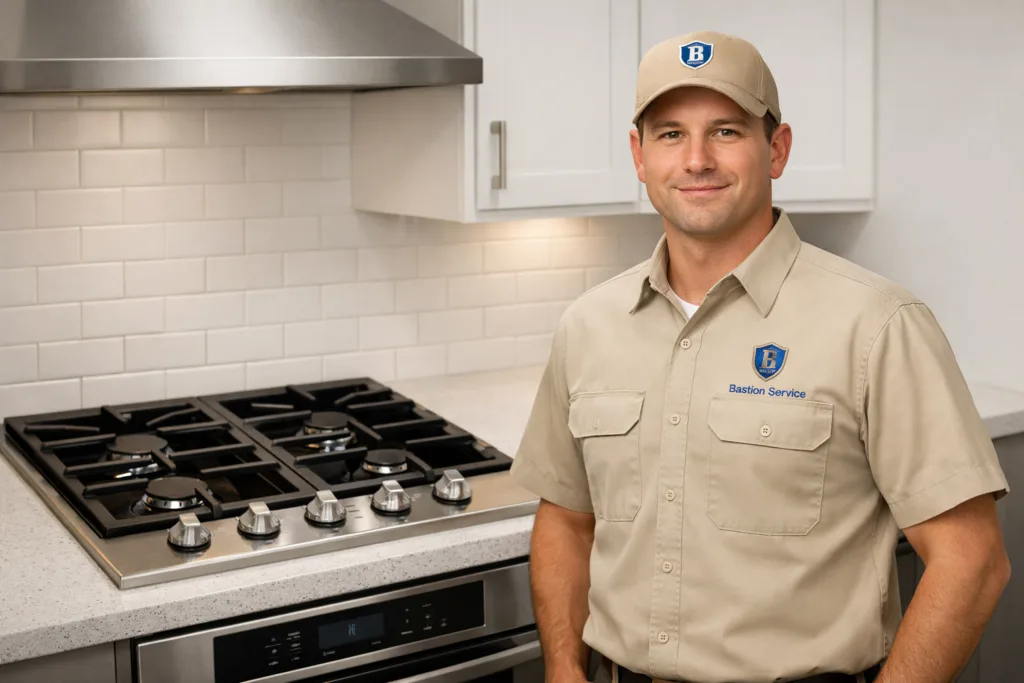
Cooktop problems rarely stay minor for long. A burner that heats too slowly, sparks at the wrong time, or refuses to respond can turn ordinary cooking into a daily hassle, and some symptoms point to conditions that should be checked before the appliance is used again. With Blomberg units, the most helpful approach is to match the exact symptom to the likely failure instead of assuming every burner issue has the same cause.
Common Blomberg cooktop symptoms and what they may mean
Different faults can produce similar surface symptoms, so the pattern matters. Whether the cooktop is electric or gas, the goal is to determine whether the problem is isolated to one burner or part of a larger electrical, ignition, or control issue.
Burner not heating at all
If one cooking zone stays cold while the others work normally, the failure may be limited to that burner circuit. On an electric Blomberg cooktop, possible causes include a failed element, a bad switch, a damaged connection, or a fault in the control system. If multiple burners stop heating at once, the issue may involve incoming power, a shared component, or the main control.
This symptom is worth checking promptly because some parts fail completely, while others work intermittently before stopping altogether.
Uneven heat or poor temperature control
When a burner cycles too aggressively, takes too long to boil water, or struggles to hold a simmer, the issue may be with the element, sensor, switch, or regulator function. Homeowners sometimes notice this first as longer cook times, scorching in one area of the pan, or heat that drops unexpectedly during normal use.
Uneven heating is not just an inconvenience. It can affect cooking results and may signal a component that is weakening under load rather than failing in an obvious way.
Clicking that will not stop
On gas models, continuous clicking is one of the most common complaints. Sometimes it starts after cleaning or a spill, especially if moisture gets around the igniter. In other cases, the problem comes from a misaligned burner cap, a worn spark electrode, or a switch that keeps sending an ignition signal even when the burner is already lit.
If the clicking continues after the area is dry and the burner parts are properly seated, the ignition system should be inspected. Ongoing clicking can make lighting less reliable and may indicate a part that is no longer operating correctly.
Burner lights slowly or will not ignite
A gas burner that takes several tries to light may have restricted gas flow, ignition weakness, burner head blockage, or alignment issues. If only one burner is affected, the problem may be local to that burner. If several burners struggle, the fault may be more system-wide.
Slow ignition should not be ignored. Repeated attempts to light a burner can create frustration and, in some situations, raise safety concerns.
Controls not responding
If turning a knob does nothing, the setting changes unpredictably, or a touch panel fails to respond, the issue may involve the switch, interface, wiring harness, or control board. Intermittent control problems are especially frustrating because the cooktop may appear normal one day and fail the next.
When the controls are inconsistent, it becomes difficult to trust the appliance during everyday use. That matters even more in busy households where cooking needs to be predictable.
Cracked glass or visible surface damage
A cracked glass cooktop is more than a cosmetic issue. Damage to the surface can affect safety, heat transfer, and the integrity of components below the glass. Even a small crack can spread with continued heating and cooling.
If the surface is broken, it is usually best to stop using the cooktop until the extent of the damage is assessed.
Signs the cooktop should not keep being used
Some malfunctions can wait a short time for scheduling. Others call for immediate caution. It is best to stop using the cooktop if you notice any of the following:
- A burner overheats and cannot be adjusted down
- The unit trips the breaker or shuts off unexpectedly
- There is a smell of overheating, melting, or burning insulation
- The glass surface is cracked
- Ignition keeps clicking continuously
- A gas burner will not light properly and there is any concern about gas odor
For gas models, a strong or persistent gas smell should always be treated as a safety issue rather than a routine repair matter.
Why cooktop problems are often misdiagnosed
Many cooktop symptoms overlap. A burner that will not heat might be blamed on the element, but the real cause could be a switch, wiring fault, or control problem. A gas burner that does not light might seem like an igniter failure when the actual issue is burner cap position or a blocked port. Because of that, replacing parts based on a guess can waste time and money without fixing the appliance.
This is especially true with intermittent faults. If the problem appears only when the cooktop is hot, only at certain settings, or only on occasion, testing the circuit and checking component behavior is often more useful than relying on appearance alone.
Repair or replace: how homeowners usually decide
In many cases, a Blomberg cooktop is worth repairing when the issue is limited to a single burner component, ignition part, switch, or isolated control-related failure. A targeted repair can restore normal cooking without the cost and disruption of replacement.
Replacement becomes more likely when several burners have problems at the same time, the glass surface is severely damaged, the control system has broader failure, or the repair cost is high relative to the condition of the unit. Age also matters, but age alone is not always the deciding factor. A well-kept cooktop with one failed part may still be a sensible repair candidate.
For homeowners in Pico-Robertson, the practical question is not just whether the cooktop can be fixed, but whether the repair addresses a single clear fault or points to broader wear across the appliance.
What to expect from a useful service visit
A productive appointment should answer a few basic questions clearly. Which part is failing? Is the issue limited to one burner or tied to a larger electrical or ignition problem? Is the cooktop safe to use before repair is completed? And does the repair make sense for the condition of the appliance?
Those answers help homeowners avoid guesswork and make a better decision about next steps. In Pico-Robertson households where the cooktop is used every day, knowing whether the problem is isolated or likely to repeat is just as important as knowing the name of the failed part.
Helpful steps before scheduling service
Without attempting a repair yourself, it can help to note a few details about the symptom:
- Whether the problem affects one burner or several
- Whether the issue is constant or intermittent
- Whether it started after a spill, cleaning, or power interruption
- Whether the cooktop shows unusual sounds, flashing behavior, or breaker trips
- Whether the burner fails at all settings or only at certain heat levels
These observations can make diagnosis faster and can help separate a simple burner-specific issue from a larger control or power problem.
Focused help for Blomberg cooktop issues in Pico-Robertson
When a cooktop stops performing the way it should, the best next step is to identify the fault based on how the appliance is actually behaving in the home. Whether the problem is poor heating, ignition trouble, nonstop clicking, damaged glass, or unresponsive controls, symptom-based evaluation helps determine whether repair is straightforward or whether replacement deserves consideration.
For Blomberg cooktop repair in Pico-Robertson, that kind of clear diagnosis gives homeowners a more useful answer than trial-and-error parts swapping and a better path back to reliable everyday cooking.