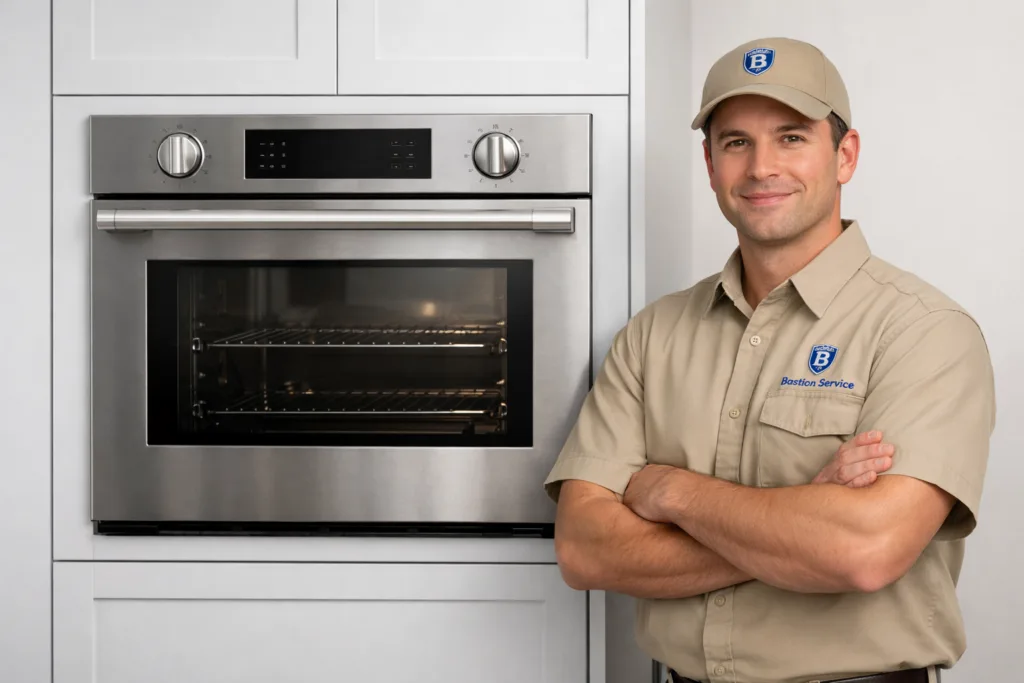
Wall ovens often fail in ways that look similar on the surface. A unit that preheats slowly, bakes unevenly, or stops mid-cycle may be dealing with a heating problem, a sensor issue, a control fault, or a door-seal problem that is letting heat escape. On a built-in Wolf oven, identifying the exact cause matters because replacing parts based on guesswork can add cost without solving the cooking problem.
What Mid-Wilshire homeowners usually notice first
Most service calls start with a pattern that has become hard to ignore. Cookies may come out dark on top and pale underneath. Roasts may need extra time even though the display says the oven is ready. The control panel may beep, flash an error, or restart unexpectedly. In some homes, the oven still turns on but no longer feels trustworthy for everyday meals or holiday cooking.
These symptoms are useful because they point the diagnosis in different directions. Heating complaints usually involve the bake or broil system, temperature sensing, relays, or incoming power. Performance issues during longer cooking cycles can also suggest airflow, cooling, or door-closing problems rather than a total no-heat failure.
Common Wolf wall oven symptoms and what they can mean
Not heating at all
If the display is active but the cavity never warms up, the problem may involve a failed element, sensor, control board, relay, thermal protection component, wiring fault, or power supply issue. In some cases, the oven appears normal from the outside while the heating circuit is not completing under load.
This is especially important on wall ovens because homeowners may assume the problem is a single bad element when the real cause is in the control or power path.
Slow preheat
Slow preheat is one of the most common complaints with built-in ovens. It can happen when a bake element is weakening, the temperature sensor is reading inaccurately, or the control is not energizing the heating system correctly. A door gasket that no longer seals tightly can also lengthen preheat times by allowing steady heat loss.
If preheat time has gradually increased over weeks or months, that trend often helps narrow the issue before complete failure occurs.
Uneven baking or roasting
Uneven results usually point to temperature regulation rather than a simple on-off failure. Common causes include calibration drift, intermittent heating, sensor problems, poor heat circulation, or a door that is slightly misaligned. Homeowners may notice one rack cooking faster than another, the back of a dish browning too quickly, or familiar recipes suddenly needing trial and error.
Temperature swings
Some temperature variation during cycling is normal, but large swings are not. If the oven runs too hot, too cool, or cannot hold a stable temperature, the sensor, control, or heating logic may be off. This becomes more noticeable with baking, where small inaccuracies show up quickly in texture, browning, and cook time.
Control panel problems
Unresponsive buttons, intermittent display issues, repeated error codes, or settings that will not save can indicate a failing interface, control board trouble, or an electrical interruption. If the oven starts and stops on its own, resets the clock, or loses communication between functions, continued use may lead to more erratic operation.
Door, latch, and seal issues
A wall oven door that will not close fully affects both performance and safety. Heat escapes, preheat takes longer, and the surrounding components can be exposed to excess heat. Hinges, latches, alignment issues, and worn gaskets are all common causes. Problems after a self-clean cycle are also common because high heat can stress locks, controls, and nearby parts.
Why built-in wall oven problems can be misleading
With freestanding appliances, some failures are easier to spot. Built-in wall ovens are different. They can partially heat, recover slowly, or seem normal during a short cycle while struggling during longer cooking. A unit may pass a quick visual check and still fail under actual cooking demand.
That is why a useful service visit should test how the oven heats, how it senses temperature, how the controls respond, and whether the door and seal are holding heat as intended. A symptom-based approach gives homeowners in Mid-Wilshire a better sense of whether the issue is isolated or part of a broader reliability problem.
When to stop using the oven and schedule service
It is best to stop using the oven if it trips power, smells electrically hot, sparks, overheats, shuts off unexpectedly, or shows repeated error messages. These symptoms can move beyond inconvenience and suggest a condition that may damage additional components if the oven keeps running.
You should also schedule service when the oven is still technically working but no longer performing predictably. Catching a failing sensor, weakening heating component, or door-seal issue early may help avoid a more involved repair later.
Repair versus replacement for a Wolf wall oven
Many repairs are worthwhile when the problem is limited to a specific part or system, such as a sensor, element, latch, seal, fan, or control-related component. If the oven is otherwise in good condition and has been reliable, repair is often the practical path.
Replacement becomes a bigger consideration when there are multiple major failures, repeat electronic issues, or signs that overall reliability has declined. The decision usually comes down to appliance age, general condition, parts availability, and whether the current problem is isolated or part of a recurring pattern.
What homeowners should expect from a service visit
A good appointment should answer a few straightforward questions: what is actually failing, whether the symptom is likely to worsen, whether continued use is safe, and what the repair path looks like. For a premium built-in oven, that matters more than a generic estimate because the same complaint can come from several different causes.
For Mid-Wilshire households, the goal is not simply getting the oven to turn back on. It is restoring consistent cooking performance so baking, roasting, and everyday meal prep feel predictable again.
Signs the problem may be getting worse
- Preheat times keep increasing from one week to the next
- Recipes that used to work now come out overdone or underdone
- The oven reaches temperature, then struggles to maintain it
- Error codes appear more often or clear only temporarily
- The door needs extra pressure to close or does not seal evenly
- The control panel responds inconsistently or resets during use
When these warning signs start stacking up, waiting rarely improves the outcome. A clear diagnosis and repair plan based on the actual symptom pattern is usually the fastest way to decide what makes sense for your Wolf wall oven in Mid-Wilshire.