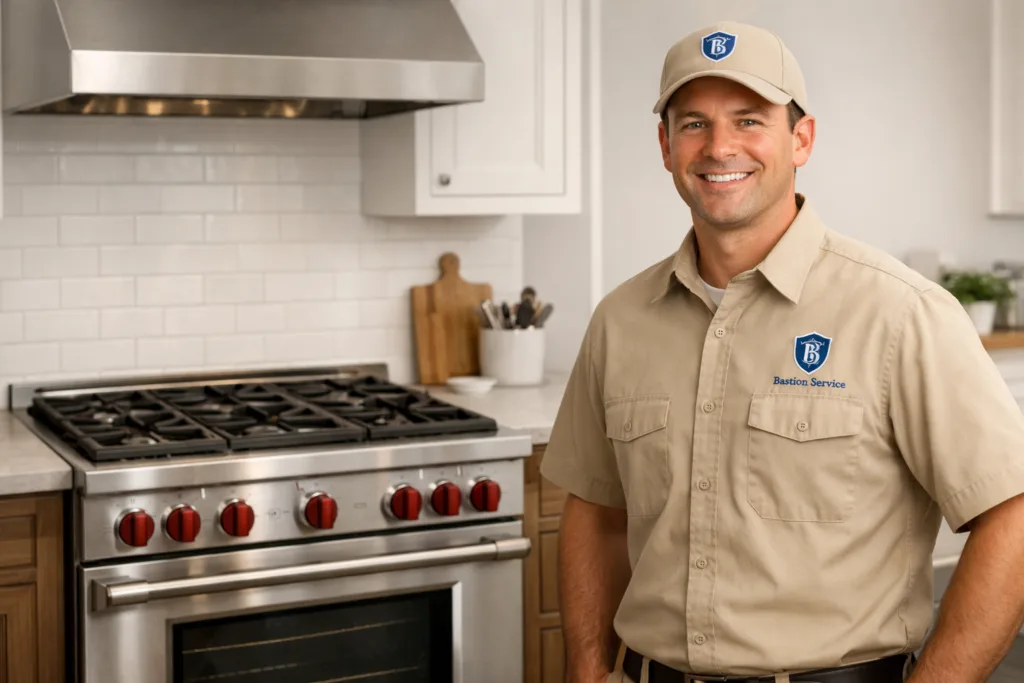
Even small changes in how a Wolf range behaves can affect daily cooking. A burner that clicks longer than usual, an oven that preheats slowly, or temperature swings that ruin familiar recipes often point to a specific fault rather than general wear. In Rancho Park homes, the best outcomes usually come from identifying the exact failing part or system before replacing anything.
Symptoms that usually mean your Wolf range needs attention
Some range problems are obvious right away, while others build gradually over time. Homeowners often notice performance changes before a complete failure happens. Paying attention to those changes can help prevent extra stress on ignition parts, sensors, controls, or heating components.
- Burners click repeatedly or do not light on the first try
- The oven takes much longer to preheat than normal
- Food bakes unevenly or finishes at inconsistent times
- The display flashes, resets, or stops responding
- The oven runs too hot, too cool, or drifts during cooking
- Error codes return after being cleared
These issues do not always come from the same cause. For example, poor oven performance might relate to ignition, sensing, airflow, control response, or heat retention. That is why symptom-based testing matters.
Burner ignition problems and nonstop clicking
One of the most common complaints with a gas range is a burner that clicks constantly or struggles to ignite. Sometimes the burner lights after a delay. In other cases, it sparks but never fully catches. This can happen because of moisture, residue around the burner base, a misaligned cap, ignition component wear, wiring trouble, or a fault in the spark system.
If clicking continues after the flame appears, the range should not be ignored. The problem may seem minor at first, but repeated ignition stress can make daily use frustrating and can lead to further wear. If you notice a strong gas odor or suspect gas is not igniting properly, stop using the appliance until it can be evaluated safely.
What homeowners can notice before service
- A burner works sometimes but not every time
- One burner behaves differently from the others
- Clicking starts after cleaning and does not stop
- The flame appears uneven or delayed after ignition
Those details help narrow down whether the issue is isolated to one burner assembly or connected to a broader ignition or control problem.
Oven heating issues: slow preheat, no heat, or poor temperature control
When the oven side of a Wolf range stops performing properly, the symptoms can look similar even when the cause is different. A weak igniter may lead to slow preheating. A sensor problem may allow the oven to overshoot or undershoot the set temperature. A control fault can create erratic behavior that seems random from one cooking cycle to the next.
Many homeowners first notice the issue through cooking results. Roasts may take longer than expected. Baked goods may brown too quickly on top while staying underdone inside. Recipes that used to be reliable may start failing without any change in cookware or settings.
Common signs of oven performance trouble
- Preheat takes unusually long
- The oven never seems to reach the selected temperature
- Food cooks too fast on one day and too slow on another
- The broiler or bake function does not respond correctly
- The oven shuts off before cooking is complete
Because premium ranges are designed for consistent results, even moderate temperature drift can be noticeable. That makes early service worthwhile when performance has clearly changed.
Uneven cooking and hot spots
Uneven cooking does not always mean the oven has stopped heating. In many cases, the range still operates but no longer distributes heat the way it should. Airflow problems, sensor drift, convection issues, door seal loss, and burner performance changes can all lead to hot spots or inconsistent browning.
If one side of a sheet pan browns faster than the other, or if dishes need repeated rotation to finish properly, the range may no longer be regulating heat evenly. This is especially frustrating for households that rely on predictable baking and roasting performance.
Heat distribution issues may show up as
- One rack cooking faster than expected
- Centers staying underdone while edges overcook
- Frequent need to adjust recipes that used to work
- Convection results that no longer feel consistent
Display, keypad, and control response problems
Modern range controls affect far more than the display alone. If the panel becomes dim, unresponsive, or intermittent, that can interfere with heating functions, timing, temperature selection, and overall operation. Some homeowners see flashing codes or random resets. Others find that commands register only part of the time.
Control issues are important because they can overlap with what appears to be a heating problem. A range may seem unable to maintain temperature when the real cause is in the electronic control path. Looking at the full operating pattern usually gives a more reliable answer than focusing on one symptom in isolation.
Door, hinge, and gasket problems that affect cooking
Not every oven complaint starts with a sensor or ignition component. Heat loss around the oven door can change cook times and make temperatures harder to maintain. Worn hinges, a damaged gasket, or poor door alignment can let heat escape during normal use.
These issues are easy to underestimate because the range may still heat. But when heat retention drops, the appliance has to work harder to maintain cooking conditions. Over time, that can add stress to other components and reduce cooking consistency.
When continued use is a bad idea
Some symptoms are more than an inconvenience. Repeated ignition failure, returning error codes, unexplained shutdowns, and unstable temperature control can indicate a problem that should be checked before regular use continues. A range that powers on is not necessarily a range that is operating properly.
It is usually time to schedule service when:
- The same problem keeps coming back
- Cleaning and basic reset attempts do not help
- Cooking performance has clearly changed
- Controls act unpredictably
- The oven temperature can no longer be trusted
For households in Rancho Park, prompt attention can help prevent a smaller repair from turning into a more disruptive one.
Repair or replacement: what usually makes sense
Most Wolf range issues are worth evaluating for repair first, especially when the appliance is otherwise in good condition and the problem can be traced to a specific component or subsystem. Burner ignition faults, sensor problems, door seal issues, and many control-related complaints often become much easier to judge once the failure point is confirmed.
Replacement becomes a more serious discussion when the range has multiple major faults at the same time, when overall condition is poor, or when repeated breakdowns suggest broader wear. In most cases, the right choice becomes clearer after inspection because the decision should be based on the actual fault, not guesswork.
What homeowners can do before scheduling service
Without disassembling the appliance, there are a few useful observations that can make service more efficient:
- Note whether the issue affects one burner or several
- Pay attention to whether the problem happens every time or only occasionally
- Write down any error code exactly as shown
- Notice whether the oven problem appears during preheat, throughout cooking, or near the end of a cycle
- Check for visible door seal wear or alignment changes
These details help distinguish between isolated component failure and a larger operating issue.
Focused Wolf range service for Rancho Park households
Wolf ranges are built for strong cooking performance, so recurring clicking, erratic heat, and unstable controls usually point to a repairable problem that should be addressed directly. For homeowners in Rancho Park, the most useful next step is service that follows the symptom pattern, tests the affected functions, and explains whether repair is practical based on the appliance’s condition and the likely repair path.
When the range is no longer cooking the way it should, timely diagnosis helps protect both convenience and performance. That gives you a clearer sense of what failed, what should be fixed now, and whether the appliance is likely to return to reliable everyday use.