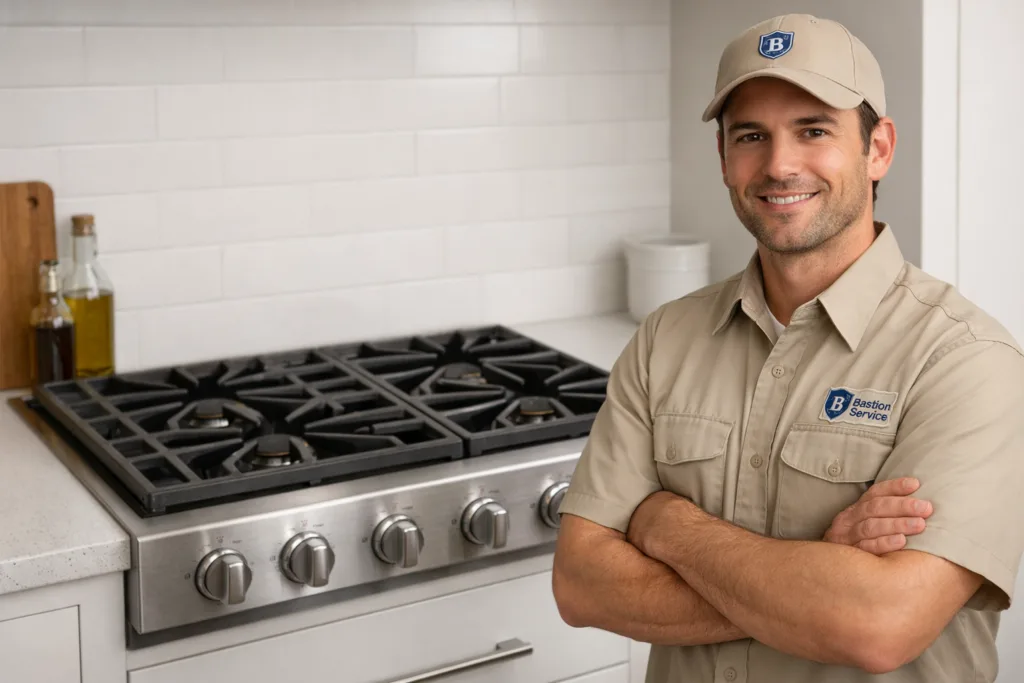
Cooktop problems rarely stay confined to convenience. If one burner stops igniting, heat becomes uneven, or the controls respond unpredictably, everyday cooking can quickly become frustrating and harder to manage. With Wolf units, the symptom pattern matters because the same complaint can come from very different components.
Common Wolf cooktop problems in Westwood homes
Most service calls start with a small change in performance: a burner takes longer to light, a flame looks different than usual, or an electric zone no longer reaches normal heat. Catching those changes early can help limit added wear on surrounding parts and make the repair path more straightforward.
Burners that click but do not ignite
Repeated clicking is one of the most common gas cooktop complaints. In some cases, the issue is as simple as burner cap misalignment, residue around the burner head, or moisture after cleaning. In others, the fault may involve the igniter, spark switch, ignition module, or wiring. If a burner lights but continues clicking, that still points to an ignition-related problem that should be checked.
If you notice a strong gas smell or delayed ignition, stop using the burner until the unit is evaluated. Those symptoms deserve prompt attention rather than repeated attempts to relight it.
Weak flame or uneven heating
A burner that runs too low, heats inconsistently, or produces an unstable flame can affect everything from boiling to simmering. This may be caused by clogged burner ports, a worn valve, gas flow issues, or a problem in the burner assembly itself. Even when the burner technically works, poor flame quality can make cooking unpredictable and signal a larger performance issue.
Electric or induction zones not heating correctly
On electric and induction Wolf cooktops, homeowners may notice a zone that stays cold, heats slowly, cycles erratically, or shuts off before reaching the expected temperature. Depending on the model, the cause could involve the element, sensor, control board, touch interface, or power supply. These faults are not always visible from the outside, which is why symptom-based testing is important.
Touch controls, knobs, or indicators acting erratically
When settings change on their own, indicator lights fail, or the cooktop responds only part of the time, the issue may be tied to switches, electronic controls, internal connections, or user interface components. Intermittent behavior is easy to dismiss at first, but it often becomes more disruptive over time and can lead to complete loss of a burner or heating zone.
What the symptom usually suggests
A useful diagnosis starts by matching what you see in daily use with the stage where the failure occurs.
- Problem at startup: often points to ignition parts, burner alignment, switch issues, or power-related faults.
- Problem during heat-up: may suggest weak elements, sensors, gas flow issues, or failing controls.
- Problem after several minutes of cooking: can indicate overheating protection, unstable electrical components, or intermittent wiring faults.
- Problem isolated to one burner: more often tied to burner-specific parts.
- Problem affecting multiple burners: may indicate a broader control, ignition, or power issue.
This kind of symptom breakdown helps separate a localized repair from a larger system problem.
Why exact diagnosis matters on a Wolf cooktop
Wolf cooktops are built with model-specific components, and similar symptoms do not always lead to the same repair. A burner that will not light is not automatically an igniter failure. A heating zone that cuts out is not always a bad element. Replacing parts based on assumption can increase cost and still leave the original issue unresolved.
For households in Westwood, the most effective service call is one based on what the cooktop is actually doing: whether the issue affects one burner or several, whether it appears every time or only occasionally, and whether the fault starts during ignition, heating, or continued cooking. That information helps narrow the repair path quickly.
When to stop using the cooktop and schedule service
Some faults are inconvenient but manageable for a short time. Others should be treated as a reason to pause normal use. It is time to have the cooktop checked when:
- Burners click repeatedly without normal ignition
- The flame is noticeably weaker, uneven, or unstable
- A heating zone stays cold or overheats
- The unit trips power or loses power intermittently
- Controls do not respond consistently
- You see sparking behavior that does not seem normal
- The same symptom keeps returning after cleaning or resetting the unit
Prompt Wolf cooktop repair in Westwood can often prevent a single-burner issue from developing into a wider control or wiring problem.
When continued use can make the repair worse
Repeated attempts to use a malfunctioning cooktop can increase wear. Ongoing ignition problems can stress spark components. Electrical heating faults can place extra load on switches, relays, and boards. Uneven burner performance can also make pans heat unpredictably, which affects cooking results and sometimes masks the fact that the appliance is deteriorating.
If the cooktop works only occasionally, behaves differently from one day to the next, or shows faults on more than one burner, it is usually better to stop pushing through the problem. Intermittent issues often spread beyond the original failed part.
Repair or replacement?
Many Wolf cooktop issues are practical to repair when the failure is limited to a burner assembly, igniter, switch, element, sensor, or control-related part and the rest of the unit remains in good condition. Replacement becomes more likely when there are multiple major faults, significant overall wear, or limited part availability for the specific model.
A practical repair plan should consider the age of the cooktop, the number of affected components, the condition of the glass or surface, and whether the unit can be restored to reliable daily use without stacking several major repairs together.
How to prepare for a service visit
Before an appointment, it helps to write down a few details from normal use in your kitchen. Useful notes include:
- The full model number if available
- Which burner or zone is affected
- Whether the problem is constant or intermittent
- Any clicking pattern, delayed ignition, or unusual flame behavior
- Whether the problem started after cleaning, a power interruption, or a gradual decline in performance
- Any indicator lights, error behavior, or control issues you have noticed
Those observations often make it easier to identify whether the issue is isolated, electrical, ignition-related, or part of a broader cooktop control fault.
Focused help for everyday home cooking problems
In Westwood homes, cooktop trouble is usually first noticed during routine meal prep, not during a total breakdown. A burner that hesitates, an induction zone that cuts out, or controls that respond inconsistently are all signs that the appliance should be evaluated before the problem grows. The right next step is to base the repair decision on the exact symptoms, the condition of the unit, and the likelihood of restoring steady, safe performance.