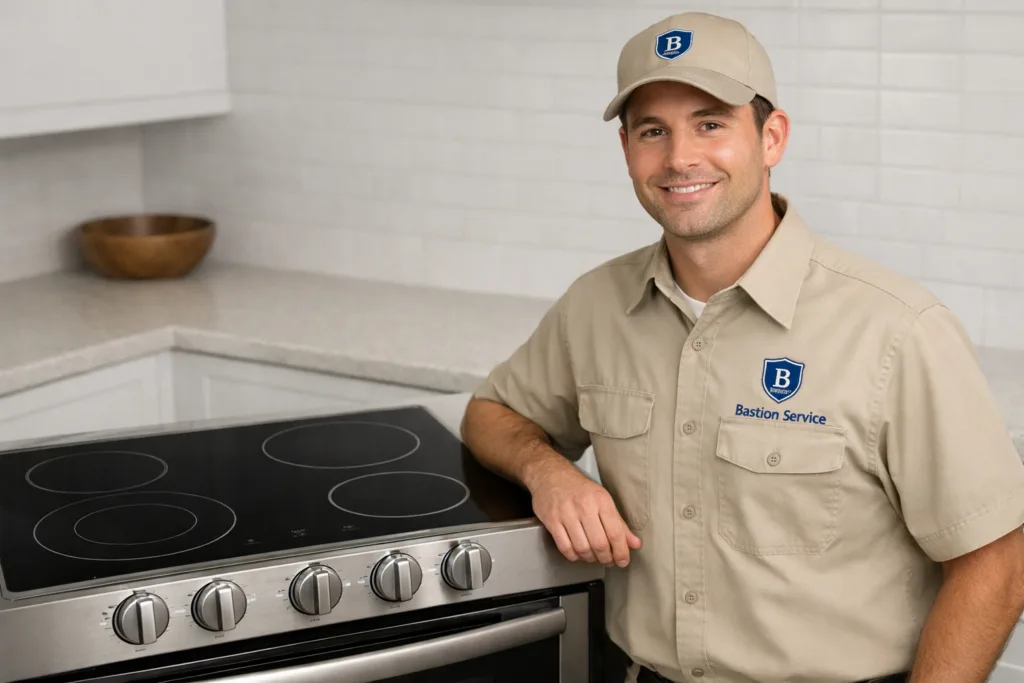
Cooktop problems rarely stay minor for long. A burner that starts heating weakly, an igniter that clicks over and over, or a control that responds inconsistently can quickly interfere with everyday meals and make the appliance harder to use safely. On Whirlpool cooktops, the same outward symptom can come from different failed parts, which is why the repair path should follow the behavior of the unit rather than assumptions.
For homeowners in Mid-City, the most useful details are often simple ones: whether one burner is affected or several, whether the problem is constant or intermittent, and whether it started after a spill, cleaning, power interruption, or gradual decline in performance. Those clues help narrow down whether the issue is more likely related to the burner assembly, switch, igniter, wiring, or control system.
Common Whirlpool cooktop symptoms and what they may mean
Burner will not heat or ignite
On an electric Whirlpool cooktop, a burner that stays cold may point to a failed element, a worn surface switch, a damaged receptacle, or a wiring fault below the top. On a gas model, failure to ignite can involve a blocked burner head, moisture around the ignition area, a spark problem, or an issue affecting gas flow. If one burner fails while the others work normally, that often suggests a more isolated component failure. If multiple burners are affected, the problem may be broader.
Burner heats unevenly or too slowly
Uneven heating can show up as food scorching in one spot, pans taking longer than usual to come to temperature, or a burner that never seems to reach the selected setting. Electric models may have a weakened element or a switch that is not regulating output correctly. Gas models may have flame distribution problems caused by clogged ports or burner cap alignment issues. Even when the cooktop still works, these symptoms usually mean performance is already declining.
Cooktop keeps clicking
Constant clicking on a Whirlpool gas cooktop often indicates the ignition system is still trying to light a burner. This can happen after boilovers, heavy cleaning, trapped moisture, or misalignment of burner parts. It can also point to a failing spark switch or spark module. If the clicking continues after the surface is dry and properly assembled, it usually needs attention rather than more trial and error.
Control knob or touch control is not responding properly
When a knob turns loosely, sticks, or no longer changes heat as expected, the fault may be mechanical, electrical, or both. On some models, the issue can involve the switch behind the knob, the stem connection, or the user interface. A touch control that does not register input consistently may indicate a deeper control problem. These issues matter because inaccurate heat control can make the cooktop unpredictable during normal use.
Intermittent operation or breaker trips
If the cooktop works some days and not others, shuts off unexpectedly, or trips the breaker, the underlying problem is usually getting worse rather than resolving on its own. Intermittent faults can come from damaged wiring, a shorting component, a failing control, or a connection that is breaking down under load. These are not symptoms to ignore, especially when they are becoming more frequent.
Cracked glass or visible surface damage
On glass cooktops, surface damage is more than a cosmetic concern. A crack can affect safe operation, allow spills into internal components, and complicate normal heating performance. Whether repair makes sense depends on the extent of the damage, the condition of the rest of the unit, and whether additional components were affected when the surface was damaged.
Why symptom patterns matter on Whirlpool cooktops
Cooktop repairs are rarely one-size-fits-all. Two units can show similar behavior while failing in completely different places. A burner that does not heat at all is not the same problem as a burner that heats but never reaches full power. A clicking burner after cleaning may need a different repair than a clicking burner that affects multiple positions and has been getting worse for weeks.
That is why a practical repair plan starts with the exact pattern of failure. Helpful observations include whether the issue appears on high heat only, whether the burner works again after cooling down, whether the problem spread from one burner to another, and whether there are any related signs such as odor, sparking, or control inconsistency.
When repair is usually worth considering
Many Whirlpool cooktop issues are repairable when the problem is limited to one or two components. Burner switches, igniters, burner assemblies, wiring connections, and certain control-related parts are common examples where repair may make sense if the rest of the appliance is in good shape.
Repair tends to be a stronger option when:
- only one burner is affected
- the cooktop is otherwise operating normally
- the glass or top surface is intact
- the symptom appeared recently rather than after years of broad decline
- there is no sign of repeated electrical damage across multiple functions
In these cases, replacing the entire cooktop may be unnecessary when the fault is confined to a specific part of the system.
When replacement may deserve discussion
Some situations point more toward replacement than repair. If a Whirlpool cooktop has multiple burner failures, recurring electrical problems, major glass damage, or age-related wear affecting overall reliability, the cost and scope of repair can become harder to justify. The same is true when one visible symptom turns out to involve several internal failures.
A balanced decision usually comes down to the condition of the full appliance, not just the part that failed first. If the cooktop has been giving repeated trouble, struggles to regulate heat accurately, or no longer meets the household’s needs, replacement may be the more practical long-term choice.
Signs you should stop using the cooktop until it is checked
Some symptoms suggest it is best to avoid continued use until the problem has been identified. That is especially true when the issue involves unstable heating or possible electrical faults.
- the burner overheats or does not respond to lower settings
- the unit trips the breaker during normal cooking
- you notice sparking, a burning smell, or signs of heat damage
- a gas burner keeps clicking and will not light reliably
- controls do not match the heat output being produced
- the glass top is cracked or compromised
Waiting in these situations can turn a limited repair into a larger problem involving additional parts.
What to note before scheduling cooktop service
If you are arranging Whirlpool cooktop repair in Mid-City, a few details can make the visit more efficient. Note whether your unit is gas or electric, which burner positions are affected, what the cooktop does when you try to use it, and whether the issue started suddenly or gradually. If the symptom began after a boilover or cleaning, that detail is also worth mentioning.
It also helps to pay attention to whether the problem happens every time or only under certain conditions. For example, some faults appear only on high heat, only after the burner has been on for several minutes, or only when more than one burner is operating at once. Those patterns can be useful when narrowing down the likely cause.
Focused help for a Whirlpool cooktop in Mid-City
Cooktop trouble is easiest to address when the problem is treated as a specific appliance issue instead of a generic burner complaint. For homeowners in Mid-City, that means looking closely at the exact symptom, the condition of the appliance, and whether the likely repair will restore normal cooking reliably. A thoughtful diagnosis and a practical repair guidance approach can help you decide whether the right next step is repair, part replacement, or a broader appliance decision.