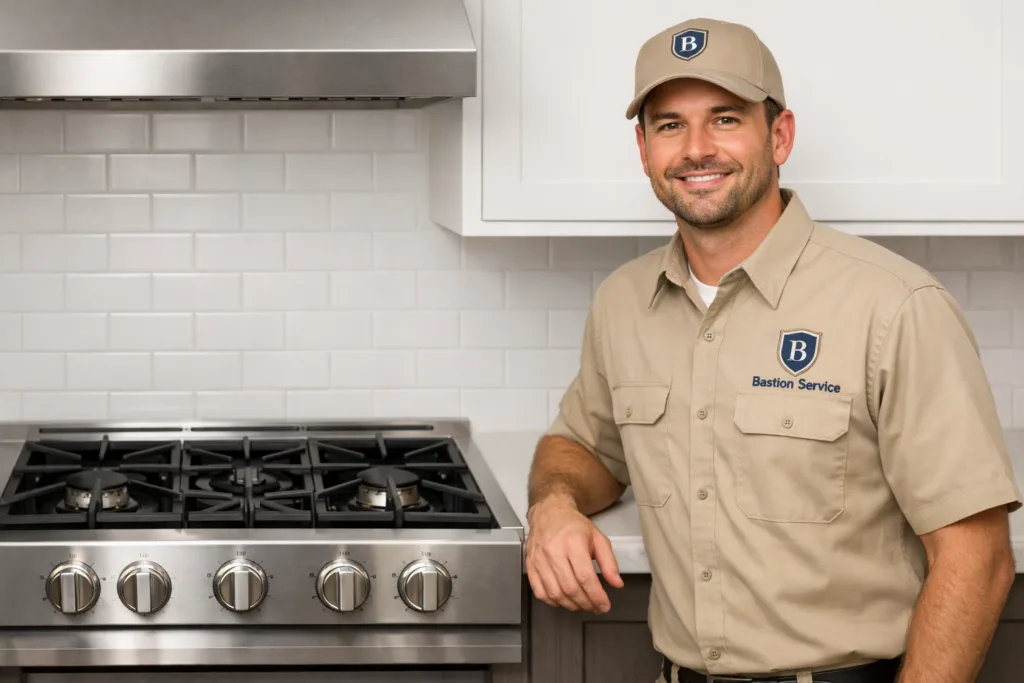
Cooktop problems tend to show up in ways that disrupt everyday cooking fast: one burner stops responding, ignition becomes inconsistent, or heat settings no longer match what is happening in the pan. With Wolf units, the symptom itself is the best starting point because a clicking burner, a weak flame, and a zone that overheats can all come from different underlying failures.
Common Wolf cooktop problems and what they often mean
A useful diagnosis starts by separating gas ignition issues from heating and control problems. That helps determine whether the fault is isolated to one burner or tied to a shared component affecting the whole cooktop.
Burner will not ignite
When a gas burner does not light at all, the cause may be as simple as a misaligned burner cap or as involved as a failed igniter, switch, or spark module. Food residue, cleaning moisture, and blocked burner ports can also prevent normal ignition. If only one burner is affected, the issue is often local to that burner assembly. If several burners stop sparking or lighting correctly, the fault may involve a common ignition component.
Continuous clicking after the burner lights
Clicking that continues after ignition usually points to moisture, residue around the igniter, switch problems, or an issue in the ignition system that keeps sending spark. Homeowners sometimes notice this after cleaning or after a pot has boiled over. If the sound returns repeatedly after the area has dried and the burner is correctly reassembled, the cooktop should be inspected before regular use continues.
Weak flame or uneven flame pattern
A burner that lights slowly or shows an uneven flame ring may have clogged ports, burner cap alignment problems, or gas flow issues. Uneven flame affects cooking results and can make simmering difficult. In some cases, homeowners notice that one side of the pan heats faster than the other or that water takes much longer to boil on a burner that used to perform normally.
Electric or induction zone not heating
On Wolf cooktops with electric or induction-style zones, a burner that stays cold, cycles unpredictably, or shuts off early may involve the element, sensor, control, or wiring. If one zone fails while the others work normally, that often narrows the problem. If multiple zones lose heat together, the repair path may shift toward shared power supply or control components.
Heat level is inaccurate or hard to control
When low settings run too hot or high settings seem weak, the issue can be tied to a faulty control, sensor feedback problem, or an element that is no longer responding properly. This kind of symptom matters because it affects more than convenience. It can lead to scorched pans, poor simmer control, and cooking that feels unpredictable from one meal to the next.
Signs the cooktop should be checked sooner rather than later
Many service calls start with a smaller warning sign that was easy to work around for a while. In Mid-City homes, those early symptoms often include longer ignition times, one burner that works only intermittently, or controls that feel less responsive than they used to.
- A burner only lights after several attempts.
- Clicking continues even when the flame is already established.
- One zone heats much slower or hotter than expected.
- The cooktop shuts off unexpectedly or behaves inconsistently.
- Problems return soon after routine cleaning and reset attempts.
- Multiple burners begin acting differently at the same time.
These patterns usually do not improve on their own. Continued use can turn a limited burner problem into added wear on ignition parts, controls, or surrounding components.
What Mid-City homeowners can safely check first
Before scheduling service, there are a few basic observations that can help narrow the issue without taking the appliance apart.
For gas cooktops
- Make sure the burner cap is seated correctly.
- Check for visible spills, grease, or debris in the burner ports.
- Allow recently cleaned parts to dry fully before testing again.
- Note whether the problem affects one burner or several.
For electric or induction cooktops
- Confirm the affected zone is receiving a response from the control.
- Watch whether the problem is constant or intermittent.
- Note if the cooktop displays unusual behavior when more than one zone is used.
- Pay attention to whether heat output is too low, too high, or absent altogether.
These checks are meant to help describe the symptom clearly, not to replace service. If performance remains erratic, the next step is professional diagnosis based on the exact symptom pattern.
When continued use may risk further damage
Some cooktop issues are mainly frustrating. Others can put extra stress on the appliance or create safety concerns. Repeated failed ignition can wear out related parts. An overheating element can damage cookware. Intermittent electrical faults can become more difficult to trace if the unit is used until complete failure.
Reduce use and arrange service if you notice sparking that seems abnormal, controls that do not respond consistently, a burner that will not stop clicking, or heat output that does not match the setting. For gas-related concerns, a strong or persistent gas odor changes the situation entirely. Stop using the cooktop, and if the smell does not clear, leave the area if needed and contact the gas utility or emergency service before arranging appliance repair.
Cracked glass, damaged surfaces, and control problems
Surface damage should not be ignored, especially on cooktops with glass components. A crack can worsen with heat and cleaning, and it may affect safe operation depending on the design and location of the damage. Control problems also deserve prompt attention because what seems like a single unresponsive knob or touch control may reflect a larger issue in the user interface or control board.
If the cooktop has visible damage along with heating or ignition trouble, repair decisions should consider both appearance and function. In many cases, the question is not just whether the burner can be made to work again, but whether the full appliance can be restored to safe, reliable everyday use.
Repair or replacement: how the decision is usually made
Many Wolf cooktop problems are repairable when the fault is limited to igniters, switches, spark modules, elements, sensors, or controls. Repair often makes sense when the cooktop is otherwise in good condition and the issue is isolated rather than widespread.
Replacement becomes more likely when there are multiple major failures, significant surface damage, repeated electronic problems, or repair costs that approach the value of restoring dependable performance. The key is evaluating the actual condition of the appliance instead of assuming every symptom points to the worst-case scenario.
What a targeted service visit should accomplish
For a household in Mid-City, cooktop trouble usually affects daily routines right away. A productive visit should identify which component failed, whether the problem is limited to a single burner or shared system, and whether any part of the cooktop should be left unused until repair is completed.
That approach helps homeowners make an informed decision about the next step, whether the answer is a focused part replacement, a broader repair, or moving on from a unit that no longer makes financial sense to restore.