




Range problems can interrupt prep, slow ticket times, and force staff to work around equipment that no longer responds the way it should. In Santa Monica, fast-moving kitchens benefit from service that starts with symptom-based testing, confirms the fault, and helps management decide whether the unit should be repaired now, used only in a limited way, or taken out of service until work is completed.
Related commercial service paths in Santa Monica include Vulcan Commercial Repair in Santa Monica, Vulcan Oven Repair in Santa Monica, and Vulcan Fryer Repair in Santa Monica.
How Vulcan range problems typically show up during daily use
Most range failures do not begin as a complete shutdown. They usually start with small changes in burner behavior, ignition timing, oven recovery, or temperature control. Over time, those changes become harder to manage and more disruptive to production.
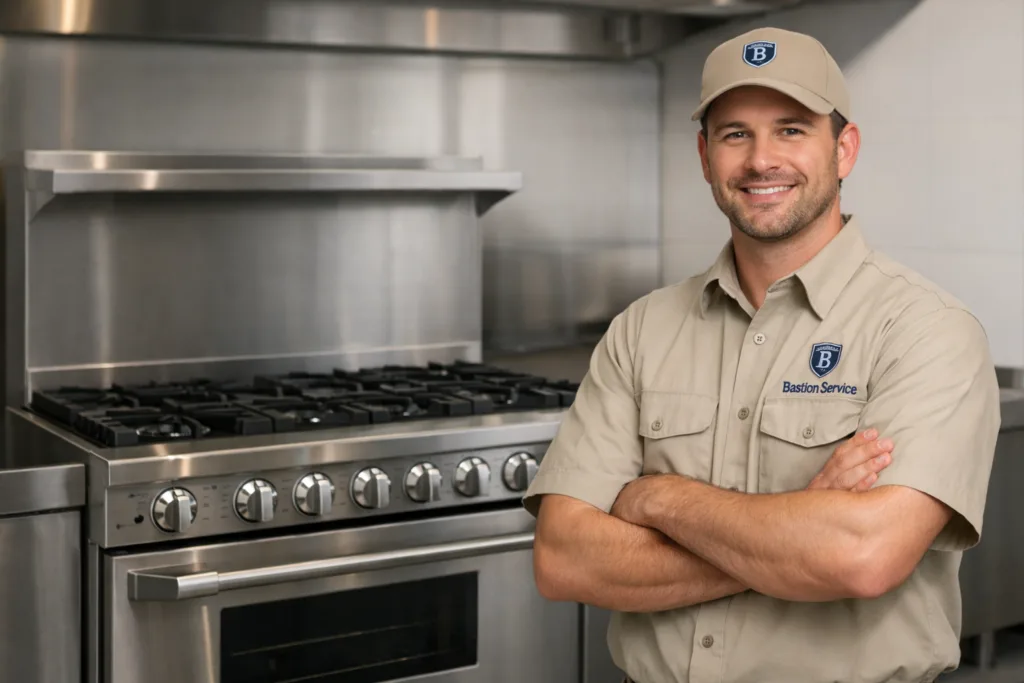
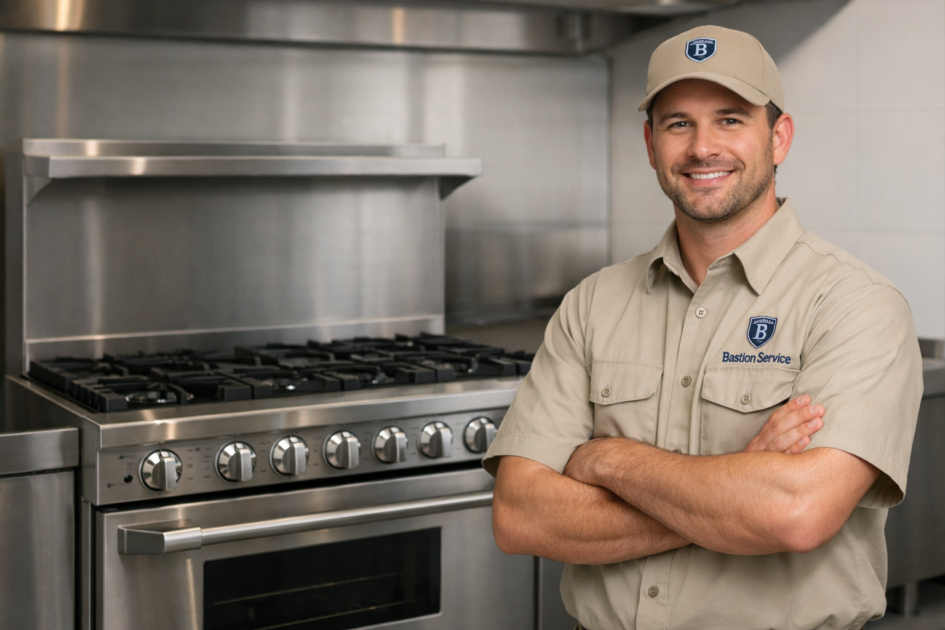
Bastion Service works with Santa Monica businesses to diagnose Vulcan range issues based on how the unit is actually behaving in the kitchen. That includes separating burner faults from gas-flow concerns, oven heating complaints from control problems, and isolated component wear from broader equipment condition.
Burners that will not light reliably
If a burner clicks repeatedly, lights only after several tries, or does not ignite at all, the problem may involve the ignition system, clogged burner ports, worn switches, pilot-related issues on some models, or fuel-delivery problems. Staff often notice this first during busy periods when repeated attempts to relight the burner start slowing service.
Even when a burner eventually lights, delayed ignition is not something to ignore. Intermittent operation can point to a fault that is becoming more consistent and more disruptive with continued use.
Weak flame or uneven heat output
When flame strength changes from burner to burner, appears uneven around the burner head, or no longer produces expected heat, cooking performance usually drops right away. Pans take longer to recover, product consistency suffers, and stations may start compensating by shifting work to other equipment.
Possible causes include blocked burner components, regulator issues, valve wear, gas pressure concerns, or damage affecting normal combustion. A proper diagnosis helps determine whether the problem is isolated or part of a larger performance issue across the range.
Oven section not reaching temperature
If the oven cavity runs cool, heats slowly, or struggles to recover after the door is opened, the cause may involve the thermostat, sensor-related controls, ignition performance, burner function, or internal heat distribution. In practice, operators usually notice longer bake times, uneven finishing, or the need to keep adjusting settings to get usable results.
Temperature swings and inconsistent cooking results
When the same setting produces different results throughout the day, the issue may not be a simple calibration complaint. Temperature instability can come from failing controls, irregular burner cycling, weak ignition, or wear that affects how heat is maintained in the oven section.
This often creates hidden costs. Waste increases, re-fires become more common, and staff lose confidence in the unit because timing becomes harder to predict.
Burners dropping out during operation
A burner that lights and then cuts out, or an oven burner that does not stay engaged as expected, should be checked promptly. These symptoms can point to ignition faults, gas delivery interruptions, safety component issues, or control failures. In a working kitchen, intermittent shutoff quickly becomes a workflow problem because the equipment cannot be trusted to hold steady through active use.
Why accurate diagnosis matters before repair approval
Range symptoms often overlap. A heating complaint may begin with ignition weakness. What looks like a burner issue may trace back to gas regulation or control response. A unit that seems to have one failing section may also show early wear in another system that affects reliability after the first repair is completed.
Testing the unit before approving work helps reduce unnecessary parts replacement, lowers the chance of repeat failures tied to missed causes, and gives managers a better idea of downtime expectations. That matters when scheduling labor, adjusting menus, or deciding whether the range can remain in partial operation until repairs are finished.
Signs the unit should be serviced sooner rather than later
Service should be scheduled when the range is still operating but no longer operating normally. Waiting for a total failure usually creates more disruption than addressing recurring symptoms early.
- Burners light inconsistently or require repeated attempts
- Clicking continues without normal ignition
- Flame is weak, uneven, or unstable
- Oven temperature drifts, overshoots, or recovers slowly
- Controls respond unpredictably
- Staff are relying on workarounds every shift to keep the unit usable
If the same workaround has become part of daily operation, the range is already affecting efficiency and should be evaluated before the problem expands.
When continued use can increase the repair scope
Using a range with poor ignition, unstable flame, or uncontrolled heat can lead to more than inconvenience. Repeatedly cycling a burner that does not light correctly, forcing production through a section with unreliable heat, or continuing to run an oven that overheats can place additional stress on related components.
In Santa Monica kitchens, the better question is not simply whether the range still turns on. It is whether the unit is operating safely and predictably enough to support service without creating larger equipment, food-quality, or scheduling problems.
If there is a strong or persistent gas odor, the unit should not continue in use while staff “see if it improves.” Gas safety procedures should be followed first, and the range should be evaluated before returning to normal operation.
Repair or replace: how businesses usually make the call
Repair is often the better option when the range is in otherwise solid condition, the fault is limited to serviceable components, and the unit still meets the kitchen’s output needs. Replacement becomes more likely when the equipment has repeated breakdowns, multiple systems are wearing out at once, or the cost of continued downtime is starting to outweigh the value of another repair.
A sound decision usually comes from looking at the current failure together with overall condition, expected reliability after service, and how much disruption the business can absorb if more issues appear soon after repair.
What to expect from a service-oriented repair visit
A productive visit should do more than confirm that the range has a problem. It should identify the failed or underperforming system, note any related wear that may affect reliability, and clarify the next step in practical terms. That may mean moving forward with repair, limiting use to certain sections, or planning around a larger equipment decision if the range is showing broad deterioration.
For businesses in Santa Monica, that kind of evaluation supports faster approvals and fewer surprises. When a Vulcan range starts showing ignition trouble, weak heat, burner faults, or unstable oven performance, scheduling service early is often the best way to protect uptime and restore dependable kitchen operation.


