




When a Vulcan oven starts missing temperature, baking unevenly, or dropping out during service in Mid-Wilshire, the best next step is to treat the symptom as a repair problem, not just a cooking problem. The same result on the line can come from very different failures inside the oven, so scheduling service early helps limit wasted product, avoid unnecessary parts replacement, and reduce disruption to daily kitchen workflow.
Related commercial service paths in Mid-Wilshire include Vulcan Commercial Repair in Mid-Wilshire, Commercial Oven Repair in Mid-Wilshire, and Vulcan Range Repair in Mid-Wilshire.
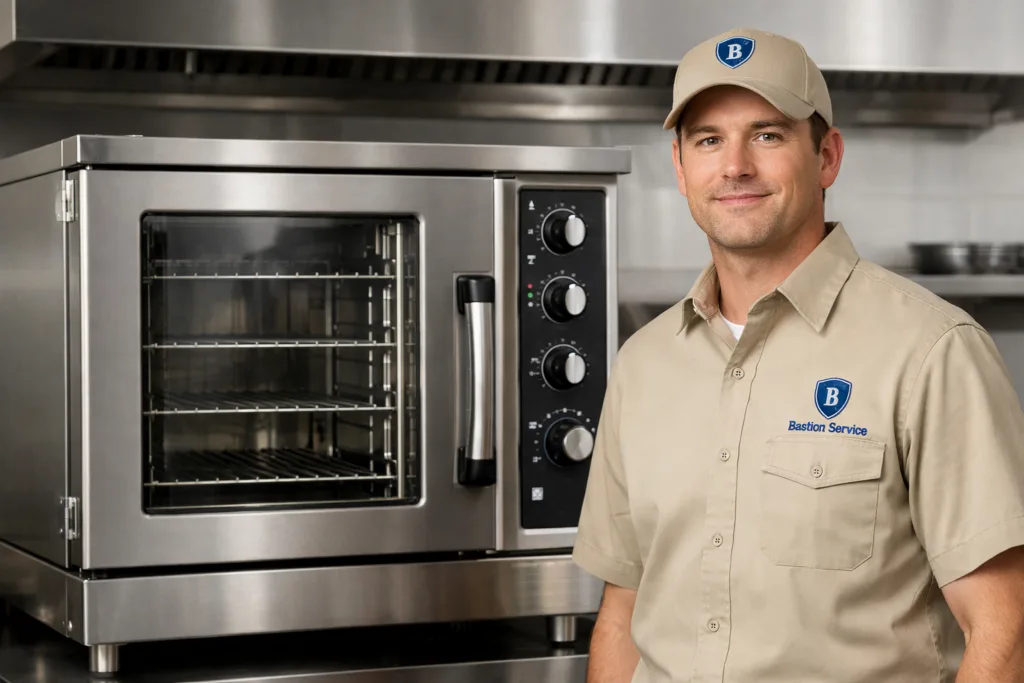
Bastion Service helps businesses in Mid-Wilshire troubleshoot Vulcan oven issues based on how the unit is actually behaving in operation. Whether the concern is no heat, delayed ignition, temperature swings, weak recovery, or controls that do not respond normally, the priority is to identify the failed system, assess whether continued use is reasonable, and move toward a repair plan that supports uptime.
Common Vulcan oven symptoms and what they often indicate
Not heating or taking too long to preheat
If the oven does not heat at all, heats slowly, or struggles to climb to the set temperature, the problem may involve the igniter, heating element, gas flow, temperature sensor, thermostat, relay, or control board. In a busy kitchen, a slow preheat issue can create wider delays than expected because production timing starts slipping before staff realize the oven is underperforming.
This symptom is worth checking promptly when the oven used to recover normally and now falls behind during repeated loads. A unit that technically heats but cannot keep pace with demand may already be operating with a failing component.
Uneven baking or hot and cold spots
Uneven results usually point to a heat distribution problem rather than a recipe issue. Possible causes include failing convection components, restricted airflow, worn door gaskets, calibration drift, sensor problems, or burner performance issues. Staff often notice this first when pans need more rotation than usual, browning becomes inconsistent, or one rack finishes earlier than another.
When these patterns continue, the oven should be evaluated before the business absorbs more waste, remake orders, or production slowdowns.
Temperature swings during a cycle
An oven that overshoots, cools off too far, or fluctuates more than normal may have a sensor or control issue, a calibration problem, or an interruption in how the heating system cycles. These temperature swings can be hard to catch without testing, but they often show up in real use as inconsistent finish quality, longer cook times, or product that looks right on the outside but is not fully cooked inside.
Ignition problems or delayed startup
Delayed ignition, repeated clicking, failed startup attempts, or a burner that does not light reliably should be taken seriously. These symptoms can be connected to ignition components, flame sensing, gas delivery, wiring faults, or control failure. Even when the oven eventually starts, repeated failed ignition cycles can add wear and make the unit less dependable during peak use.
Shutting off during operation
If the oven starts normally and then shuts down mid-cycle, the fault may involve overheating protection, intermittent electrical loss, unstable ignition, failing controls, or a component that drops out under load. This type of problem is especially disruptive because it can ruin product already in the cavity and create uncertainty for the rest of the shift.
Controls not responding normally
Buttons that do not respond, erratic display behavior, incorrect readings, or settings that do not match actual oven performance can point to interface or control-system issues. Sometimes the visible control problem is the primary failure. In other cases, it is the result of another electrical or temperature-related fault affecting overall operation.
Why symptom-based diagnosis matters for Vulcan oven repair
With Vulcan ovens, the visible complaint is not always the failed part. A no-heat call might be tied to ignition on one unit, a sensor problem on another, and a control fault on a third. That is why repair decisions should be based on how the oven behaves from startup through temperature recovery, not on guessing from one symptom alone.
A focused diagnosis helps answer the questions that matter to a business: whether the unit can stay in service temporarily, whether the repair is likely to restore stable performance, and whether continued operation may cause additional failures. That information is often more valuable than replacing parts one by one without confirming the root issue.
When service should be scheduled
It makes sense to schedule repair as soon as the oven starts affecting consistency, timing, or staff workflow, even if it has not failed completely. Many ovens continue operating in a limited way before a more obvious breakdown happens, and that period often creates hidden costs through slower output and uneven food quality.
Service is especially important when:
- Preheat time is noticeably longer than before
- The oven does not reach the selected temperature
- Temperature recovery is weak between batches
- Food is baking unevenly from side to side or rack to rack
- The unit intermittently fails to ignite or stay lit
- The oven shuts off during use or needs repeated resets
- The controls show inconsistent readings or fault behavior
- Door seal wear appears to be affecting heat retention
How continued use can increase downtime
Some operators try to work around oven problems by adjusting cook times, rotating pans more often, lowering production volume, or restarting the unit between cycles. Those short-term workarounds may get a kitchen through part of a day, but they can also hide a failure that is getting worse.
Running a Vulcan oven with unstable heat, weak airflow, faulty ignition, or inconsistent control response can put added strain on related components. What begins as one repair may expand into a larger outage if the oven is pushed through repeated service periods without correction. If the unit is already showing intermittent behavior, it is usually better to inspect it before the next busy shift rather than after a full shutdown.
Repair versus replacement
Many Vulcan oven problems are repairable when the unit is otherwise in solid condition and the issue is limited to serviceable parts. Repair is often the practical option when the oven still fits the kitchen setup, supports the production menu, and has not developed a pattern of recurring failures.
Replacement becomes a more realistic discussion when breakdowns are frequent, multiple systems show wear at the same time, or the expected repair does not restore reliable operation. The decision usually comes down to condition, parts outlook, business interruption, and whether the oven can return to stable day-to-day use after service.
What helps speed up a service visit
Before scheduling repair, it helps to note exactly how the problem appears in daily use. Useful details include whether the issue happens during startup or only after the oven is hot, whether all cooking is affected or only certain racks, how long preheat is taking, and whether the controls show any unusual behavior. If the problem is intermittent, knowing when it tends to happen can make diagnosis faster.
It is also helpful to know whether staff have noticed recent changes in baking results, ignition timing, shutdown frequency, or heat recovery under heavier loads. Small observations often point technicians toward the right test sequence more quickly.
Service-focused support for businesses in Mid-Wilshire
For businesses in Mid-Wilshire, oven repair should lead quickly to a usable decision: what is failing, how urgent it is, whether the unit can remain in operation, and what repair path makes the most sense for the kitchen. If a Vulcan oven is no longer heating evenly, reaching set temperature, or staying stable through production, scheduling service early is usually the most efficient way to protect workflow and avoid a larger interruption.


