
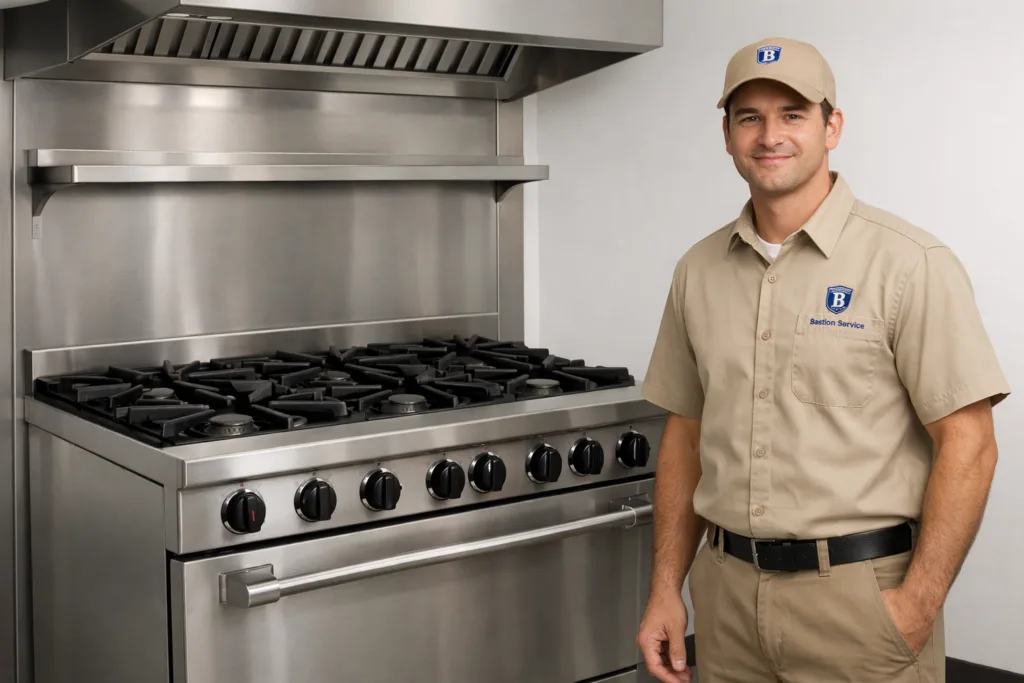




When a Vulcan oven, range, or fryer starts missing temperature, failing to ignite, or slowing production in Mid-Wilshire, the next step should be service-focused: identify the actual fault, decide whether the unit can stay in limited use, and schedule repair before the problem affects a full shift. For businesses that rely on steady output, early repair planning helps limit downtime, reduce wasted product, and avoid turning one failing component into a broader shutdown.
For specific equipment paths in Mid-Wilshire, review Vulcan Oven Repair in Mid-Wilshire, Vulcan Range Repair in Mid-Wilshire, and Vulcan Fryer Repair in Mid-Wilshire.
Bastion Service helps businesses in Mid-Wilshire troubleshoot Vulcan cooking equipment problems based on how the unit is behaving in real operation. That includes symptom review, equipment inspection, repair recommendations, and scheduling based on kitchen workload rather than guesswork.
What symptoms usually point to needed repair
Cooking equipment rarely fails without warning. In many cases, operators notice a pattern first: longer preheat times, drifting temperatures, weak burners, erratic cycling, delayed ignition, or a unit that works at startup and then falls behind during peak periods. Those symptoms matter because they affect consistency, staff timing, and daily output even before the equipment stops completely.
Repair should usually move up in priority when:
- Set temperature is no longer reliable
- Ignition becomes intermittent or delayed
- Heat recovery slows during busy periods
- Burners do not respond normally to controls
- The unit shuts down unexpectedly
- Staff must use workarounds to keep service moving
- The same issue returns after temporarily improving
These are not minor nuisances in a working kitchen. They often indicate wear in ignition systems, heating components, sensors, controls, gas-flow parts, or electrical connections that should be inspected before the equipment becomes unreliable enough to interrupt service.
Vulcan fryer problems that affect throughput
Fryers usually show trouble through temperature instability, slow recovery, overheating, failure to maintain set heat, or sudden trip-outs during use. In a busy kitchen, even a fryer that still turns on can create production problems if it lags between batches or cycles unpredictably.
Common fryer-related complaints include:
- Oil not reaching the selected temperature
- Slow recovery after baskets are dropped
- Overheating or erratic cycling
- Controls that do not respond correctly
- Intermittent shutdowns during operation
- Heating performance that drops under load
These symptoms may point to problems with thermostatic regulation, sensors, heating systems, control components, electrical faults, or gas-related performance issues. When a fryer runs acceptably at low volume but struggles during rush periods, that pattern often helps narrow the repair path. It can mean a component is beginning to fail under operating stress rather than failing all at once.
If product color, cook times, or recovery speed have changed noticeably, repair is usually more cost-effective than continuing to compensate with longer cycles and extra labor.
Vulcan oven issues tied to temperature and consistency
Oven problems often show up as uneven cooking, weak heat, delayed preheating, temperature drift, or controls that no longer match actual performance. These issues are especially disruptive when consistency matters across multiple batches or rack positions.
Operators often request service when a Vulcan oven:
- Takes too long to preheat
- Does not hold the selected temperature
- Cooks unevenly from one section to another
- Produces different results throughout the day
- Shows control or display irregularities
- Recovers too slowly after the door is opened
Not every oven problem is the same. Some calls lead to calibration-related findings, while others involve igniters, sensors, airflow issues, heating components, or control failures. What matters for the business is whether the oven can continue to support predictable output without waste, menu disruption, or extra supervision from staff.
Once an oven starts producing inconsistent results, the issue is no longer just mechanical. It becomes an operations problem, and that is usually the point where repair scheduling should move forward.
Vulcan range burner and ignition faults
Ranges tend to reveal problems quickly because staff interact with them constantly. Burners that click repeatedly, light late, burn weakly, or heat unevenly can slow prep and create avoidable station pressure.
Typical range service concerns include:
- Burners that do not ignite reliably
- Delayed ignition after controls are turned on
- Weak or unstable flame
- Uneven heat across burner positions
- Controls that do not change flame normally
- Intermittent burner operation during service
These symptoms may involve ignition components, burner assemblies, clogged or worn parts, gas-flow problems, or control-related faults. Because ranges are used heavily and often continuously, even a single underperforming burner can affect line timing and staff workflow.
If there is a strong or persistent gas smell, the equipment should not remain in use. Gas safety issues need to be addressed immediately before any normal cooking operation continues.
When waiting creates more downtime
Some equipment problems can be watched briefly. Heat loss, ignition problems, recovery delays, and shutdowns usually should not be. Waiting tends to increase the chance of a mid-shift failure, especially when the unit is already showing intermittent behavior.
It is usually time to schedule service when:
- The unit cannot keep up with normal volume
- Staff has changed routines to work around the problem
- Performance drops as the day gets busier
- The equipment restarts but does not stay reliable
- More than one symptom is appearing at the same time
Inspection also helps management decide whether a piece of equipment can stay in limited use until a scheduled repair window or whether continued operation risks added damage. That decision is difficult to make accurately from symptoms alone, which is why timely diagnosis matters.
How repair planning helps businesses in Mid-Wilshire
Effective cooking equipment repair is not just about swapping a failed part. It involves confirming the source of the failure, checking whether related systems have been affected, and planning the repair around actual kitchen demands. A fryer may need more than a simple control replacement if heat performance has already become unstable. An oven issue may involve both temperature sensing and ignition behavior. A range complaint may start at one burner but point to a broader gas or control problem.
For businesses in Mid-Wilshire, that kind of repair planning helps answer practical questions:
- Can the equipment remain in operation until the repair visit?
- Is the fault isolated or likely to expand?
- Should service be staged around slower hours?
- Is a targeted repair likely, or is broader work needed?
- Does the current condition justify replacement review?
Those decisions matter because production equipment affects more than one station. When a key unit becomes inconsistent, delays often spread through prep timing, ticket flow, and staffing efficiency.
When repair versus replacement needs to be considered
Replacement discussions usually come up when a unit has repeated major failures, repair history is stacking up across multiple systems, or the equipment no longer supports reliable daily operation even after service. Still, it is important not to assume replacement too early. Some units that appear to be nearing the end of service life only need a focused repair, while others with intermittent symptoms may have broader deterioration that makes future downtime more likely.
The useful question for most operators is whether the equipment can return to stable, repeatable performance after repair. A proper service visit helps answer that with actual findings rather than assumptions based only on one visible symptom.
Scheduling service for Vulcan cooking equipment in Mid-Wilshire
If a Vulcan oven, range, or fryer is affecting temperature consistency, ignition reliability, recovery speed, or normal kitchen flow, the most practical next step is to schedule service before the issue spreads to a full outage. A repair visit in Mid-Wilshire can help determine whether the unit should stay in use, what repair scope makes sense, and how to plan the work around business operations with as little disruption as possible.


