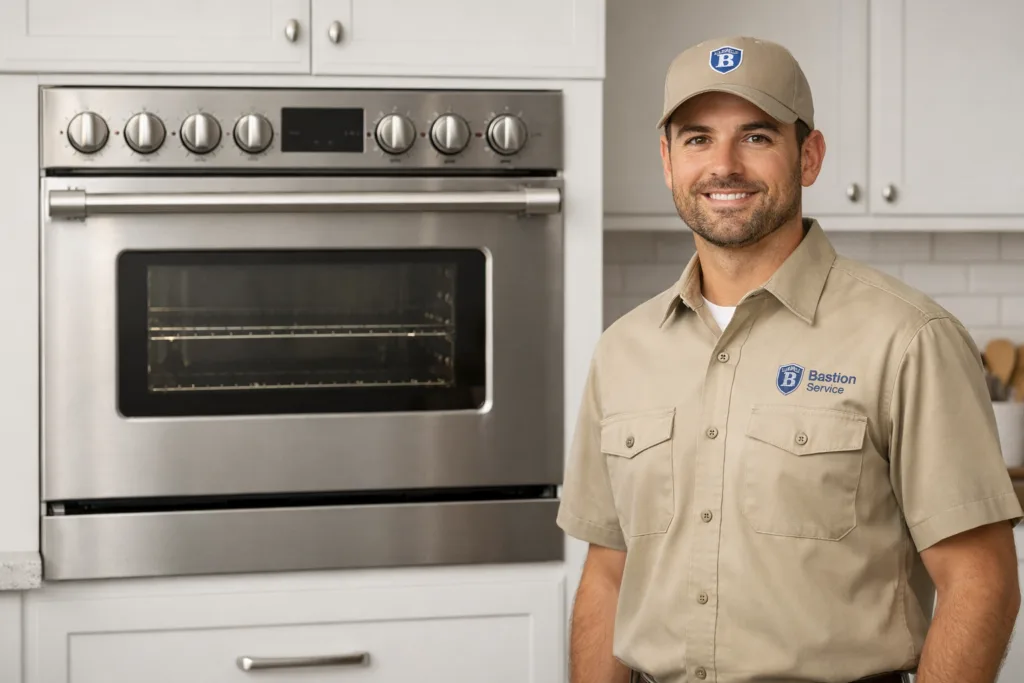
How Viking oven problems usually show up at home
Most oven failures start as performance changes rather than a complete shutdown. A Viking oven may begin taking too long to preheat, cook one side of a dish faster than the other, shut off before food is done, or run hotter than the set temperature. Those patterns matter because they often point to different parts of the heating, sensing, or control system.
In Palos Verdes Estates homes, these issues tend to become obvious during normal weekly cooking: roasted foods finish unevenly, baked goods need extra time, or a familiar recipe suddenly stops coming out right. When the symptom is tracked carefully, it becomes much easier to tell whether the problem involves heat production, temperature feedback, airflow, or the electronic controls.
Symptoms that usually point to a specific repair path
- No heat at all: Often tied to a failed igniter on gas models, a damaged bake or broil element on electric models, a control problem, or an electrical supply issue.
- Slow preheat: Commonly related to a weak igniter, a struggling element, sensor drift, or a control that is not regulating heat correctly.
- Uneven baking: Can come from convection fan trouble, a worn door gasket, temperature sensor issues, or one heating circuit not operating normally.
- Overheating or burning food: Frequently linked to a faulty sensor, relay trouble, or temperature calibration problems.
- Display works but cooking will not start: May involve the control panel, latch system, safety lock functions, or communication faults between components.
What not heating, slow preheat, and temperature swings can mean
An oven that does not heat at all is usually easier to notice than one that heats badly. The more frustrating calls are often the ovens that still turn on, still light up, and still produce some heat, but no longer do the job well. That is where slow preheat, drifting temperature, and inconsistent cooking times become the main clues.
With Viking ovens, a weak heating component can sometimes keep the oven partially functional while still causing poor performance. A gas igniter may glow but fail to draw enough current to open the gas valve reliably. An electric bake element may show visible activity while no longer providing full output. A temperature sensor can also send inaccurate readings that make the control cycle heat too early or too late.
If the complaint is “it heats, but not like it used to,” the repair path often depends on whether the oven is failing to reach the selected temperature, failing to maintain it, or simply misreporting it.
Everyday signs of unstable oven temperature
Temperature instability does not always appear as an obvious error code. More often, it shows up in cooking results:
- cookies browning more on the back rack than the front
- casseroles staying cool in the center after normal cook time
- roasts finishing early one week and late the next
- preheat alerts sounding before the cavity is actually ready
- broiling performance becoming weak or unpredictable
These are useful details to mention during service because they help narrow the problem faster than a general report that the oven is “off.”
Uneven baking is often more than a rack-position issue
Homeowners sometimes assume uneven baking is caused by cookware, recipe differences, or where the pan was placed. While those factors can matter, repeated uneven results in the same Viking oven often suggest a mechanical or electrical issue. Convection models may have airflow problems if the fan is not running properly or not circulating heat evenly. On non-convection cycles, the issue may be tied to one heating function underperforming.
Door seal wear can also affect results. If heat escapes during operation, the oven may struggle to maintain stable cavity temperature, especially during longer baking cycles. In other cases, the sensor may be reading inaccurately enough that the oven seems normal at first, but drifts during the cook.
Why the same food keeps coming out differently
When a reliable recipe becomes unreliable, that is usually a stronger sign of oven trouble than a single bad result. Consistency matters. If the same pan, same settings, and same cook time produce noticeably different results across multiple uses, it is reasonable to suspect a service issue rather than user error.
Control and ignition issues on Viking ovens
Modern Viking ovens rely on more than just a heat source. They use sensors, relays, interface boards, control boards, and safety systems that all have to work together. When one part of that chain stops responding correctly, the symptom may look confusing from the outside. The display may operate normally while the oven never starts heating. A cycle may begin and then cancel. Buttons may respond inconsistently, or an error code may appear only some of the time.
On gas ovens, ignition complaints deserve prompt attention. Delayed ignition, repeated clicking, or a glow igniter that does not lead to proper burner operation can indicate a weakening igniter or related gas-heating fault. On electric ovens, hidden bake elements and broil elements can degrade gradually, which is why performance often worsens before the oven stops heating entirely.
Common control-related complaints
- the oven powers on but will not enter a bake cycle
- touch controls stop responding consistently
- error codes return after being cleared
- the unit shuts off mid-cycle
- self-clean or door-lock functions interfere with normal operation
These symptoms may involve the interface, the main control, the door lock assembly, or a sensor input that is causing the control to block operation.
Problems that should be checked promptly
Some oven issues are mainly inconvenient, while others should not be ignored. Stop using the appliance and arrange service if you notice any of the following:
- burning smells that suggest overheated wiring or insulation
- breaker tripping during oven use
- the oven overheating badly enough to scorch food quickly
- repeated shutdowns during cooking
- a gas smell that is strong, persistent, or out of the ordinary on a gas model
Even when the oven still runs, continued use can worsen damage if the underlying problem is electrical, control-related, or tied to overheating.
When repair makes sense and when replacement may be worth considering
Many Viking oven problems are tied to serviceable parts such as igniters, elements, sensors, fans, switches, and certain control-related components. If the oven is otherwise in sound condition and the fault is isolated, repair is often the more sensible option for a household kitchen.
Replacement becomes a more serious consideration when the oven has multiple major failures at once, repeated unresolved electronic issues, significant wiring damage, or overall wear that makes further work hard to justify. The important part is evaluating that decision after the actual cause is identified, not just from the surface symptom.
Questions that help with the decision
- Is the oven safe to keep using right now?
- Has the problem become more frequent or more severe?
- Is the failure limited to one main system or affecting several?
- Would a completed repair reasonably restore normal daily cooking?
What to note before scheduling service
A few details can make diagnosis faster and more accurate. It helps to note whether the oven is gas or electric, whether the problem affects bake, broil, or both, and whether the issue happens every time or only during certain cycles. If there is an error code, write down the exact code rather than a rough description. If the oven overheats, estimate how far off the temperature seems in real cooking rather than relying only on the display.
It is also useful to mention whether the problem appeared suddenly or developed gradually. A sudden failure often points to a single component stopping outright. A gradual decline may suggest a weak igniter, drifting sensor, deteriorating element, or airflow problem that has been getting worse over time.
Viking oven service for households in Palos Verdes Estates
For most homeowners, the goal is simple: get the oven back to reliable cooking without guessing at parts. A useful service visit focuses on the exact complaint, tests the heating and control functions tied to that complaint, and determines whether repair is likely to restore normal operation. That approach is especially helpful when the oven still works intermittently, because intermittent failures can be the hardest to judge from appearance alone.
Whether the problem is no heat, slow preheat, uneven baking, unstable temperature, or a control issue, symptom-based evaluation usually gives the clearest path forward for a Viking oven in Palos Verdes Estates.