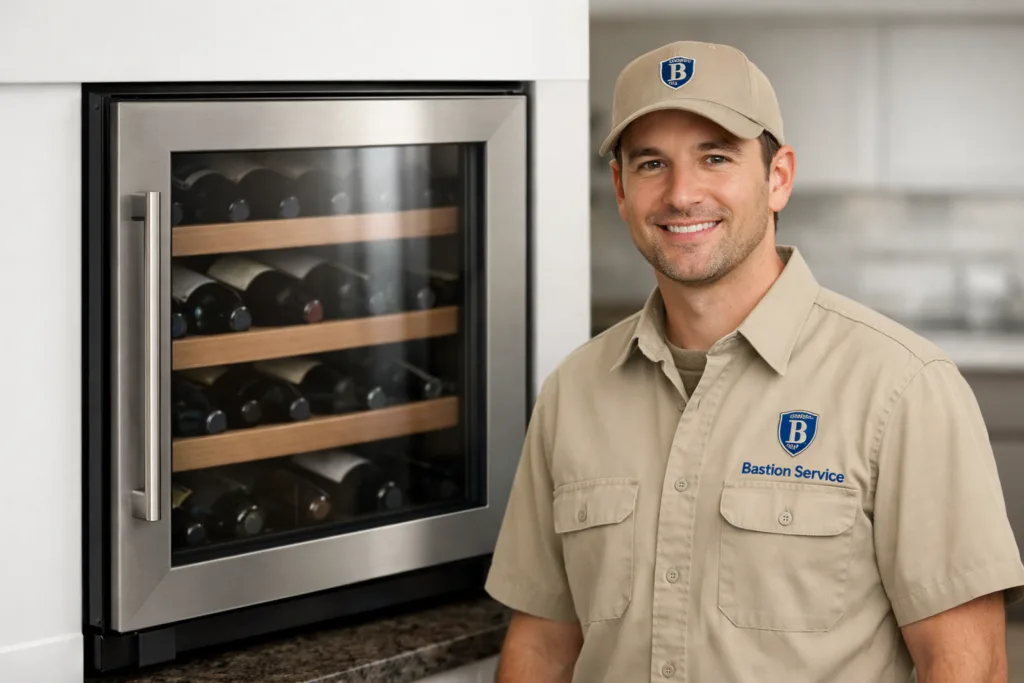
Small changes in wine cooler performance usually show up before a full failure. A few degrees of temperature drift, a new fan sound, or moisture on the glass can all signal that a U-Line unit needs attention before storage conditions become unreliable.
What the symptom is usually telling you
U-Line wine coolers are built to maintain a stable interior environment, so the most useful way to approach a problem is by looking at the exact pattern. Two units may both seem “warm,” but one may have an airflow problem while the other has a control or sealed-system issue.
Not cooling enough
If bottles are no longer staying near the set temperature, the cause may involve restricted airflow, a weak evaporator fan, a sensor problem, a control issue, or trouble in the refrigeration circuit. In some cases, the cabinet cools unevenly, with one shelf feeling much warmer than another. That often points to circulation or fan-related trouble rather than a complete loss of cooling.
It also helps to look at how quickly the problem developed. A gradual decline can suggest dirty condenser components, reduced airflow, or a part that is weakening. A sudden change can point more directly to a failed fan motor, sensor fault, or electronic control problem.
Running constantly or starting too often
A wine cooler that seems to run nonstop is usually struggling to reach or hold the target temperature. Common causes include a leaking door gasket, dirty condenser area, inaccurate temperature sensing, or compressor-related stress. Frequent short cycling can also indicate that the unit is trying repeatedly to stabilize but cannot complete a normal cooling cycle.
When this happens, homeowners in Rancho Park often notice that the cooler is active far more than usual even though the room conditions have not changed. That is a good sign to schedule service before extra run time puts more wear on the system.
Condensation, water, or frost
Moisture problems can show up in several ways: fogging on the glass, damp labels, water under the cabinet, or frost collecting along interior surfaces. These symptoms may come from poor door sealing, a blocked or slow drain, airflow restriction, or a defrost-related issue depending on the model.
Frost is especially easy to misread. It does not always mean a major refrigeration failure, but it does mean the unit is no longer managing moisture and temperature the way it should. If frost keeps returning after being cleared, there is usually an underlying fault that needs to be corrected.
Noise, buzzing, or vibration
Some operational sound is normal, but a noticeable change matters. Buzzing may come from a compressor working harder than normal. Rattling can be caused by loose panels or vibration against surrounding cabinetry. Clicking can point to a start-related electrical issue, while scraping or uneven fan noise may indicate fan blade contact or motor wear.
If the sound is new, sharper, or more frequent, it is worth checking before the strain spreads to other parts.
Display or control problems
When the display is blank, erratic, inaccurate, or unresponsive, the issue may involve the control board, user interface, sensor input, or power supply to the unit. Sometimes the lights still work while cooling does not, which can make the problem seem confusing. That combination often means the cooler still has partial power but is not controlling the refrigeration system correctly.
Why symptom-based diagnosis matters
Wine cooler issues overlap more than many homeowners expect. A warm cabinet does not automatically mean compressor failure. Condensation does not always point to a bad door gasket. Excess noise does not always mean the entire unit is near the end of its life.
That is why the best repair decision starts with a clear diagnosis based on cooling behavior, airflow, control response, moisture pattern, and sound changes. Once the source is identified, it becomes much easier to tell whether the fix is likely to be straightforward or whether the repair path is more involved.
Common household conditions that can affect performance
Not every complaint begins with a failed part. A few basic conditions can make a U-Line wine cooler work harder or perform unevenly:
- Door not fully closing because of bottle placement or shelf interference
- Interior vents blocked by tightly packed storage
- Condenser area collecting dust and restricting heat release
- Cabinet not level, leading to vibration or poor door sealing
- Frequent door opening during warm parts of the day
These checks do not replace service, but they can help narrow down whether the problem is environmental, mechanical, or electronic.
When service should not wait
Some symptoms are more urgent than others. It is best not to delay when the unit is fully warm, repeatedly clicking without stabilizing, leaking enough water to affect surrounding flooring, or making a strong new mechanical sound. Those signs can indicate a problem that is getting worse with continued operation.
More moderate symptoms, such as mild temperature drift or occasional condensation, still deserve attention because wine storage quality depends on consistency. Catching the issue earlier may help prevent heavier frost buildup, extended compressor strain, or loss of cooling altogether.
Repair or replacement: how the decision is usually made
Repair is often worthwhile when the problem is limited to a fan motor, control component, sensor, gasket, drain issue, or another isolated part and the cabinet itself remains in good condition. These faults are usually easier to evaluate because the rest of the appliance may still be structurally sound and performing normally apart from the failed component.
Replacement becomes more likely when there is major sealed-system trouble, repeated breakdown history, advanced overall wear, or a repair cost that no longer makes sense for the condition of the cooler. Age alone does not decide the issue; the better question is whether the unit has a sensible repair path with a reasonable outcome.
What to note before the appointment
A few details can make troubleshooting more efficient:
- The set temperature and the actual temperature you are seeing
- Whether the problem is constant or intermittent
- Any recent moisture, frost, or water under the unit
- Changes in fan sound, buzzing, clicking, or vibration
- Whether the display and interior light are working normally
- How long the issue has been going on
These observations help connect the symptom to the most likely system involved and reduce guesswork once service begins.
Focused help for U-Line wine cooler problems in Rancho Park
For many Rancho Park households, the real concern is not just whether the appliance turns on, but whether it is still protecting the collection the way it should. Stable cooling, proper airflow, dry interior conditions, and normal cycling all matter in a wine cooler more than they might in a standard refrigerator.
When those conditions change, the next step is to identify whether the problem is tied to controls, fan operation, door sealing, drainage, or the refrigeration system itself. From there, it is much easier to decide whether repair is the practical next move and how urgent the issue has become.