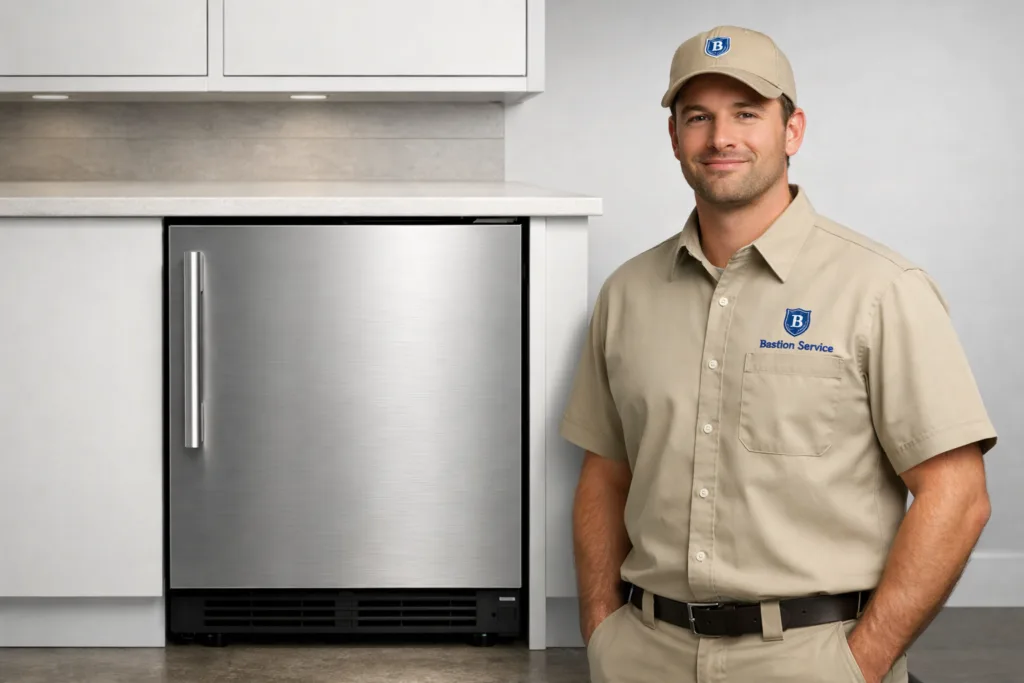
Food spoilage, puddles on the floor, and recurring frost are usually signs that a refrigerator problem has moved beyond a simple setting adjustment. With U-Line units, the same visible symptom can come from airflow trouble, a sealing issue, a failed sensor, a defrost fault, or a more serious cooling-system problem. The most useful next step is to match the repair to the actual failure instead of guessing from the symptom alone.
Common U-Line refrigerator problems homeowners notice
Refrigeration issues often show up gradually. A compartment may seem a little warm one day, then struggle to recover after the door is opened, then start producing excess condensation or unusual noise. Paying attention to the pattern helps narrow down what the appliance is doing and why.
Not cooling enough
If milk, leftovers, or produce are not staying cold enough, the cause may be reduced evaporator airflow, a condenser issue, a temperature sensor problem, a faulty control, or compressor-related trouble. Sometimes the refrigerator still runs, but it cannot remove heat efficiently enough to maintain a stable food-safe temperature.
This symptom becomes more urgent when the cabinet feels warm even after temperature adjustments, when items near the back stay colder than items near the door, or when cooling drops off after the appliance has been running for a while.
Freezing food or creating cold spots
A refrigerator that freezes beverages, leafy greens, or items stored on one shelf may have an airflow imbalance, damper issue, thermistor problem, or control fault. Poor door sealing can also allow temperature swings that create icy patches in one area while another section stays too warm.
This kind of uneven performance is frustrating because it can look like the refrigerator is cooling well when it is actually controlling temperature poorly.
Leaks and interior moisture
Water under the appliance or droplets collecting inside the cabinet can point to a blocked defrost drain, excess humidity entering through a worn gasket, or a leveling problem that affects drainage. In a kitchen, even a small leak can become a bigger household issue if moisture reaches flooring, trim, or nearby cabinetry.
Frost buildup
Frost on interior walls, shelves, or around stored items often means warm air is entering where it should not, or that the defrost system is not clearing ice the way it should. Clearing frost manually may offer short-term relief, but if it returns quickly, the root problem is still active.
Noise, clicking, or constant running
New sounds matter, especially when they repeat in a pattern. Buzzing, clicking, fan rubbing, or a compressor that seems to run without cycling off can indicate fan motor wear, a start-component problem, restricted airflow, or stress in the cooling system. A refrigerator that never seems to rest is often working harder than normal to hold temperature.
Unit will not start
If the refrigerator appears dead or clicks but does not run, the issue may involve the power supply, controls, start components, or compressor function. This is different from weak cooling and usually calls for prompt testing rather than repeated resets.
Why symptom-based diagnosis matters
Several failures can produce the same complaint. A warm cabinet does not automatically mean the compressor has failed. It could also be tied to ice-covered coils, a weak evaporator fan, a bad thermistor, or a door that is not sealing consistently. Likewise, frost is not always a defrost-heater problem; it may begin with warm air entering around the gasket or frequent temperature swings caused by another component.
That is why useful service starts by checking how the unit is behaving as a system: temperature response, airflow, frost pattern, drain condition, fan operation, gasket contact, and control behavior. Once the cause is identified, it is much easier to decide whether the repair is minor, moderate, or a sign of a larger appliance decline.
Signs the problem should not be ignored
Some refrigerator issues can wait a short time for scheduling, but others should be treated as urgent. If food is no longer staying cold, if leaks are recurring, or if the machine is making sharp new noises, continued operation may increase wear or create secondary damage in the home.
- Food spoils sooner than expected even though settings have not changed
- The refrigerator runs almost constantly without recovering temperature
- Frost returns soon after being removed
- Water keeps appearing under or inside the unit
- The appliance clicks repeatedly, trips power, or fails to restart after cycling off
- Sections of the cabinet are freezing while others remain too warm
What homeowners can check before service
A few basic observations can help separate a simple use issue from a mechanical problem. These checks do not replace repair work, but they can make the symptom pattern clearer.
- Confirm the temperature setting was not changed accidentally
- Make sure food containers are not blocking interior vents
- Check whether the door closes fully without resistance
- Look for torn, loose, or dirty gasket areas that could affect sealing
- Notice whether frost is light and scattered or thick and concentrated in one area
- Watch for water appearing after the door opens often versus appearing continuously
If the problem continues after these basic checks, or if the appliance is clearly warming, leaking, or frosting over, repair is usually the safer next step.
Repair or replacement: how to make the call
Not every cooling failure means the refrigerator should be replaced. Many U-Line problems are tied to serviceable parts such as fans, sensors, controls, drains, gaskets, or defrost components. When the appliance is otherwise in good condition, a targeted repair can restore normal operation without the cost of full replacement.
Replacement becomes more reasonable when the repair involves major sealed-system trouble, repeated breakdowns, or a combination of aging components that suggests the unit is nearing the end of useful life. The decision usually comes down to three things: the exact failed part, the overall condition of the refrigerator, and how much confidence there is that the repair will solve the full problem rather than only part of it.
What good refrigerator service should clarify
For homeowners in Brentwood, the value of service is not just in replacing a part. It is in understanding what failed, how that failure connects to the symptoms you are seeing, and whether continued operation could cause more food loss or property damage. A repair visit should help answer practical questions such as whether the appliance is safe to keep using, whether the issue is likely isolated, and what repair path makes the most sense for the household.
When a U-Line refrigerator is warming up, freezing food, leaking, frosting over, or making unusual sounds, timely diagnosis usually prevents more inconvenience than waiting and hoping the symptom settles on its own.