
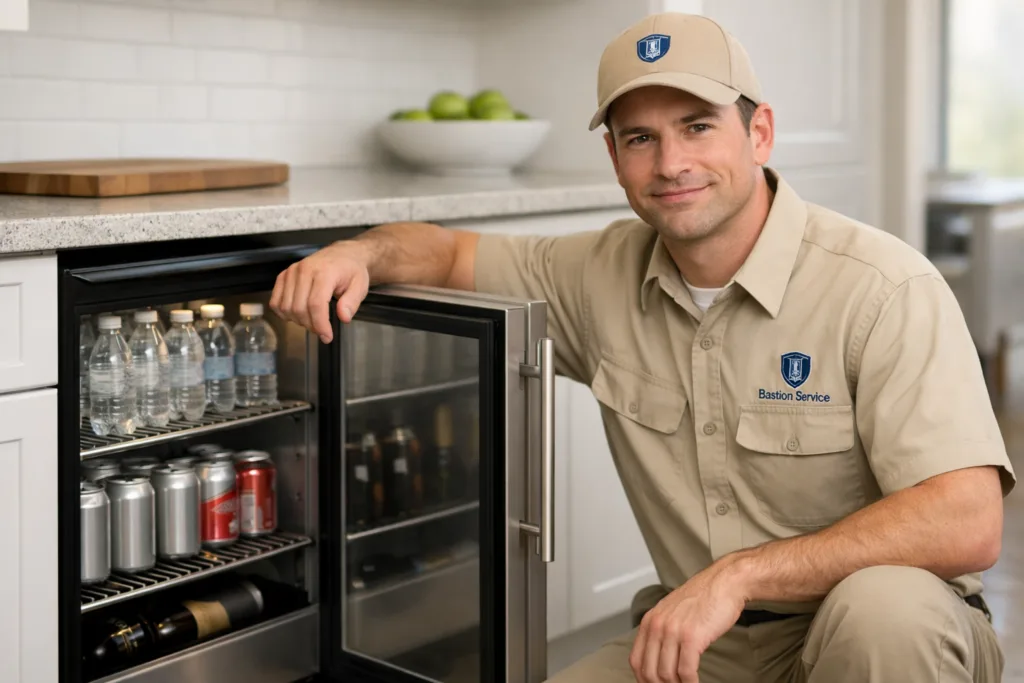




Small changes in performance are often the first sign that a U-Line unit needs attention. A beverage refrigerator that feels a little warm, an ice maker that slows down, or a wine cooler that seems to run longer than usual can all point to underlying problems that are easier to address before they spread to other components.
For specific U-Line appliance paths in Brentwood, review U-Line Refrigerator Repair in Brentwood, U-Line Freezer Repair in Brentwood, and U-Line Ice Maker Repair in Brentwood.
How U-Line cooling problems usually show up
U-Line appliances are commonly installed in kitchens, bars, entertaining spaces, and built-in cabinet areas where appearance and steady temperature matter just as much as basic operation. Because many of these units are compact or undercounter, airflow limitations, drainage issues, and door sealing problems can affect performance more quickly than homeowners expect.
In many cases, the symptom matters more than the appliance category. Warm temperatures, frost, leaks, unusual sounds, and nonstop running can appear in refrigerators, freezers, ice makers, and wine coolers for different reasons. Looking at the exact pattern helps separate a minor maintenance-related issue from a more serious cooling failure.
Refrigerator symptoms that should not be ignored
A U-Line refrigerator may first show trouble through uneven cooling. Drinks may stay cool on one shelf but feel noticeably warmer on another. In other cases, the cabinet may seem cold enough at first, yet food does not stay consistently chilled over time.
Common refrigerator warning signs include:
- Interior temperatures rising above normal
- Water pooling inside or below the unit
- Frequent cycling or constant operation
- New humming, clicking, or fan noise
- Condensation around the door or frame
These symptoms do not always mean compressor failure. Restricted airflow, a clogged drain, a worn door gasket, sensor issues, or a fan problem can create similar results. That is why diagnosis should come before assumptions about major parts.
Freezer problems that can lead to food loss
Freezer issues tend to become urgent quickly. If frozen items are softening, frost is spreading across interior panels, or the door is no longer sealing tightly, performance can drop fast. A freezer that keeps running without reaching the right temperature may be struggling with airflow, defrost, or control-related faults.
Watch for these patterns:
- Food that is no longer staying fully frozen
- Heavy frost buildup on shelves or walls
- A door that pops open or does not close cleanly
- Grinding or high-pitched fan sounds
- Ice crystals forming more quickly than usual
When frost and soft food appear together, continued use often makes the problem harder to manage. Frost can choke airflow, force longer run times, and hide the original cause.
Ice maker issues often start before production stops completely
Many homeowners notice an ice maker problem only after output falls off, but the warning signs usually start earlier. Cubes may become smaller, hollow, cloudy, or irregular before the unit stops making ice altogether. Leaks, slushy ice, or a sheet of ice forming where it should not are also important clues.
An ice maker may need service if it is:
- Producing little or no ice
- Making misshapen or stuck-together cubes
- Leaking water onto the floor or into the cabinet area
- Creating excess frost or unwanted ice buildup
- Taking much longer than normal to refill supply
These issues can come from fill problems, water supply restrictions, drainage trouble, scaling, internal temperature faults, or control failures. If water is escaping the unit, stopping normal use is often the best way to avoid cabinet or flooring damage.
Wine cooler temperature drift matters more than many people think
A wine cooler does not have to stop cooling entirely to have a real problem. Even modest temperature swings can affect storage conditions over time. If the display setting looks correct but bottles feel warmer than expected, or if the unit runs almost nonstop while struggling to hold range, something is likely interfering with normal regulation.
Common wine cooler complaints include:
- Temperature that does not match the setting
- Hot spots or uneven cooling inside the cabinet
- Moisture or condensation on the door glass
- Persistent vibration or louder operation
- A unit that cycles too often or hardly cycles at all
Because wine storage depends on stability, a cooler that seems only slightly off can still warrant prompt evaluation.
Why the same symptom can have different causes
One of the most confusing parts of U-Line appliance problems is that different failures can look almost identical at first. Poor cooling may come from blocked vents, a dirty condenser area, a failed fan motor, a sensor issue, or a sealed-system problem. Water under the unit might point to drainage trouble, a supply connection issue, or condensation forming where it should not.
This overlap is why symptom-based diagnosis matters. Replacing the first part that seems related does not always fix the appliance, and it can delay the real solution. A practical repair plan starts with how the unit behaves, when the problem started, and whether performance is changing gradually or all at once.
Signs the problem is getting worse
Some appliances limp along for a while before failing completely. Others deteriorate quickly. Homeowners in Brentwood should be especially cautious when a cooling unit shows more than one symptom at the same time, such as warming temperatures plus noise, or leaking plus heavy frost.
Schedule service sooner rather than later if you notice:
- Temperature instability that keeps getting worse
- Repeated puddles, condensation, or cabinet moisture
- Frost spreading beyond a small isolated area
- Clicking, buzzing, rattling, or grinding that is new
- The appliance running constantly without recovering
- The unit failing to start reliably after stopping
When continued use can cause more damage
A unit that is only mildly off may still be usable for a short period, but some conditions call for caution. Heavy leaks can damage surrounding finishes. A refrigerator that cannot hold safe temperatures can lead to spoilage. A freezer with growing frost may overwork internal components. An ice maker that is leaking or freezing in the wrong places can create a bigger repair than the original issue.
If the appliance is tripping power, making harsh mechanical noise, leaking heavily, or no longer cooling, turning it off is usually safer than trying to keep it going.
Repair or replacement depends on the whole picture
Not every U-Line problem leads to replacement. Many units are worth repairing when the failure is specific, the cabinet and internal condition are otherwise solid, and there is no pattern of repeated major breakdowns. Built-in and specialty cooling equipment often deserves closer evaluation because size, fit, and installation complexity can make replacement less straightforward than it first appears.
Replacement becomes more likely when there is major cooling-system failure, corrosion, repeated expensive repairs, or a general decline across several components at once. The best choice usually depends on age, condition, and the exact failure pattern rather than on one bad day of performance.
What Brentwood homeowners can do before service
Before scheduling a visit, it helps to note a few details about the symptom. Was the change sudden or gradual? Is the unit still cooling somewhat, or not at all? Is there water, frost, or a change in sound? Has the door been closing normally? This information can make troubleshooting more efficient and help narrow the probable cause.
It is also useful to remove anything blocking vents, avoid overpacking the compartment, and check whether the door is sealing fully. These simple observations do not replace diagnosis, but they can help clarify whether the issue is operational, airflow-related, or likely mechanical.
Choosing the next step
For households in Brentwood, the best approach is usually to respond to the symptom early instead of waiting for a total failure. Whether the issue involves a refrigerator, freezer, ice maker, or wine cooler, a prompt inspection can help determine if the problem is limited and repairable or part of a larger decline. That keeps decisions grounded in the actual condition of the appliance and reduces the chance of avoidable food loss, water damage, or repeat problems.


