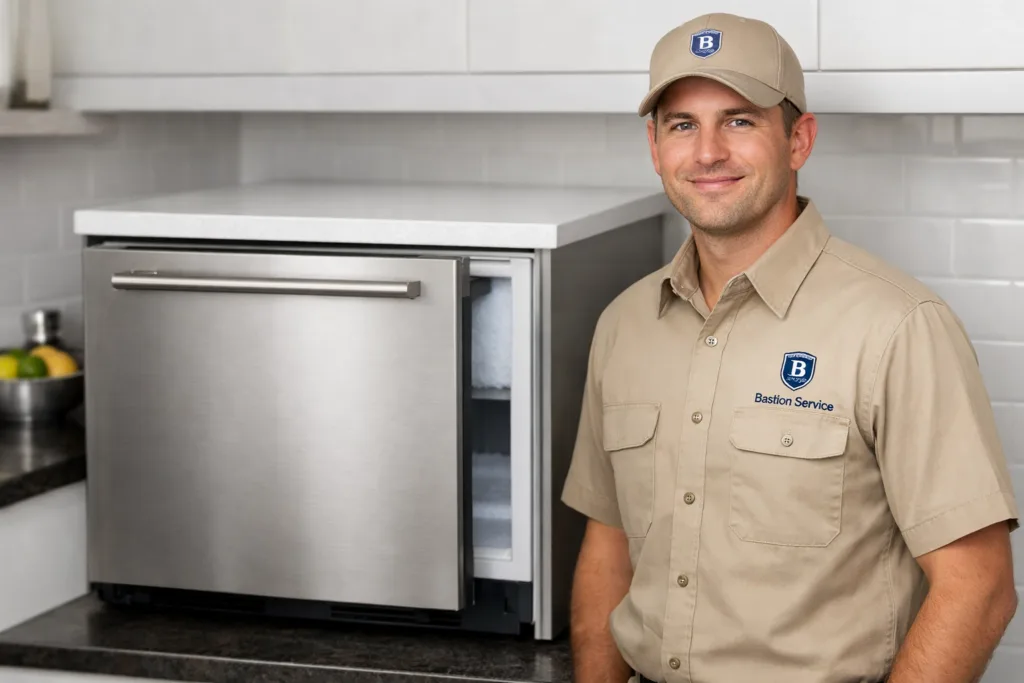
Freezer problems rarely stay minor for long. When frozen food starts softening, frost keeps returning, or the unit runs louder than usual, the smartest next step is to match the symptom pattern to the most likely failure points rather than guessing at parts.
Signs your U-Line freezer needs attention
Many homeowners first notice a performance change before a full breakdown. The temperature may drift upward slowly, ice may form in unusual places, or the freezer may seem to run almost nonstop. These early signs matter because they often point to airflow, defrost, sensor, door seal, or cooling-system issues that can worsen with continued use.
Food is soft or not staying fully frozen
If the freezer is on but food is no longer staying solid, several different faults may be involved. Frost hidden behind the interior panel can choke airflow. A faulty sensor or control can misread cabinet temperature. In some cases, the compressor starts but the system cannot maintain proper cooling. This symptom usually deserves prompt service because temperature loss can become more severe quickly.
Frost buildup keeps coming back
Heavy frost on shelves, around drawers, near the door opening, or across the rear interior panel usually means warm air is getting in or the freezer is not completing defrost properly. A worn gasket, a door that is not sealing evenly, a drain issue, or a failed defrost component can all create similar frost complaints. Simply clearing the ice rarely solves the underlying cause.
The freezer runs constantly or cycles oddly
A U-Line freezer that rarely shuts off may be trying to overcome warm air leaks, restricted airflow, dirty condenser conditions, or weak cooling performance. Short cycling can point in a different direction, including control faults or compressor start issues. Both patterns are worth checking because they put extra strain on the appliance and can increase the chance of food loss.
You see water, condensation, or stray ice
Water under the unit, moisture around the door area, or ice where it does not normally form can suggest a clogged drain, defrost trouble, or repeated warm-air intrusion. Even when the freezer still seems cold enough, moisture problems usually mean something is off in the way the unit is sealing, draining, or managing temperature.
New noises are coming from the freezer
Clicking, buzzing, rattling, or fan noise that was not there before can help narrow down the source of trouble. Ice contacting a fan blade, a failing motor, start component problems, vibration, or compressor strain can all sound similar at first. A changing noise pattern is often one of the clearest clues that a mechanical or electrical part is no longer operating normally.
Why U-Line freezer issues should be diagnosed by symptom
U-Line freezers are often installed in compact residential settings, including built-in and undercounter spaces, and those layouts can affect airflow, heat exchange, and service access. That matters because a problem that looks simple from the outside may have a different cause behind the panel. Frost, for example, may come from a door-sealing problem, but it can also result from a failed defrost heater, control issue, or restricted circulation path.
That is why good service starts with how the freezer is cooling in real conditions, how the evaporator area is behaving, whether the door is sealing correctly, and whether the controls are responding properly. Replacing a visible part without tracing the reason for the symptom can lead to repeat failures and unnecessary cost.
Common causes behind temperature swings
Temperature inconsistency is one of the most frustrating freezer complaints because the unit may seem fine at one moment and unreliable the next. In Pico-Robertson homes, this can show up as partially thawed items, uneven freezing from one shelf to another, or a freezer that recovers slowly after the door is opened.
- Airflow restrictions: Ice buildup or fan problems can prevent cold air from circulating evenly.
- Door seal problems: Even a small leak can allow repeated warm-air intrusion.
- Thermistor or control faults: The freezer may run at the wrong times or fail to maintain a stable setpoint.
- Defrost failure: A unit may cool at first, then lose performance as frost spreads over the evaporator area.
- Sealed-system or compressor concerns: Cooling may become weak, slow, or inconsistent despite long run times.
When waiting makes the repair harder
Some freezer issues are most repairable when they are addressed early. A door gasket that is starting to fail can lead to excess frost, then blocked airflow, then poor cooling. A noisy fan can turn into a no-cooling problem if ice buildup or motor failure progresses. A unit that is running nonstop may still be preserving food for the moment, but that does not mean it is operating safely or efficiently.
It is usually time to schedule service if you notice any of the following:
- Food softening or refreezing unevenly
- Recurring frost after manual clearing
- Water under or inside the freezer
- A door that must be pushed firmly to stay shut
- Noticeably louder operation or repeated clicking
- Long run times with poor temperature results
Repair or replace: what usually makes sense
Not every freezer problem points to replacement. Many U-Line freezer issues involve parts such as gaskets, fan motors, sensors, controls, drains, or defrost components that may be serviceable once the cause is confirmed. On the other hand, replacement becomes a more serious consideration when there is major sealed-system trouble, repeated major failures, or a repair cost that no longer makes sense for the age and condition of the unit.
The important part is making that decision based on findings, not frustration. A freezer that seems unreliable may still have a repairable airflow or control issue. A freezer that still runs but cannot hold safe temperature may have a deeper cooling-system problem. The difference matters.
What homeowners in Pico-Robertson should check before service
Without taking the appliance apart, there are a few useful observations you can make before an appointment:
- Check whether the door closes flush on its own or needs extra pressure.
- Look for frost concentrated near the door, rear panel, or fan area.
- Notice whether the freezer is running all the time or only in short bursts.
- Pay attention to when noise occurs, such as during startup or while the fan is running.
- See whether water or condensation appears after a defrost cycle or after frequent door openings.
These details can help narrow the repair path and reduce trial-and-error diagnosis.
A focused repair approach for a household freezer
The goal of service is not just to get cold air back for a day or two. It is to identify why the freezer started missing temperature, frosting over, leaking, or making unusual noise, then determine the most sensible correction for the way the unit is installed and used in the home. For households in Pico-Robertson, that means a repair plan based on the actual fault, the condition of the appliance, and whether continued operation risks more damage or food loss.
When a U-Line freezer stops acting predictably, symptom-based diagnosis gives you a clearer path forward and helps you decide whether targeted repair is the right next step.