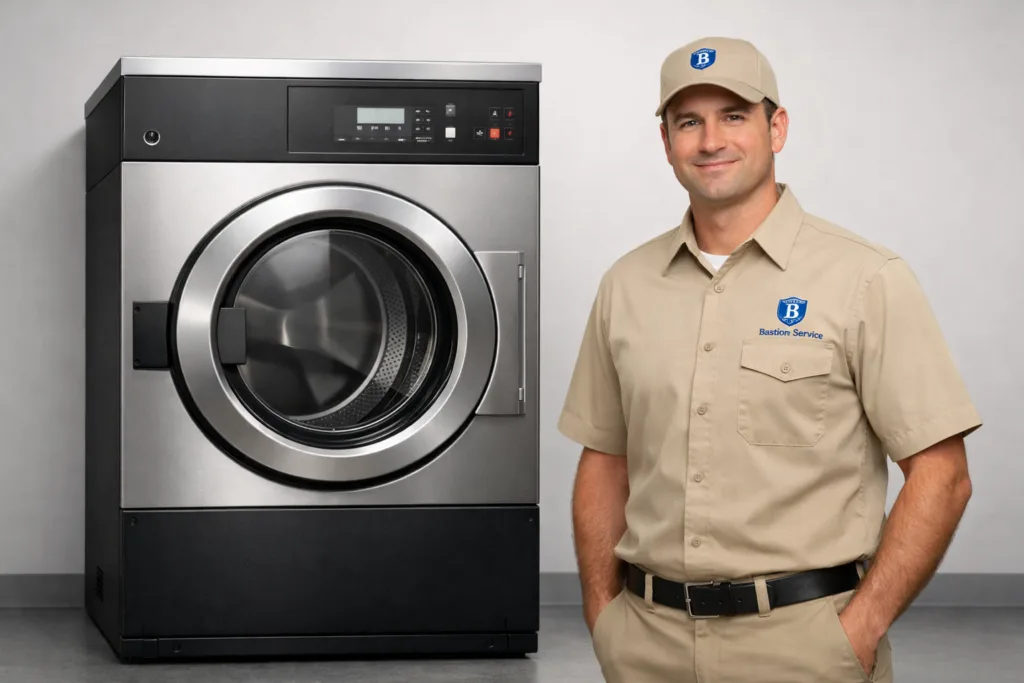




Dryer problems can interrupt laundry flow fast when loads start coming out damp, cycles run too long, or a unit stops before finishing. For businesses in Santa Monica, service is most useful when the repair process starts with the exact symptom pattern, the machine’s recent behavior, and how the issue is affecting daily operations. Bastion Service handles Speed Queen dryer repair with attention to heat performance, airflow, drum movement, controls, and the wear points that often cause repeat downtime if they are overlooked.
Related commercial service paths in Santa Monica include Speed Queen Commercial Repair in Santa Monica, Commercial Dryer Repair in Santa Monica, and Speed Queen Washer Repair in Santa Monica.
Common Speed Queen dryer symptoms that need repair
No heat or low heat
If the drum turns but clothing or linens stay wet, the problem may involve the heating system, operating thermostat, igniter, gas valve function on gas models, high-limit safety components, or the control side of the machine. In other cases, the dryer is producing heat but cannot move air properly, which leads to weak drying performance and rising internal temperatures. What looks like a simple heating problem can quickly become an airflow and shutdown issue if the machine keeps running under strain.
Long dry times and incomplete cycles
When a Speed Queen dryer begins taking much longer than normal, it often points to restricted exhaust, blower trouble, moisture-sensing issues, or temperature regulation problems. Loads may finish unevenly, or the cycle may end with damp sections that require another run. In a business setting, that reduces throughput, ties up staff, and creates delays that spread to the rest of the laundry process.
Drum not turning
A dryer that powers on but does not tumble may have a broken belt, a failed idler assembly, worn support rollers, motor trouble, or a door-switch problem. Sometimes the drum starts slowly, binds under weight, or stops after a few minutes, which can indicate drag from worn mechanical parts or a motor that is overheating. Continued operation in this condition can increase damage to related components.
Shuts down during operation
If the machine starts normally and then cuts off before the cycle is complete, overheating is a common cause. Restricted airflow, a weak motor, failing safety devices, or control problems can all trigger shutdown behavior. This is one of the more important symptoms to address promptly because repeated interruptions usually mean the dryer is no longer operating within normal temperature or load conditions.
Noise, vibration, or burning smell
Squealing, thumping, scraping, and rumbling usually come from worn rollers, glides, bearings, pulleys, or blower parts. Vibration can also point to imbalance, drum support wear, or mounting issues. A burning smell deserves immediate attention because it may indicate lint buildup, slipping components, overheating electrical parts, or friction from failed drum supports.
Why a Speed Queen dryer may not heat or finish the cycle
Two of the most common complaints are “it is not heating” and “it runs but never seems to finish properly.” On Speed Queen dryers, those complaints can come from several different causes that need to be separated before a repair decision is made.
- Airflow restriction: Poor exhaust movement traps heat inside the cabinet and reduces drying efficiency.
- Heating component failure: Elements, igniters, valves, or related parts may stop producing proper heat.
- Temperature control issues: Thermostats, sensors, or safety devices may interrupt normal heat cycling.
- Control problems: The unit may fail to command heat correctly or end cycles at the wrong time.
- Drive-system drag: If the drum or motor is under stress, overall performance can drop even when heat is present.
Because several failures can produce similar results, diagnosis matters more than replacing parts based only on the first symptom.
What technicians look at during diagnosis
A useful service visit for a Speed Queen dryer in Santa Monica should do more than confirm that the machine is “not working.” It should narrow the problem to the failed part, the operating condition causing the failure, or the wear pattern behind repeat issues.
That evaluation often includes:
- Heat production and temperature behavior
- Airflow through the dryer and exhaust path
- Drum rotation, belt condition, and support wear
- Motor performance under load
- Door-switch and safety-device operation
- Control response and cycle behavior
- Signs of overheating, lint accumulation, or electrical stress
This approach helps separate an isolated repair from a larger reliability problem that could bring the machine back down again soon.
How airflow problems affect drying performance
Airflow issues are especially important because they can imitate other failures. A dryer with restricted venting may still generate heat, but the hot air cannot move moisture out efficiently. The result is long dry times, damp loads, hotter cabinet temperatures, nuisance shutdowns, and added strain on heating parts and motors.
For businesses in Santa Monica, airflow-related problems can quietly reduce capacity before the machine fails completely. If staff are rerunning loads, noticing unusual heat around the unit, or seeing repeated cycle extension, the problem may already be affecting both performance and component life.
When drum noise points to a bigger repair
Not every noisy dryer is close to complete failure, but certain sounds usually mean the machine should be inspected before normal use continues. A high-pitched squeal can indicate roller or pulley wear. A thump may suggest a flat spot, worn support part, or drum issue. Scraping can mean metal contact where supports have deteriorated. As these parts wear down, the motor works harder and the chance of a second failure increases.
If the dryer is still running but has become noticeably louder, that is often the best time to repair it. Waiting until the drum stops turning entirely can turn a smaller mechanical repair into a larger one.
Signs the problem is affecting operations, not just one machine
Dryer issues often show up in workflow before they appear as a full breakdown. In hotels, laundromats, salons, fitness facilities, and other laundry-dependent businesses, the warning signs may include:
- Staff rerunning loads to reach normal dryness
- Backlogs forming during busy periods
- Heat-related shutdowns during consecutive cycles
- Rising complaints about turnaround time
- Unusual odors or sounds that return after resets
When these patterns start, repair scheduling becomes less about convenience and more about protecting uptime.
Repair or replacement: how to evaluate the next step
Repair is often the right move when the fault is limited to a heating part, drive component, control issue, or airflow-related correction and the dryer remains structurally sound. If the cabinet, drum supports, motor system, and controls all show extensive wear, replacement may deserve discussion instead of repeated service calls.
The decision usually depends on the unit’s age, service history, severity of the current failure, and the risk of additional downtime after the immediate repair. A symptom-based evaluation helps businesses in Santa Monica decide whether the machine is a good candidate for continued service or whether costs are starting to stack up around an aging unit.
When to schedule service promptly
It makes sense to schedule repair as soon as a Speed Queen dryer shows any of the following:
- No heat or weak heat
- Repeated long cycles
- Drum not turning
- Stopping mid-cycle
- Breaker trips or power interruptions at startup
- Burning smells
- Loud mechanical noise or vibration
- Control problems or inconsistent cycle completion
These symptoms tend to get worse with continued use, especially when the machine is handling frequent daily loads.
For businesses in Santa Monica, the most effective next step is to schedule service around the actual dryer behavior rather than wait for a full shutdown. A thorough inspection can identify whether the issue is isolated, whether related wear needs attention, and what repair path makes the most operational sense for your Speed Queen dryer.