
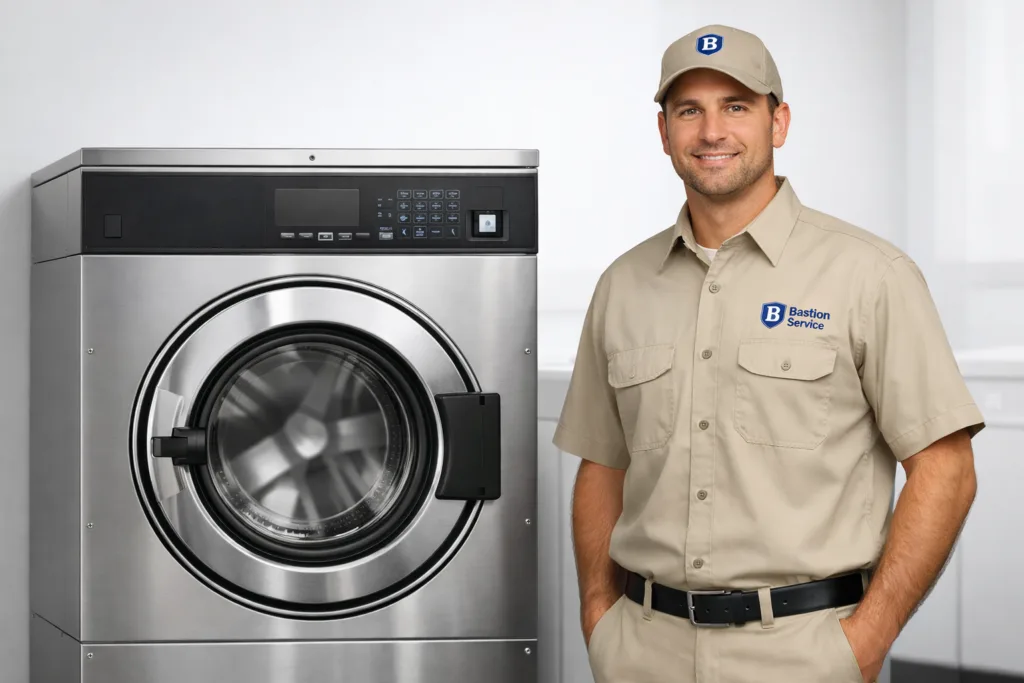




When Speed Queen laundry equipment starts causing missed turns, backed-up loads, or inconsistent cycle completion, the right next step is to have the symptom pattern evaluated before more machines, staff time, and production are affected. For laundromats, shared laundry rooms, hotels, and other businesses in Santa Monica, repair scheduling is usually driven by one question: what is actually failing, and how quickly can normal washer and dryer flow be restored?
For specific equipment paths in Santa Monica, review Speed Queen Washer Repair in Santa Monica, Speed Queen Dryer Repair in Santa Monica, and Commercial Appliance Repair in Santa Monica.
Bastion Service helps businesses identify whether a Speed Queen problem points to drainage trouble, heating loss, control failure, mechanical wear, airflow restriction, or an electrical issue that makes the machine unreliable in daily use. That matters because similar complaints can come from very different causes, and the best repair decision depends on what the equipment is doing under real operating conditions.
How laundry equipment problems disrupt business operations
Washer and dryer issues rarely stay isolated for long. One machine that leaks, overheats, fails to drain, or stops mid-cycle can slow load turnover, create staff workarounds, and put more strain on the remaining units. In busy settings, even a partial loss of performance can matter as much as a complete breakdown.
Service is often worth scheduling once equipment starts showing repeat symptoms instead of waiting for total failure. Machines that need manual restarting, produce uneven results, or only work on selected settings are already showing that something is wrong. Continued use in that condition can lead to additional part damage, safety concerns, or harder-to-manage downtime.
Speed Queen washer symptoms that usually require repair attention
Washer will not start or stops before the cycle finishes
If a washer will not begin a cycle, pauses unexpectedly, or shuts down before completion, the problem may involve controls, power input, door or lid lock components, sensors, or internal drive-related faults. In a business setting, repeated attempts to restart the unit usually do not solve the underlying issue. A diagnosis helps determine whether the machine can return to service quickly or should remain offline until repairs are completed.
Slow draining, standing water, or incomplete extraction
Water left in the machine after a cycle often points to a blocked drain path, pump trouble, sensor issues, or a control problem that prevents proper drain operation. Slow drainage also affects load turnover and can leave laundry too wet for efficient drying. If staff are seeing standing water, delayed draining, or recurring wet-load complaints, repair should be scheduled before the washer is put back into normal rotation.
Excessive vibration, banging, or unusual noise
Hard shaking, knocking, scraping, or grinding can indicate worn suspension parts, bearing wear, drive issues, imbalance conditions, or mounting problems. These symptoms are important because they often get worse with continued operation. What begins as vibration can turn into larger mechanical damage if the machine continues running under full load.
Leaks around the washer
Water on the floor may come from hoses, seals, valves, pumps, drains, or internal water path problems. In a laundry room, leaks are more than a nuisance. They can affect safety, nearby equipment, and daily workflow. Repair evaluation helps determine whether the source is a connection issue, a failed component, or a deeper internal problem that requires parts replacement.
Speed Queen dryer symptoms that reduce throughput
Dryer runs but produces little or no heat
A dryer that tumbles without proper heat slows output immediately. The cause may involve heating components, temperature controls, electrical supply issues, airflow restriction, or failed sensors. Because poor heat performance increases cycle time and labor handling, it is usually best to schedule service when heat loss first becomes consistent rather than waiting until the dryer stops working entirely.
Long dry times and repeated damp loads
When loads take longer than normal to dry, the issue is often tied to airflow, venting, heating performance, or temperature regulation. Extended run times lower capacity and can place extra strain on the machine. If staff are rerunning loads or adjusting expectations around one dryer, that is a strong sign the equipment needs repair evaluation.
Dryer stops early, overheats, or does not rotate normally
If the drum does not turn properly, the cycle ends too soon, or the cabinet becomes unusually hot, the dryer should be checked before continued use. These symptoms may be related to belt failure, motor problems, safety cutoff activation, control issues, or restricted airflow. Running the dryer in that condition can increase wear and create avoidable downtime.
Burning smells, squealing, thumping, or scraping
Unusual sounds and odors are signs that the dryer should be inspected promptly. Worn support components, drive-related wear, overheating, and lint-related airflow problems can all produce these warning signs. In many cases, taking the unit out of service early helps prevent a more serious outage.
What Speed Queen laundry equipment problems do you troubleshoot?
Businesses commonly schedule repair for symptom patterns such as:
- Washers that will not start, lock, fill, drain, spin, or complete a cycle
- Washers with leaks, standing water, vibration, banging, or repeated shutdowns
- Dryers with no heat, weak heat, long run times, overheating, or early shutoff
- Dryers with drum rotation problems, noise, burning smells, or inconsistent drying results
- Equipment that trips breakers, shows intermittent operation, or performs differently from shift to shift
This kind of troubleshooting is important because the visible symptom is not always the failed part. A washer that will not drain may also have control-related issues. A dryer with long dry times may be dealing with both airflow and heating faults. The goal of service is to identify the real cause and determine the repair path that best supports uptime.
When repair should be scheduled without delay
Some conditions should not be left to routine observation. Prompt service is the better choice when a unit is leaking, overheating, making severe noise, stopping unpredictably, failing to complete basic cycles, or creating a bottleneck that affects the rest of the laundry line.
It is also smart to move quickly when:
- The same problem is happening across multiple loads
- Staff are manually monitoring a machine to get acceptable results
- Drying performance is causing turnaround delays
- Vibration or noise has become more intense
- One washer or dryer being down is pushing too much demand onto the remaining equipment
Early action can prevent a manageable repair from turning into a larger outage, especially when motors, pumps, heating parts, and support components are operating under stress.
Repair versus replacement considerations
For many Santa Monica businesses, the decision is not only whether the machine can be repaired, but whether repair still makes operational sense. That usually depends on the age of the unit, the severity of the current failure, repeat service history, overall condition, and how important that machine is to daily capacity.
Repair is often the better choice when the problem is limited to serviceable parts and the equipment is otherwise in solid working condition. Replacement becomes a stronger consideration when the machine has repeated major failures, multiple systems are wearing out at once, or the risk of continued downtime is too high for the role that unit plays in daily operations.
What a service visit helps clarify
A repair appointment is not just about identifying a bad part. It helps answer whether the equipment should stay out of service, whether continued operation could worsen the damage, what type of repair is likely needed, and how the issue affects scheduling and load flow. For businesses that rely on consistent washer and dryer performance, those answers help with planning as much as they help with the repair itself.
If your Speed Queen washer or dryer in Santa Monica is showing leaks, drainage trouble, vibration, cycle failure, no-heat conditions, or long dry times, the practical next step is to schedule service and review the repair options before the problem spreads into wider downtime.


