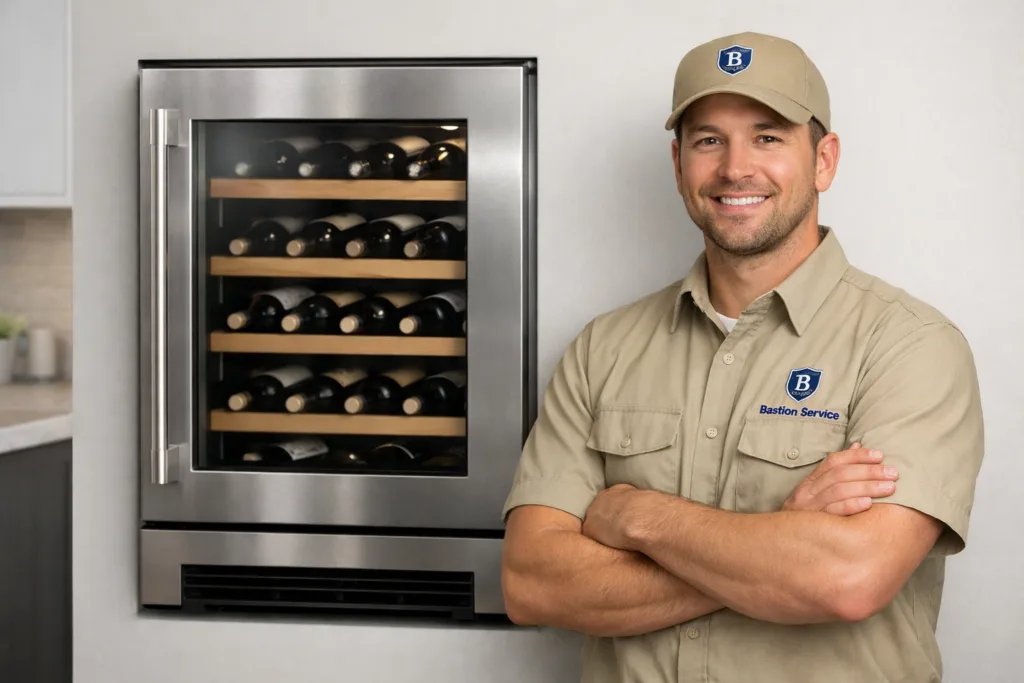
Small shifts in wine cooler performance can lead to bigger storage problems than many homeowners expect. A cabinet that runs a few degrees warm, develops moisture, or cycles strangely may still appear to be working, but unstable conditions can affect both the appliance and the bottles stored inside. With Perlick units, the most useful approach is to match the symptom to the likely system involved instead of assuming every cooling problem points to the same failed part.
Common Perlick wine cooler problems in El Segundo homes
Most service calls begin with one of a handful of complaints: the cooler is not holding temperature, it runs too often, it has become noisy, or water is showing up where it should not. These symptoms can overlap, which is why the pattern matters. Whether the issue is constant or intermittent, mild or severe, the details help narrow the repair path.
Temperature swings or poor cooling
If the cabinet feels warmer than the display suggests, or bottles are not staying at the intended serving or storage temperature, there are several possible causes. Airflow restrictions, evaporator or condenser fan problems, sensor faults, control issues, door seal leaks, or sealed-system performance loss can all produce similar results. A cooler that starts cold and then drifts upward later in the day may be dealing with a different issue than one that never reaches temperature at all.
Watch for a pattern such as warmer upper shelves, inconsistent cooling after the door is opened, or recovery that takes much longer than before. Those details can point toward airflow or circulation issues rather than a total refrigeration failure.
The unit runs constantly
A Perlick wine cooler that rarely shuts off is often compensating for lost efficiency somewhere in the system. Warm air may be entering through a worn gasket, heat may not be leaving the cabinet properly, or the controls may be reading temperature inaccurately. In other cases, the compressor is working harder because the refrigeration system is no longer performing as it should.
Constant running matters because it increases wear and raises the chance that a manageable problem turns into a more expensive one. If the unit runs almost nonstop and still struggles to cool, service is usually warranted.
Noise, vibration, or clicking
Not every sound means major failure, but a noticeable change in sound should not be ignored. Buzzing, rattling, clicking, humming that has grown louder, or vibration through cabinetry can come from loose mounting, fan blade interference, leveling issues, or a component under strain. A brief click at startup may be normal, while repeated clicking without proper cooling can suggest a harder-starting compressor or an electrical control problem.
If the sound is new, more frequent, or paired with cooling complaints, it is worth having the unit evaluated before the noise becomes a secondary symptom of a larger failure.
Condensation or water inside the cooler
Moisture can show up as droplets on shelves, damp labels, water near the door, or pooling beneath the unit. Common causes include door seal gaps, drainage issues, humidity management problems, or controls that are allowing the cabinet to operate outside its normal range. In some cases, repeated condensation is a sign that warm air is entering regularly even if the cooler still seems to be cooling.
Water issues should be addressed promptly, especially in finished kitchens, bars, or built-in spaces where moisture can affect surrounding surfaces.
Display or control problems
When the control panel does not respond correctly, shows an inaccurate temperature, or behaves erratically, the problem may be with the interface itself, the sensor input, or the control board interpreting cabinet conditions incorrectly. A display problem is not always cosmetic. If the controls are giving false information, the wine cooler may cool too much, too little, or cycle at the wrong times.
How symptom patterns help narrow the cause
Wine cooler problems are easier to solve when the behavior is described clearly. For example, “not cooling” can mean several very different things:
- The cabinet is slightly warm but still running
- The display shows the set temperature, but the interior does not match it
- The unit cools at night but struggles during the day
- The cooler runs, clicks, or hums but never gets cold enough
- Only one area of the cabinet seems affected
Those differences matter because they point toward different systems: airflow, controls, door sealing, defrost-related moisture issues, fans, or refrigeration components. Accurate diagnosis saves time and helps avoid replacing parts that do not address the actual failure.
Checks homeowners can make before scheduling repair
Before arranging service, a few basic observations can be helpful:
- Make sure the door closes fully and the gasket sits evenly all around
- Confirm bottles, shelves, or liners are not blocking interior airflow
- Check whether the temperature setting was changed accidentally
- Listen for fan noise, repeated clicking, or unusual vibration
- Look for visible condensation, frost, or water accumulation
- Note whether the problem is constant or comes and goes
These checks do not replace service, but they do help clarify whether the issue appears minor, environmental, or tied to a mechanical or control fault.
When repair is usually worth considering
Many Perlick wine cooler issues are repairable when they involve components such as fans, controls, sensors, door seals, drainage-related parts, or isolated electrical faults. If the cabinet is otherwise in good condition and the cooler has been performing well up to this point, a targeted repair may restore normal operation without much disruption.
Repair tends to make less sense when there is major sealed-system trouble, repeated breakdown history, or overall wear that suggests reliability will remain poor even after the immediate issue is fixed. The deciding factor is rarely just age by itself. What matters more is the exact failed component, the condition of the rest of the unit, and whether stable performance is likely after service.
Signs you should not wait
It is best to schedule service sooner if you notice any of the following:
- The cabinet is running warm enough to put wine at risk
- The compressor seems to run almost constantly
- There is repeated clicking, buzzing, or new vibration
- Condensation or leaking keeps returning
- The display is inaccurate or unresponsive
- The cooler has stopped recovering after normal door openings
Even if the appliance is still partially cooling, unstable operation usually does not improve on its own. Continued use under strain can turn a smaller repair into a larger one.
What homeowners in El Segundo usually want to know
In most cases, the practical questions are straightforward: what is actually causing the problem, can the unit be repaired reliably, and is the cost justified by the condition of the appliance? Those answers depend on testing the cooler as a system rather than treating every warm cabinet as a compressor issue or every leak as a simple gasket problem.
For households in El Segundo, that means looking closely at temperature behavior, airflow, control response, moisture patterns, and operating sounds before deciding on the next step. A wine cooler is meant to maintain stable storage conditions, so precision matters more than trial-and-error part replacement.
What effective service should focus on
Good service should be centered on the real complaint inside the home: unstable temperature, noise, condensation, control trouble, or loss of cooling. From there, the repair plan should address the specific fault and the overall condition of the unit, not just the most obvious symptom. When that happens, homeowners get a much better basis for deciding whether repair is the right investment or whether replacement deserves consideration.
If your Perlick wine cooler has started behaving differently, paying attention early often gives you more options and a better chance of restoring dependable performance.