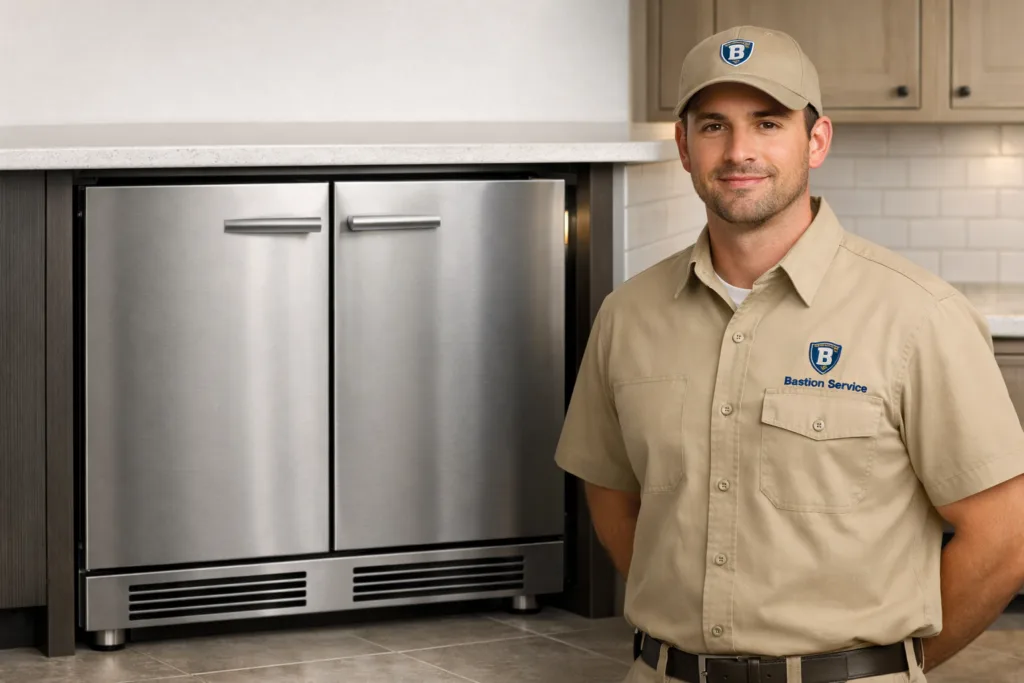
A Perlick refrigerator that starts running warm, leaking, frosting up, or cycling strangely can disrupt everyday kitchen use quickly. The most useful next step is to match the symptom pattern to the likely system involved, because the same cooling complaint can come from airflow trouble, controls, door sealing issues, or a more serious refrigeration fault.
What common symptoms usually point to
Food is not staying cold
If the cabinet feels cool but not cold enough, the problem may involve restricted airflow, dirty condenser components, a failing evaporator fan, a weak start device, or temperature sensing and control issues. When the refrigerator runs for long stretches without reaching the set temperature, that often means it is working harder than it should and needs testing rather than trial-and-error part replacement.
Fresh food is freezing
Freezing in the fresh-food section usually means cold air is not being regulated correctly. A sensor, thermostat, control board, or damper-related issue can cause certain shelves or drawers to become much colder than expected. This symptom is easy to dismiss at first, but it often signals that the unit is no longer cycling normally.
Water under or inside the refrigerator
Leaks can come from a blocked defrost drain, excess condensation, poor door sealing, or an internal temperature imbalance. In a home kitchen, even a small recurring leak can affect flooring, trim, or nearby cabinetry. If you are wiping up water more than once, the issue is usually active rather than incidental.
Frost keeps returning
Frost buildup often points to warm air entering the cabinet, a gasket issue, a defrost problem, or weak internal air circulation. Once frost begins to interfere with normal airflow, temperatures can swing and the refrigerator may start running much longer to compensate.
Clicking, buzzing, rattling, or fan noise
Some refrigerator sounds are harmless, but new or repetitive noise deserves attention when it appears with poor cooling or longer run times. Buzzing at startup can suggest a compressor starting problem, while scraping or uneven fan noise may indicate ice interference or a failing motor.
Simple checks homeowners can make first
Before scheduling service, it helps to rule out a few basic conditions that can mimic a larger failure:
- Make sure the door is closing fully and not being blocked by bins or stored items.
- Check whether the gasket looks loose, torn, or dirty enough to prevent a full seal.
- Confirm that food containers are not blocking interior vents.
- Look for heavy frost that may be restricting air movement.
- Notice whether the refrigerator is running constantly or only failing intermittently.
If these checks do not change the behavior, the next step is usually a component-level diagnosis.
Why symptom patterns matter on a Perlick refrigerator
A warm cabinet does not always mean a compressor problem, and frost does not always mean the same failed part. Symptom timing is often the clue. For example, a unit that cools well in the morning and struggles later may be dealing with airflow or control issues, while a refrigerator that clicks repeatedly and never settles into normal operation may have a startup or compressor-side fault.
This is why Perlick refrigerator repair in Venice is most effective when the unit is evaluated based on what it is actually doing day to day. The goal is not just to confirm that cooling is weak, but to identify why the cooling process is breaking down.
Signs the problem may be getting worse
Some refrigerators decline gradually. Others give short periods of normal cooling before failing again. Watch for these signs that the issue is progressing:
- Food spoilage happens even after temperature adjustments.
- The refrigerator runs almost nonstop.
- Frost returns soon after being cleared.
- Leaks become more frequent or spread beyond the appliance footprint.
- Noise becomes louder, more frequent, or happens at the same point in each cycle.
Intermittent recovery does not usually mean the problem is gone. It often means a part is weakening or a system is losing consistency.
When continued use can create added damage
If the refrigerator is not maintaining safe temperatures, continued use can strain other components while still failing to protect stored food. A unit that runs constantly may place extra wear on motors and compressor-related parts. Heavy frost can choke airflow and force the refrigerator to overwork. Ongoing leaks can damage nearby flooring and cabinets. When cooling is clearly unstable, reducing use until the problem is checked is often the better choice.
Repair or replacement: how the decision usually gets made
Many refrigerator problems still make sense to repair, especially when the issue involves a fan, sensor, control, drain, gasket, or startup component and the overall condition of the appliance is good. Replacement becomes a more serious consideration when the diagnosis points to major sealed-system trouble, repeated high-cost breakdowns, or a repair path that no longer fits the age and condition of the unit.
For most homeowners in Venice, the decision comes down to three practical questions:
- What failed and how extensive is the repair?
- Is the refrigerator otherwise in solid condition?
- Will the repair restore reliable performance without leading into another major issue soon after?
What to schedule service for right away
Prompt service is usually the right move when the refrigerator is warm enough to affect food safety, leaking repeatedly, building heavy frost, or making new noises while cooling poorly. It is also worth scheduling service when the appliance seems to correct itself for a short time and then slips back into the same problem.
For households in Venice, the most helpful approach is to treat the symptom pattern as useful information, not as proof of one specific failed part. That keeps the repair path focused, reduces unnecessary parts swapping, and makes it easier to decide whether the refrigerator is a good candidate for continued service.