



Monogram appliances are built for high daily use, but even premium models usually show warning signs before they stop working completely. Paying attention to those signs can help prevent food loss, interrupted meals, water damage, or an appliance that becomes harder to repair after continued use.
For specific Monogram appliance paths in Pico-Robertson, review Monogram Refrigerator Repair in Pico-Robertson, Monogram Freezer Repair in Pico-Robertson, and Monogram Wine Cooler Repair in Pico-Robertson.
Start with the symptom, not the part
The same appliance behavior can come from several different faults. A refrigerator that seems warm may have an airflow problem, a defrost issue, a failing fan, a control fault, or a sealed-system concern. A dishwasher that leaves dishes dirty might have a wash circulation problem, low water fill, spray arm blockage, or heating trouble. Replacing parts too early can waste time and money if the root cause has not been narrowed down first.
For homeowners in Pico-Robertson, symptom-based diagnosis is especially important with built-in Monogram products, where access, fit, and repair planning can be different from standard freestanding appliances.
Common Monogram refrigerator and freezer issues
Cooling problems usually need the fastest attention. If a Monogram refrigerator is running constantly, not holding temperature, building frost, leaking water, or making new noises, the issue may involve airflow restrictions, evaporator or condenser fans, defrost components, sensors, door sealing, or drainage. A freezer with soft food or heavy frost should also be checked promptly, since cooling performance often declines further once the first symptoms appear.
Some refrigerator problems seem minor at first but become more expensive if ignored. A small drainage issue can turn into repeated leaking. A defrost problem can restrict airflow and reduce cooling. A fan noise that starts occasionally can turn into a full no-cool complaint if the failing part stops completely.
Signs the refrigerator problem may be urgent
- Fresh food compartment feels warm even when settings are correct
- Freezer items are soft or partially thawing
- Water is collecting under drawers or on the floor
- Clicking, buzzing, or loud fan noise is new and persistent
- The unit runs almost nonstop but temperatures still rise
Dishwasher symptoms that deserve closer attention
A Monogram dishwasher may still finish a cycle while not actually washing or draining correctly. Homeowners often first notice cloudy glasses, food residue, standing water, leaks, or unusual sounds. Those symptoms can point to different parts of the machine, including circulation components, drain restrictions, float or fill issues, door seals, sump components, or heating-related faults.
Leaks are one of the most important signs not to ignore. Water escaping from a dishwasher can affect flooring, cabinet edges, and the area beneath the unit. If the machine is leaving water behind after each cycle, repeated use may also strain the drain system or allow odor problems to develop.
Typical dishwasher complaint patterns
- Not cleaning well: often related to wash pressure, spray arm blockage, detergent use, or water heating
- Not draining: may involve a clog, drain pump issue, hose problem, or installation-related restriction
- Leaking: commonly tied to seals, hose connections, inlet parts, or sump areas
- Noisy operation: can suggest pump wear, motor issues, or loose internal components
Cooktop and range problems often show up in daily cooking
Monogram cooktops and ranges usually reveal trouble through burner performance. On gas models, homeowners may notice repeated clicking, slow ignition, uneven flame, or a burner that lights inconsistently. On electric models, a surface element may heat unevenly, fail to cycle properly, or stop responding at certain settings. Some issues are isolated to one burner, while others point to switches, ignition parts, controls, or wiring concerns.
Ranges can also combine surface cooking symptoms with oven performance problems. If both functions begin acting unpredictably, it may be a sign that the issue is broader than one single component.
If there is a strong gas odor around a Monogram gas appliance, stop using it and address the gas safety concern first before scheduling appliance repair. Repeated clicking without a gas smell is more often an ignition-related fault, but it should still be inspected before regular use continues.
Oven and wall oven performance issues
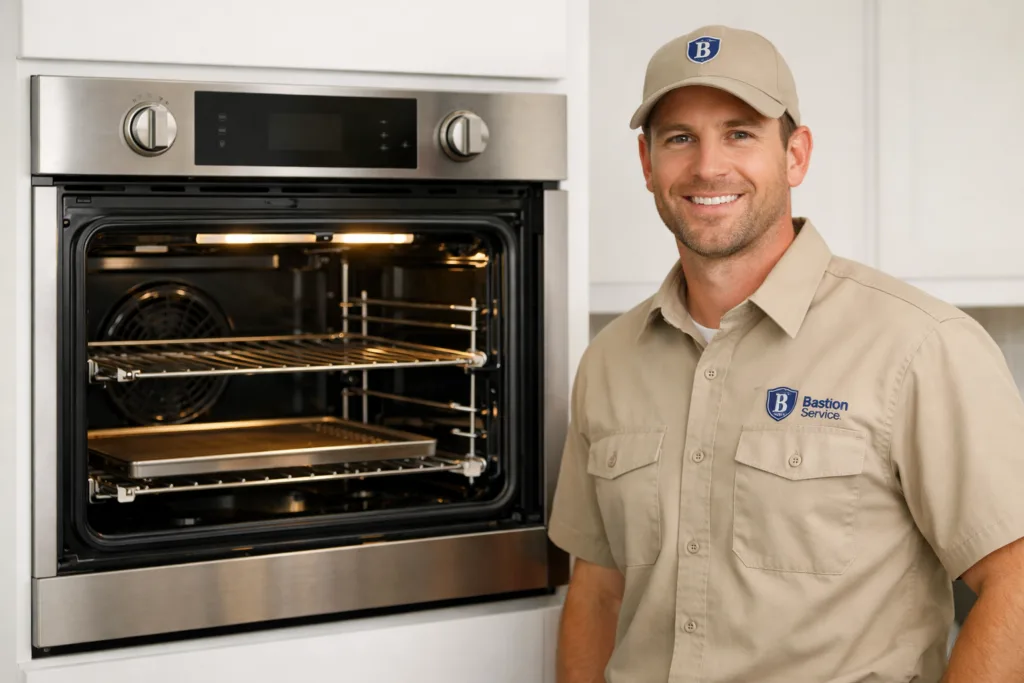
Uneven baking, long preheat times, temperature drift, error codes, and doors that do not close correctly are all common oven complaints. In Monogram ovens and wall ovens, these symptoms may relate to heating elements, igniters, temperature sensors, control boards, relays, door hardware, or latch systems. Because many of these faults overlap, the symptom pattern matters more than the first guess.
For example, an oven that eventually reaches temperature but takes far too long may not have the same issue as one that overheats and burns food. One may point to weak heating performance; the other may suggest sensing or regulation problems. Both feel like “temperature issues,” but the repair path can be very different.
Oven symptoms that should not be ignored
- Preheat takes much longer than usual
- Food browns unevenly on different racks
- The oven shuts off unexpectedly during cooking
- The display shows recurring error codes
- The appliance overheats or does not regulate temperature correctly
Wine cooler problems are usually about stability
Monogram wine coolers often develop problems gradually. Instead of failing all at once, they may begin with mild temperature fluctuation, fan noise, condensation, or a door that no longer seals tightly. These issues can affect storage conditions long before the unit stops cooling entirely.
Because wine storage depends on consistency, small changes matter. A unit that cycles oddly or struggles to hold a steady setting may need attention before the problem becomes a complete cooling failure.
What certain symptom groups can indicate
While inspection is still necessary for an exact answer, these patterns are often useful when deciding how urgent the issue may be:
- No power or intermittent power: outlet, breaker, wiring, fuse, user interface, or main control problems
- Water on the floor: drains, hoses, seals, valves, or defrost drainage faults
- New grinding, buzzing, or rattling noises: pumps, fans, motors, compressors, or loose internal parts
- Poor heating: elements, igniters, thermostatic control, sensors, or relays
- Poor cooling: airflow restriction, fan failure, defrost trouble, sensor faults, or sealed-system issues
- Error codes: a stored fault pattern that needs to be matched to the real-world symptom, not treated as the diagnosis by itself
When waiting can make the repair worse
Some appliance issues can be monitored briefly, but others tend to spread damage if the unit keeps running. A leaking dishwasher can affect nearby finishes. A refrigerator with blocked airflow or a defrost failure can place more strain on cooling components. An oven with a weak igniter or failing element may become unreliable at exactly the wrong time. A cooktop that only lights after repeated attempts should not be treated as normal wear.
Repeated breaker trips, burning smells, persistent leaks, erratic controls, and sudden changes in temperature performance are all signs to schedule service sooner rather than later.
Repair or replace?
Many Monogram appliances remain good repair candidates when the problem is isolated and the rest of the unit is in solid condition. That is often true for failed igniters, sensors, pumps, fans, seals, drain components, and other single-system faults. Replacement becomes more likely when there are repeated major failures, severe cooling-system issues, widespread electronic damage, or repair costs that no longer make sense compared with the condition of the appliance.
Built-in products deserve a little extra thought before replacement. Matching size, finish, alignment, and installation constraints can make repair the more practical option when the fault is repairable and the appliance has otherwise been performing well.
What homeowners in Pico-Robertson should watch for
The most useful approach is to notice changes early: longer run times, inconsistent temperatures, standing water, unusual noise, slow ignition, or controls that behave differently than usual. Those details help narrow the fault faster and make it easier to decide whether the appliance can continue in temporary use or should be stopped and inspected.
For Monogram refrigerator, dishwasher, cooktop, oven, range, wall oven, freezer, and wine cooler problems in Pico-Robertson, the strongest next step is to match the repair decision to the actual symptom pattern instead of assuming every failure has the same cause.