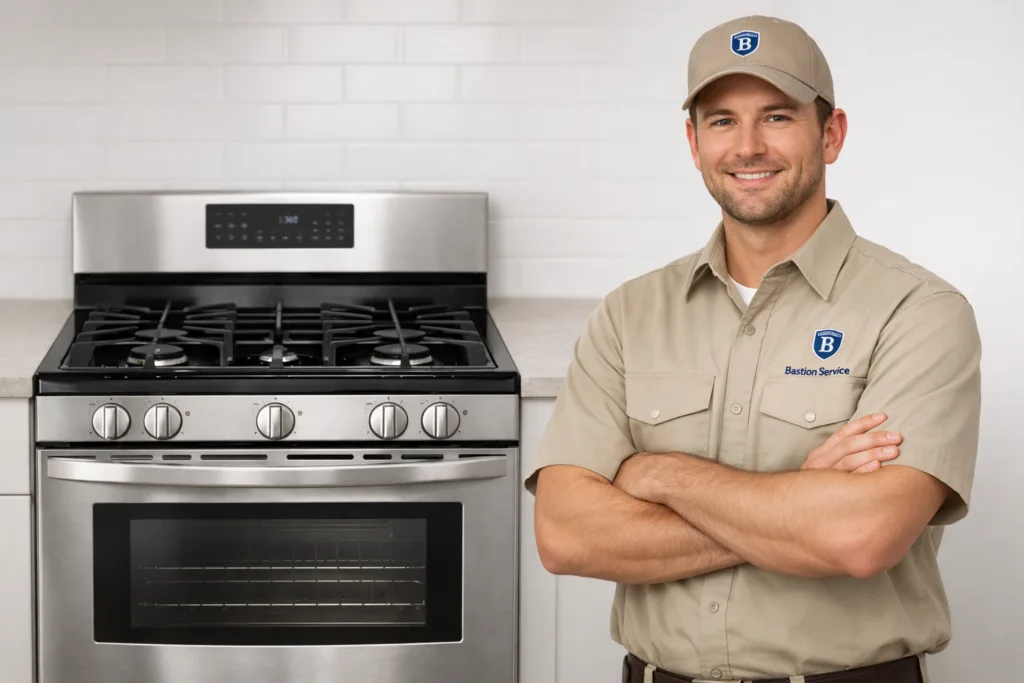
Cooking problems rarely start with a completely dead appliance. More often, an LG range begins showing smaller warning signs first: a burner that clicks longer than usual, an oven that seems slow to preheat, or temperatures that no longer match what the display says. Paying attention to those early symptoms can help prevent a more disruptive breakdown.
Common LG range symptoms homeowners notice
Most range issues fall into a few recognizable categories. Looking at the symptom pattern makes it easier to understand whether the problem is likely related to ignition, heating, temperature sensing, controls, or power supply.
Burners that click but do not light
On gas LG ranges, repeated clicking without ignition often points to a burner cap alignment problem, clogged burner ports, moisture around the igniter, or a spark ignition fault. Sometimes the burner will eventually light after several clicks, which can make the problem seem minor, but delayed ignition is still worth addressing. A burner should light reliably and produce a steady flame without hesitation.
If only one burner is affected, the issue may be isolated to that burner assembly. If multiple burners are behaving the same way, the diagnosis may need to include the spark system, wiring, or related control components.
Weak flame or uneven heating on the cooktop
A burner that lights but does not heat properly can make everyday cooking frustrating. Low flame, uneven flame spread, or poor heat transfer can result from blocked burner openings, burner head issues, or gas flow problems within the appliance. In practical terms, this shows up as longer cook times, pans heating unevenly, and difficulty maintaining a steady simmer.
Oven not reaching temperature
If the oven takes too long to preheat or never seems to get fully hot, likely causes can include a failing igniter on gas models, a weak bake element on electric models, a temperature sensor issue, or a control problem. This symptom often appears first with baking, where food comes out underdone or requires longer than expected cooking time.
Homeowners sometimes notice this before seeing any error code. The oven still turns on, but performance is inconsistent enough to affect results.
Oven heating, but not evenly
Uneven cooking is a common complaint when one part of the oven system is not working correctly. Food may brown too much on one side, the top may cook faster than the bottom, or different racks may produce very different results. This can happen when the bake or broil circuit is not operating as intended, when the temperature sensor is reading inaccurately, or when airflow inside the oven is compromised.
Range display or keypad problems
An unresponsive control panel, flickering display, clock resets, or settings that do not register correctly can point to electronic control trouble. These faults can affect both convenience and function. In some cases, the range may still heat, but the user cannot select the correct mode or temperature with confidence.
Electric burners stuck on high
On electric LG range configurations, a surface element that stays too hot even on a lower setting usually indicates a failed infinite switch or another control-related fault. This is not just a cooking annoyance. It can overheat cookware, burn food quickly, and create an unsafe situation if the burner does not respond properly to setting changes.
What these symptoms usually mean
The same general complaint can come from more than one failing part. “The oven is not heating” might sound straightforward, but the actual cause may be different depending on the model and fuel type. A gas oven may have an igniter issue, while an electric oven may have a failed bake element. If the heat seems present but inaccurate, the sensor or control may be the better place to investigate.
That is why symptom-based diagnosis matters. It helps avoid replacing parts based only on guesswork and focuses attention on the system actually causing the problem.
Signs the problem should not be ignored
Some issues are more than performance problems and should be taken seriously right away. Stop using the range and have it checked if you notice:
- Persistent clicking after ignition should have stopped
- Burners that repeatedly fail to light
- Sparking that seems abnormal or continuous
- Electrical burning smells
- An oven that overheats well beyond the selected setting
- A burner that will not regulate heat properly
- Breaker trips associated with range use
If there is a strong or ongoing gas smell, discontinue use immediately and follow appropriate gas safety steps before arranging appliance service.
How LG range problems affect everyday cooking
Even when a range still technically works, reduced performance changes how usable it feels in a busy household. A weak burner can slow dinner preparation. A drifting oven temperature can ruin baked dishes. A faulty control panel can make it hard to use timed cooking features or set the correct mode. These are the kinds of problems that turn routine meal prep into trial and error.
In Manhattan Beach homes, many households rely on the range every day, so even a partial failure can become disruptive quickly. Addressing the problem early often helps keep the repair simpler than waiting until additional components are affected.
Repair or replace: how to think it through
Replacement is not automatically the right answer just because the range is acting up. In many cases, repair makes sense when the appliance is otherwise in solid condition and the failure is limited to a specific igniter, element, sensor, switch, or control-related component.
Replacement tends to become more reasonable when:
- Multiple systems are failing at the same time
- The same appliance has needed repeated major repairs
- The control system has extensive damage
- The overall condition of the range is poor
- The expected repair cost is too close to replacement value
A clear diagnosis helps separate a single repairable fault from a broader decline in appliance condition.
What a useful service visit should accomplish
A worthwhile appointment should do more than confirm that the range is malfunctioning. It should identify which function is failing, when the symptom appears, whether the problem is isolated or system-wide, and what repair path makes sense. That may include testing burner ignition, verifying oven heat performance, checking temperature response, and evaluating the control system.
From there, the next step should be easy to understand: repair the failed component, stop using the appliance until a safety-related issue is addressed, or consider replacement if the unit no longer justifies further work.
When to schedule LG range repair in Manhattan Beach
It is usually time to schedule service when normal cooking results are no longer dependable. That includes burners that do not ignite consistently, ovens that heat slowly or unevenly, controls that fail to respond, or any sign that the appliance is operating outside normal temperature behavior.
For homeowners in Manhattan Beach, the most helpful approach is to act when symptoms become repeatable rather than waiting for a complete failure. An early repair is often less disruptive than losing the range entirely during regular household use.