Range problems tend to interrupt the part of the day that is hardest to postpone. If an Amana range is clicking, heating unevenly, or struggling to preheat in Manhattan Beach, it helps to match the repair plan to the exact symptom instead of assuming every heating problem has the same cause. The same complaint can come from an igniter, element, sensor, switch, control, wiring issue, or even a burner part that is dirty or misaligned.
Start with the symptom, not the part
Homeowners usually notice range trouble in a few predictable ways: a burner will not light, an oven stays cold, the temperature feels off, or the control panel behaves erratically. Symptom-based diagnosis matters because replacing parts based on guesswork can waste time and money. On many Amana ranges, the difference between a simple repair and a more involved one comes down to identifying whether the fault is in the heating system, ignition path, control system, or power supply.
Surface burners that do not work correctly
If a surface burner will not heat at all, only works on certain settings, or takes too long to respond, the failure may be different depending on whether the range is gas or electric.
- Electric models: a bad surface element, damaged receptacle, failed infinite switch, or wiring problem can all produce similar symptoms.
- Gas models: repeated clicking, delayed ignition, weak flame, or no ignition may point to the spark system, burner cap alignment, clogged burner ports, or an igniter-related issue.
A burner that works intermittently is often especially frustrating because it can seem fine during one meal and fail during the next. That pattern often suggests a part that is weakening rather than fully failed.
Oven not heating, slow preheat, or uneven cooking
When the oven is the issue, the complaint is often broader than “it does not work.” Many ranges still produce some heat even when a critical part is failing. That can lead to undercooked food, scorched edges, long preheat times, or baking results that change from rack to rack.
Common possibilities include:
- a weak igniter on gas ovens
- a failed bake or broil element on electric ovens
- a temperature sensor reading incorrectly
- a control problem affecting heat regulation
- door seal or hinge issues allowing heat to escape
If food suddenly takes much longer than usual to cook, that often points to a heating system that is still operating, but not at full strength.
Clicking, sparking, or ignition trouble
Continuous clicking is one of the most common complaints on gas ranges. Sometimes it happens only after cleaning. In other cases, it starts during normal use and does not stop even when the burner is off. Moisture, debris around the burner head, a mispositioned cap, or a failing ignition component can all be involved.
If the burner clicks but does not light promptly, avoid repeated attempts to force ignition. Delayed lighting can create a more disruptive and potentially unsafe situation than a burner that simply stays off.
Display and control issues
An unresponsive keypad, flashing display, random shutoff, or error code can make the whole appliance feel unreliable. These symptoms are not always caused by the main control board itself. Depending on the model, the problem may involve the user interface, touchpad, wiring connections, terminal block, or another electrical fault that affects communication inside the range.
Intermittent control problems are worth addressing early because they can complicate temperature control and make the appliance difficult to trust during everyday cooking.
Signs the range should not keep being used
Some issues are inconvenient but stable for a short period. Others call for stopping use until the unit is checked. It is usually best to discontinue use if you notice:
- a strong gas odor
- arcing, sparking, or visible scorching
- a burner that ignites with a delay or uneven flame
- an oven that overheats or will not regulate temperature
- melting around knobs, wiring smells, or signs of overheating
- a door that will not close securely during operation
Problems that involve heat, ignition, or wiring tend to get more expensive if the range is pushed past the point where it is operating normally.
What often causes uneven performance
Not every cooking complaint means the entire appliance is failing. In many homes, the concern is inconsistent performance rather than a complete breakdown. A range may seem to work, but not well enough to rely on.
That can show up as:
- cookies browning more on one side
- burners cycling too hot or too cool
- pots taking longer than usual to boil
- broiling that is weak or irregular
- temperature settings that no longer match actual cooking results
These issues often trace back to a specific failed or drifting component rather than the age of the appliance alone.
Repair or replace?
Many Amana range problems are still worth repairing, especially when the fault is limited to a burner component, igniter, sensor, switch, heating element, or door-related part. Replacement becomes more reasonable when multiple major systems are failing at once, wiring damage is extensive, the control system has become uneconomical to repair, or the range has a long history of recurring problems.
For most Manhattan Beach households, the decision usually comes down to three things:
- the exact failed component and total repair scope
- the overall condition and age of the range
- whether the repair is likely to restore normal day-to-day reliability
A proper diagnosis makes that decision much easier because it separates an isolated fault from a broader decline in the appliance.
What to have ready before service
If service is being scheduled, a few details can speed up the process and help narrow the likely cause:
- whether the range is gas or electric
- which burner or oven function is failing
- whether the problem is constant or intermittent
- any recent cleaning, power outage, or unusual smell
- error codes or control behavior you have noticed
It also helps to note whether the problem started suddenly or became worse over time. That timeline can be useful when distinguishing between a part that failed outright and one that has been weakening gradually.
What homeowners in Manhattan Beach usually want to know
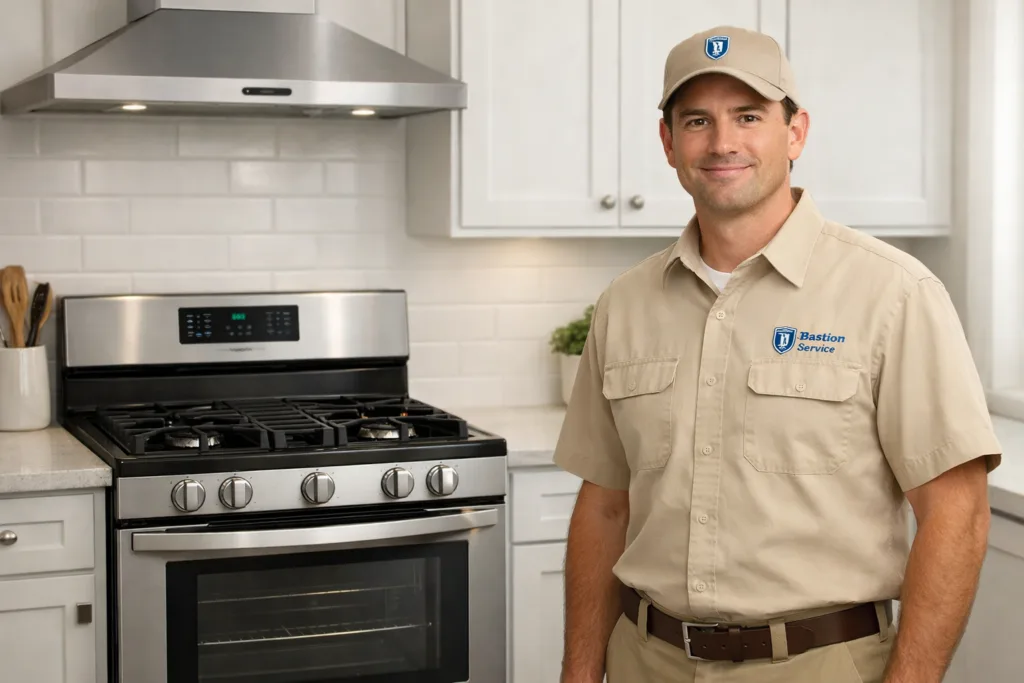
Most people are not looking for a technical deep dive. They want to know if the range is safe to use, what is actually wrong, and whether the repair makes financial sense. Bastion Service helps Manhattan Beach homeowners sort through those questions with diagnosis first and a repair recommendation based on the actual fault, appliance condition, and likely outcome.
If your Amana range is no longer heating, igniting, or regulating temperature the way it should, the next useful step is to have the symptom evaluated before a smaller issue turns into a bigger one.