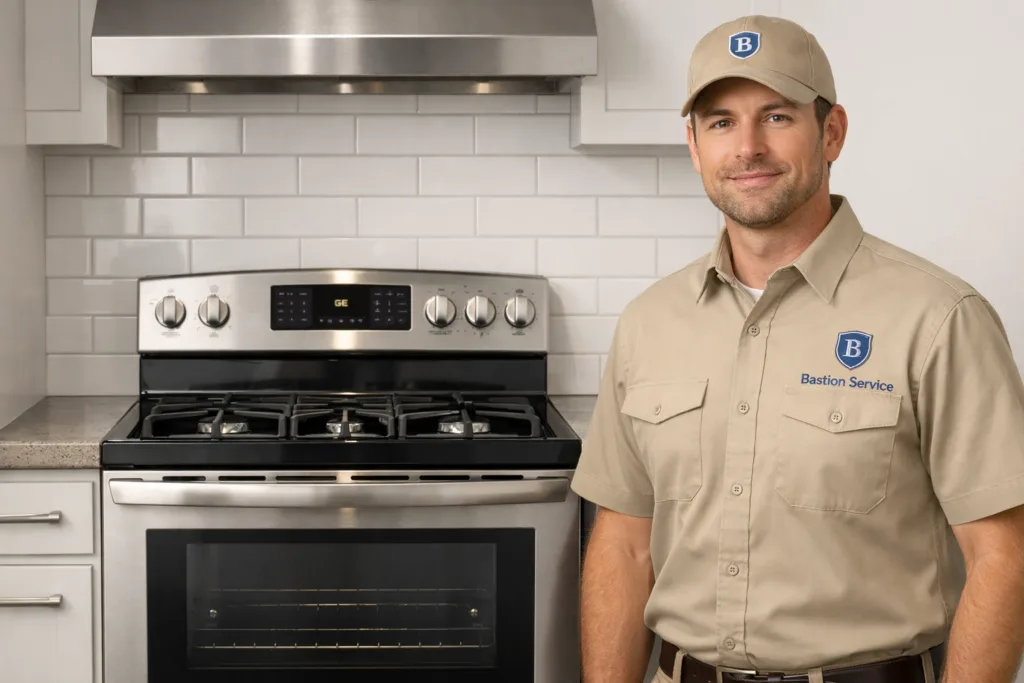
Range problems tend to show up in ways that disrupt everyday cooking fast: a burner that clicks without lighting, an oven that takes far too long to preheat, or temperatures that suddenly stop matching the setting on the display. With GE ranges, those symptoms can come from several different systems, so the most useful next step is to match the repair plan to the exact behavior of the appliance.
Common GE range problems in Hermosa Beach homes
Some faults affect only the cooktop, while others point to oven heating, controls, or incoming power. Paying attention to the pattern can help you decide whether the range is still safe to use temporarily or whether it should be checked before the problem spreads.
Burners that click but do not light
On gas models, repeated clicking usually means the ignition system is trying to light the burner but something is interrupting the process. That may be caused by moisture near the igniter, a misaligned burner cap, food debris around the burner head, a weak spark, or a fault in the ignition circuit. If one burner acts up while the others work normally, the issue may be isolated. If several burners have the same symptom, the problem may involve a shared component.
If you notice a persistent gas odor, stop using the range until the cause is addressed. A burner that lights only after several attempts is not something to ignore, especially if the behavior is getting worse.
Oven not heating or taking too long to preheat
When a GE oven stays cold or preheats very slowly, the cause may differ depending on whether the range is gas or electric. Gas ovens often depend on a properly functioning igniter to open the gas valve at the right time. Electric ovens may struggle because of a failed bake element, wiring issue, sensor problem, or control fault. In either case, slow preheating usually means the oven is not operating efficiently even if it eventually reaches temperature.
This often becomes noticeable during weeknight meals, baking, or any recipe where timing matters. If preheat has gone from normal to noticeably delayed, that change usually points to a part that is already weakening rather than a temporary glitch.
Food baking unevenly
Uneven cooking can show up as browned edges with a pale center, one side of a sheet pan cooking faster than the other, or dishes that need extra time even after the oven says it is ready. This may be related to temperature sensing, heating element performance, ignition strength, convection issues on equipped models, or control calibration.
Because uneven baking can happen before a complete failure, it is easy to put off service. But when the same familiar foods stop turning out correctly, the range is often giving an early warning that one heating component is no longer working as it should.
Temperature running too hot or too cool
If the oven reaches a temperature that does not match the setting, meals can burn on the outside or stay undercooked in the middle. Common causes include a drifting temperature sensor, control board issues, or a heating system that cycles incorrectly. Homeowners usually notice this first when recipes they make often suddenly need very different cook times.
Temperature problems are more than a convenience issue. They can affect food quality and make the range hard to trust for routine cooking.
Surface elements not heating correctly
On electric GE ranges, a burner that stays cold, heats unevenly, or works only on certain settings may have a failed element, a damaged receptacle, a bad infinite switch, or wiring trouble. On smooth-top models, an element can also appear to work but deliver weak or inconsistent heat. That can make boiling water slow and pan temperatures unpredictable.
If one element is much slower than the others or cycles erratically even on a steady setting, the problem usually will not improve on its own.
Display, keypad, or control problems
A blank screen, unresponsive keypad, beeping without input, or settings that change unexpectedly can point to user interface or main control trouble. Sometimes the issue is tied to the range itself, and sometimes it starts with power supply problems. Because modern ranges route multiple functions through the controls, these faults can affect baking, broiling, timers, and cooktop operation at the same time.
Why the same symptom can have different causes
A range that will not heat is not always dealing with the same failed part. One oven may need a sensor, another may need an igniter, and another may have a control or wiring problem. The same is true for clicking burners, weak elements, or intermittent operation. That is why symptom-based diagnosis matters before any repair decision is made.
It also helps avoid the common mistake of focusing on the first visible symptom without finding the underlying cause. Replacing the wrong part can leave the original problem unresolved and delay getting the range back to normal use.
Signs the range should not be used until it is checked
Some range issues are mainly inconvenient. Others raise enough safety or reliability concern that it is better to stop using the appliance and schedule service promptly. Watch for signs like these:
- A strong or recurring gas smell during ignition or after a burner fails to light.
- Sparking, breaker trips, or flickering power at the control panel.
- An oven that overheats, shuts off unexpectedly, or will not regulate temperature.
- Burners that keep clicking after ignition or fail repeatedly.
- Visible damage to an electric element, receptacle, or glass cooking surface.
- Error codes combined with loss of heating or unresponsive controls.
If the range still partly works, it can be tempting to keep using only the functions that seem normal. But intermittent faults often put extra strain on switches, controls, ignition parts, and heating components.
When repair usually makes sense
Many GE range problems are repairable when the appliance is otherwise in good condition and the issue is limited to one system. A single failed igniter, temperature sensor, element, switch, or control-related component can often be addressed without replacing the full appliance. That is especially true when the range has been performing well up until the current problem appeared.
Repair tends to make less sense when several major functions are failing at once, the unit has a history of repeated breakdowns, or there is broader wear affecting controls, heating performance, and overall reliability together. In those cases, it helps to compare the scope of the repair with the expected remaining life of the appliance.
What to note before scheduling service
A few details can make the problem easier to pinpoint. Before service, it helps to note:
- Whether the issue affects the cooktop, oven, or both.
- Whether the problem is constant or intermittent.
- Any error codes shown on the display.
- Whether the fault began suddenly or got worse gradually.
- Whether one specific burner or oven mode is affected.
- Any unusual sounds, smells, or timing changes during use.
Even small observations can be useful. For example, one burner clicking longer than the others, or an oven that now needs twice as long to preheat, can help narrow down the likely source of the failure.
What Hermosa Beach homeowners can expect from a symptom-based repair approach
In Hermosa Beach homes, range trouble often becomes urgent because it affects everyday meals right away. A symptom-based approach keeps the process focused: identify which system is failing, determine whether continued use is appropriate, and decide whether the repair is worth making based on the appliance’s condition and the likely fix.
For GE range repair in Hermosa Beach, that approach is usually the fastest way to move from confusing symptoms to a practical repair path without relying on guesswork.