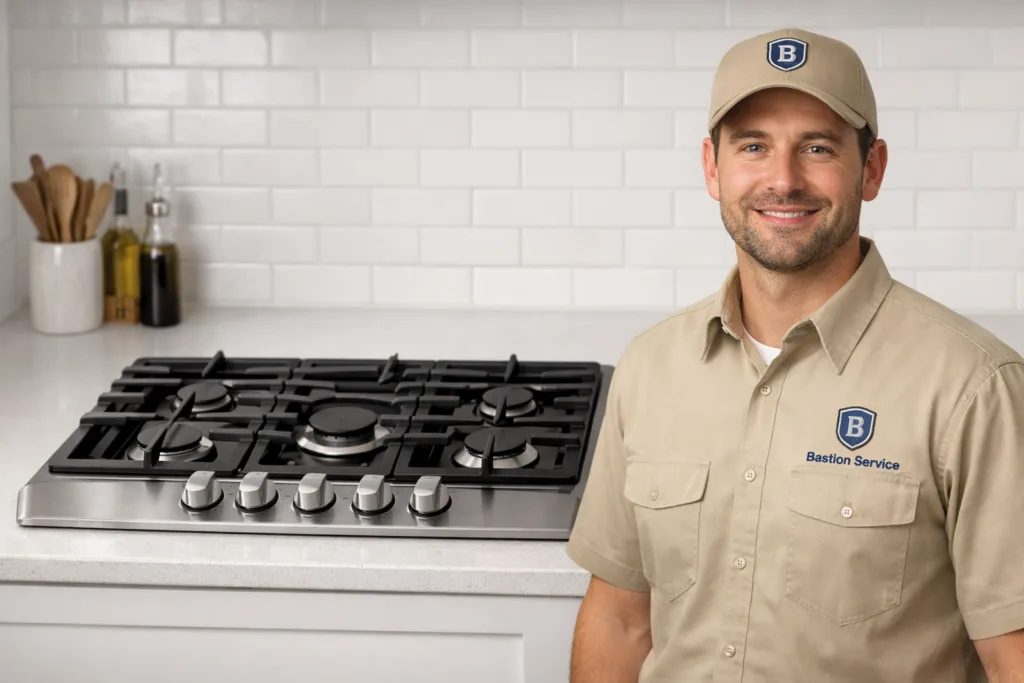
Cooktop failures often look simple from the outside, but the same symptom can point to very different internal problems. A GE cooktop that will not heat, keeps clicking, or runs hotter than the setting suggests may need anything from a burner-level repair to a control or wiring diagnosis. For homeowners in Rancho Park, the best results usually come from identifying the exact failure before any parts are replaced.
What different cooktop symptoms usually mean
Not every cooktop problem starts with a complete shutdown. In many cases, the first warning signs are subtle: slower heating, unreliable ignition, a burner that works only sometimes, or controls that no longer feel precise. Those small changes matter because they often show that a part is wearing out, overheating, or losing electrical continuity.
On GE cooktops, symptoms tend to fall into a few categories:
- Heat problems: burner not heating, overheating, or cycling poorly
- Ignition problems: clicking, delayed flame, or no flame on gas models
- Control problems: knobs or touch controls not responding correctly
- Surface problems: cracked glass, damaged burner areas, or signs of scorching
- Electrical problems: tripped breakers, burning smells, or intermittent power loss
Because these issues can overlap, symptom-based diagnosis is usually more helpful than assuming one visible part is the cause.
Common GE cooktop problems in Rancho Park homes
Burner will not heat or ignite
If a single burner stops working while the others still operate normally, the fault may be limited to that burner’s element, switch, igniter, receptacle, or local wiring. If several burners are affected at once, the problem may involve shared power, a spark ignition component, or the control system.
For electric GE cooktops, a dead burner may come from a failed radiant element, an issue at the connection point, or a switch that is no longer sending proper power. On gas models, the cause may be a blocked burner port, misaligned cap, worn igniter, or a fault in the spark system.
Uneven heating or weak cooking performance
When a burner still works but no longer cooks evenly, the problem is easy to ignore at first. You may notice that water takes longer to boil, pans develop hot spots, or one heat setting behaves like another. On electric models, weakened elements or faulty regulation can cause that pattern. On gas models, poor flame spread can come from debris, burner cap alignment issues, or ignition-related problems affecting burner performance.
Uneven output does not always mean the cooktop is near total failure, but it often means performance will continue to decline until the underlying part is corrected.
Clicking that does not stop
Constant clicking is one of the most common complaints on gas cooktops. Sometimes the cause is simple, such as moisture after cleaning or a burner cap that is not seated correctly. In other cases, the clicking continues because of a failing switch, a spark module issue, or an ignition component that is no longer behaving normally.
If the clicking continues after the surface is dry and the burner parts are properly positioned, the cooktop should be checked before repeated use puts more strain on the ignition system.
Heat levels that do not match the setting
A burner that stays too hot, does not respond when adjusted, or cycles unpredictably can make everyday cooking frustrating. This symptom often points to a worn infinite switch on an electric model or a control-related fault affecting regulation. Even when the cooktop still turns on, unreliable temperature control can lead to overheated cookware, poor cooking results, and extra stress on surrounding components.
Cracked glass or visible surface damage
Glass cooktops need special attention if the surface is cracked, chipped around an active burner area, or showing signs of heat damage. Even when the burner still operates, surface damage can affect safe use and may allow heat or moisture to reach parts beneath the top. In some cases, repair is reasonable. In others, the combination of surface damage and internal risk makes replacement the better long-term choice.
Signs the problem may be getting worse
Some GE cooktop issues stay stable for a while, but many do not. Homeowners often keep using the appliance as long as one or two burners still work, only to find that the original problem spreads. A weak electrical connection can arc and damage nearby wiring. A failing switch can overheat a burner. An unresolved ignition fault can wear out spark components faster.
It is smart to stop and reassess if you notice:
- A burner working only intermittently
- Clicking that returns repeatedly
- Heat output changing without touching the control
- Discoloration, scorching, or unusual odor
- A breaker tripping when the cooktop is used
- A control that feels loose, stuck, or inconsistent
When to stop using the cooktop
Not every issue requires immediate shutdown, but some symptoms should not be ignored. If there is a strong gas odor, visible sparking, a burning smell, evidence of overheating, or a cracked surface near an active cooking area, continued use may not be safe. The same is true if the cooktop trips electrical power or cannot regulate heat correctly.
In those cases, stopping use of the affected burner—or the entire cooktop, depending on the symptom—is usually the safer choice until the unit can be inspected.
Repair or replace: how the decision is usually made
Many GE cooktop problems are repairable when the failure is limited to a burner component, switch, igniter, spark part, or accessible wiring issue. Replacement becomes more likely when the glass is badly damaged, multiple major components have failed, or the repair cost approaches the value of the appliance.
A good repair decision usually depends on:
- The exact failed part
- The overall condition of the cooktop
- Whether there is secondary damage
- Parts availability for the specific GE model
- How often the unit has needed recent service
That is why diagnosis matters so much. It separates a manageable repair from a situation where replacement makes more sense.
What a service-focused visit should evaluate
For GE cooktop repair in Rancho Park, a useful service visit should do more than confirm the obvious complaint. It should also evaluate the related burner function, controls, wiring behavior, ignition performance, and any signs that the original issue has affected nearby parts. That gives the homeowner a realistic picture of what failed and what the repair path looks like.
This kind of assessment is especially helpful when the cooktop is only partly failing. A burner that works some days and not others, or ignition that acts up only after cleaning or heavy use, can be harder to judge without testing the system under the symptom pattern you are actually seeing at home.
Practical next steps for Rancho Park homeowners
If your GE cooktop is still usable but clearly not operating the way it should, it is usually better to address the issue before it turns into a broader parts failure. Early attention can prevent added damage to switches, wiring, ignition components, or the cooking surface itself.
For many households in Rancho Park, the key question is not just whether the cooktop turns on, but whether it is heating, igniting, and responding safely and consistently. Once the symptom is narrowed down, it becomes much easier to decide whether repair is the sensible next move.