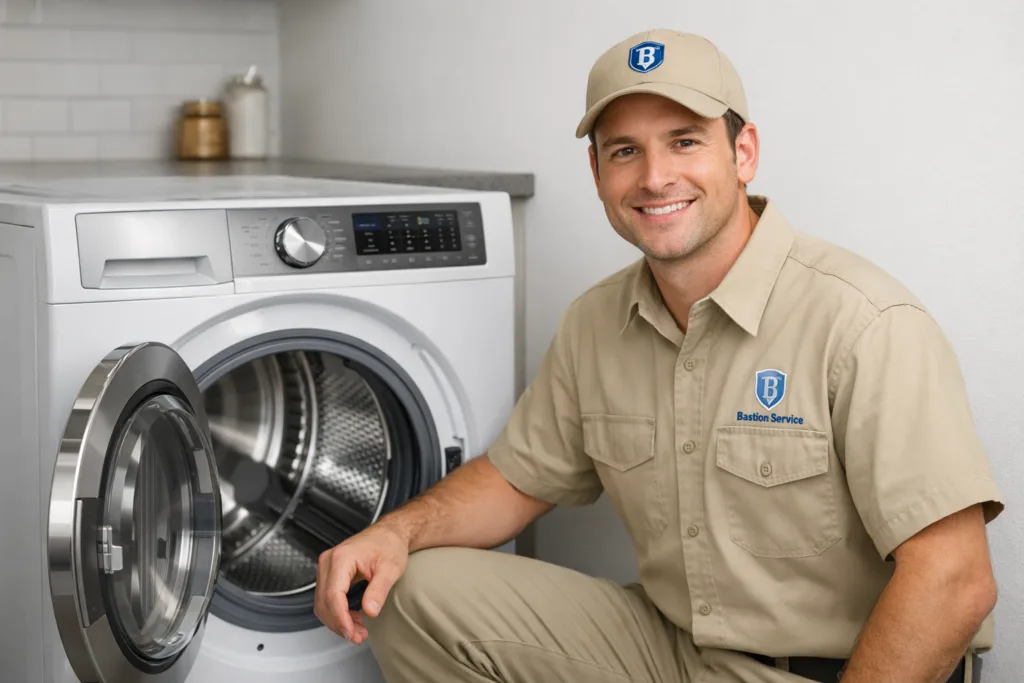
Many dryer complaints look similar from the outside, but the fix can be very different depending on what the machine is actually doing. An Electrolux dryer that tumbles without heat, overheats, stops early, or makes new noises needs symptom-based troubleshooting rather than guesswork. For homeowners in Manhattan Beach, that usually means separating airflow restrictions from heating failures, drum support wear, sensor problems, or electrical issues before deciding on repair.
Common Electrolux dryer problems and what they may mean
Dryer runs but does not heat
If the drum turns but clothes come out cold or damp, the problem may involve the heating element, high-limit thermostat, thermal fuse, control board, or incoming power. On electric models, a dryer can still appear to run even when it is not receiving the full power needed to heat properly. That is why a no-heat complaint should not automatically be treated as a bad heater.
Drying takes too long
Long dry times often point to restricted airflow, a venting issue, lint buildup inside the dryer path, weak heat output, or a moisture sensing problem. In daily use, this often shows up as loads that need repeated cycles or towels that stay damp long after the cycle ends. When airflow is poor, the dryer works harder while performance gets worse.
Dryer will not start
A no-start condition can come from a failed door switch, blown thermal fuse, control issue, start circuit fault, or power supply problem. It also matters whether the dryer is completely dead or lights up but will not begin tumbling. Those are different symptom patterns and usually lead to different repair paths.
Drum does not turn
If the dryer powers on but the drum does not move, possible causes include a broken belt, seized rollers, worn idler pulley, failing motor, or an obstruction in the drum support system. Some units may hum without starting, while others may stop mid-cycle after the motor overheats. Continuing to run the machine in this condition can increase wear on surrounding parts.
Noise during operation
Squealing, thumping, scraping, or rattling usually means a moving part is wearing out or something has come loose inside the dryer. Common sources include support rollers, drum glides, blower wheel problems, belt issues, or objects caught where they should not be. A noisy dryer may still finish a load, but noise is often the warning sign that a more expensive failure is developing.
Dryer shuts off too soon
When a cycle ends before clothes are dry, the cause may be tied to the moisture sensor, control behavior, overheating protection, or restricted airflow. This is one of the most misunderstood dryer complaints because short cycling can look like a sensor problem even when heat buildup or poor ventilation is the real trigger.
Why airflow matters more than many homeowners expect
Airflow problems are behind a large number of dryer performance complaints. Even when the heating system is working, trapped heat and moisture can leave laundry damp, extend cycle times, and put stress on thermostats and other temperature-related parts. In more serious cases, poor airflow can cause the dryer to run hotter than intended and shut down unpredictably.
Signs that airflow may be part of the issue include:
- clothes feel hot but still damp at the end of the cycle
- the outside of the dryer feels hotter than usual
- the laundry area becomes unusually warm or humid
- dry times increase gradually over time
- the dryer seems to heat, but performance keeps getting worse
Because airflow symptoms can overlap with heater and sensor complaints, it is important to look at the full pattern rather than replacing parts based on one clue.
Symptoms that should not be ignored
Some dryer problems are inconvenient. Others can quickly turn into larger mechanical or electrical failures. It is worth stopping use and scheduling service when the machine shows signs that internal parts are under strain.
- the dryer smells hot or gives off a burning odor
- the drum drags, bangs, or squeals during operation
- the unit trips a breaker or loses power mid-cycle
- loads suddenly need much longer to dry
- the dryer starts only occasionally or stops without finishing
- there is visible overheating, scorching, or repeated thermal shutdown
Using the dryer after these symptoms appear can turn a single-part repair into a broader internal repair involving multiple worn components.
How Electrolux dryer diagnosis usually works
Accurate troubleshooting starts with the symptom sequence. Does the dryer heat at first and then stop? Does it run normally on timed dry but not on sensor cycles? Does the drum turn freely by hand? Does the problem happen every load or only sometimes? These details help narrow the issue to the correct system.
On Electrolux dryers, several systems can affect the same result. A damp-load complaint might come from weak heat, restricted airflow, sensor feedback, or interrupted cycling. A no-start complaint might be caused by a door switch, thermal protection device, or control fault. Looking at the machine as a complete system helps avoid trial-and-error part replacement.
Repair or replace: what usually makes sense
For many households in Manhattan Beach, repair is still worthwhile when the problem is isolated and the dryer is otherwise in solid condition. Belt failures, roller wear, thermal fuse issues, and some heating-related faults are often repairable without treating the appliance as a total loss.
Replacement becomes more likely when the dryer has multiple failing systems, recurring control problems, significant internal wear, or a repair cost that no longer makes sense for the machine’s condition. Age matters, but overall performance matters more. A well-kept dryer with one clear failure can be a better repair candidate than a newer unit with repeated breakdowns in different systems.
Helpful factors to consider include:
- whether the issue is limited to one component or part of larger wear
- how the dryer has performed over the last year
- whether previous repairs have solved the problem or only delayed it
- the condition of the drum, motor, controls, and heating system
What homeowners usually want from service
Most people are not looking for a complicated explanation. They want to know why the dryer is failing, whether repair is sensible, and what can be done to restore normal laundry use without repeated downtime. Good service should match the repair plan to the actual symptom pattern and explain whether the issue appears isolated or part of broader wear.
If your Electrolux dryer is leaving clothes damp, refusing to start, making abnormal noise, or stopping before a load is dry, the next step is finding the fault behind that specific behavior so the repair decision is based on evidence instead of guesswork.