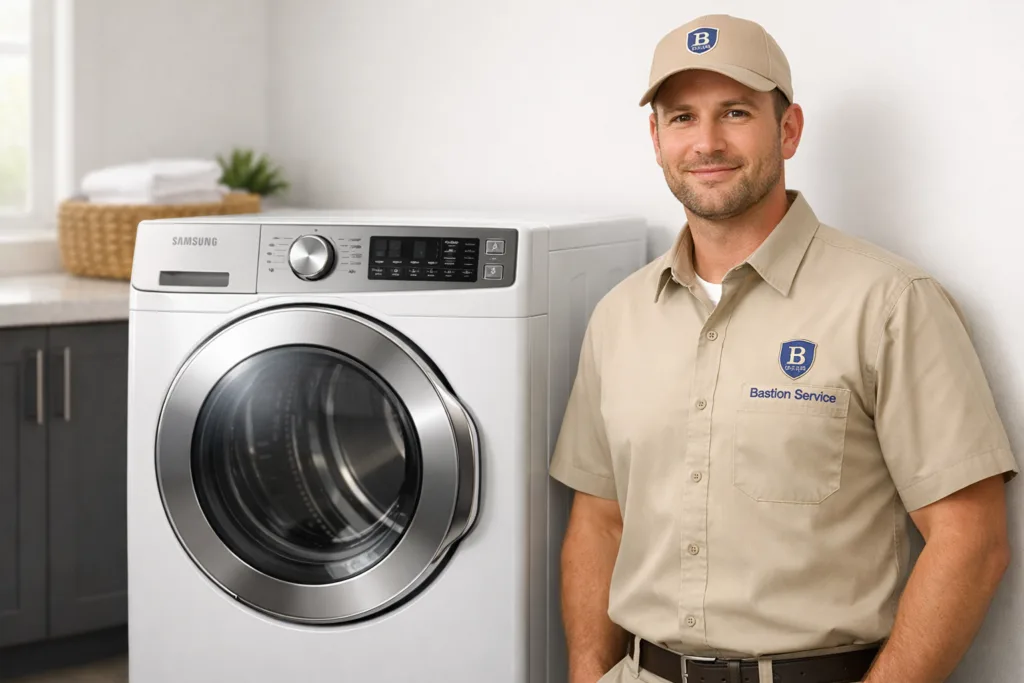
Laundry problems escalate quickly when a dryer starts leaving clothes damp, making new noises, or refusing to start. With Samsung dryers, the same symptom can come from very different causes, so it helps to look at the full pattern before deciding on a repair. A unit that seems to have a heating problem may actually be dealing with restricted airflow, while a dryer that stops mid-cycle may be reacting to overheating rather than a bad control.
Symptoms that point to Samsung dryer trouble
Most dryer failures show up in a few familiar ways. Clothes may take too long to dry, the drum may turn without heat, the machine may not respond when you press start, or it may begin making squealing, scraping, or thumping sounds. Some problems stay mild for a while, but others can worsen quickly if the dryer keeps running under strain.
Looking at when the problem happens matters. If the dryer runs normally for several minutes and then shuts off, that often suggests overheating, airflow restriction, or a motor issue. If it never starts at all, the problem may be in the door switch, fuse, power supply, control, or start circuit. If it heats but never dries well, venting and moisture sensing are often part of the diagnosis.
Common Samsung dryer issues in Manhattan Beach homes
No heat or not enough heat
A Samsung dryer that tumbles but does not produce heat can have a failed heating element, thermostat problem, thermal fuse issue, or power supply fault on an electric model. On gas units, ignition-related parts may be involved. In some cases, the dryer is technically heating, but poor airflow prevents moisture from leaving the drum efficiently, making the load feel like it never fully dries.
If heat seems inconsistent, it can also point to a component that works intermittently as temperatures rise. That is one reason occasional success does not necessarily mean the dryer is fine.
Long dry times
Long dry times are often blamed on the dryer itself, but they frequently involve vent restriction, lint buildup, weak blower performance, or sensor-related issues. If clothes feel hot yet remain damp, the machine may be generating heat without moving moist air out fast enough. This can add stress to heating parts and cause repeated high-temperature cycling.
Loads that once dried in one cycle but now need two or three are worth checking sooner rather than later. That kind of symptom tends to increase energy use and can shorten component life.
Dryer will not start
When a Samsung dryer does nothing after the start button is pressed, the cause may be electrical, mechanical, or electronic. Common possibilities include a bad door switch, blown thermal fuse, faulty terminal connection, control board problem, or incoming power issue. Sometimes the console lights up but the drum never moves, which can narrow the issue toward the start circuit or drive system.
If the dryer hums but does not turn, the belt, motor, or idler assembly may be binding. Repeated attempts to start it can make damage worse.
Stops during the cycle
A dryer that starts normally and then shuts down partway through a load may be overheating, losing motor function as it gets hot, or tripping a protective safety component. This is not a symptom to ignore. Repeated shutdowns often mean the unit is working harder than it should, and continued use can turn a manageable repair into a more expensive one.
Noise, vibration, or burning smell
Unusual sounds usually mean wear in moving parts. Support rollers can flatten, idler pulleys can seize, belts can fray, and drum glides can wear down enough to create scraping or thumping. A burning odor may come from overheating, belt friction, motor stress, or lint accumulation in places that should stay clear.
If the cabinet becomes unusually hot or the smell is sharp and persistent, stop using the dryer until it is checked.
Why airflow matters so much
Airflow problems are one of the most common reasons a Samsung dryer seems to be failing when the heating system is only part of the story. A dryer depends on moving hot, damp air out of the machine efficiently. When that path is restricted, drying times increase, temperatures rise inside the cabinet, and safety devices may shut the unit down.
In Manhattan Beach homes, airflow should be evaluated alongside the dryer itself rather than treated as a separate issue. A heating element may test bad, but vent conditions can still be part of why that component failed early. A complete diagnosis usually includes both appliance checks and airflow review.
How moisture sensor problems show up
Samsung dryers with sensor cycles can behave oddly when the moisture sensing system is not reading fabrics correctly. Loads may stop too soon, run longer than expected, or seem inconsistent from one cycle to the next. Residue from dryer sheets or detergent can interfere with sensor bars, and in other cases the issue may involve wiring, control interpretation, or overall cycle logic.
Sensor-related complaints are easy to mistake for weak heat. If the dryer works better on a timed cycle than on an automatic cycle, that comparison can be useful when narrowing down the cause.
When repair usually makes sense
Many Samsung dryer repairs are worthwhile when the fault is limited to one main area, such as the heating system, belt drive, roller set, idler pulley, switch, sensor, or fuse-related failure. These problems are often more straightforward than issues involving several aging systems at once.
Repair decisions become harder when the dryer has a long history of repeat breakdowns, major cabinet wear, motor and control problems together, or signs that multiple parts are near the end of service life. In those cases, the cost of restoring reliable performance may not compare as well with replacement.
Signs it is time to stop using the dryer
Some symptoms should be treated as a reason to stop running the machine until it is inspected:
- Burning smell during or after a cycle
- Scorching on fabrics
- Drum not turning properly
- Loud grinding, scraping, or metal-on-metal noise
- Repeated mid-cycle shutdowns
- Excessive heat on the cabinet exterior
- Breaker trips or recurring power loss while drying
Even if the dryer restarts later, an intermittent problem can still point to overheating or a part that is failing under load.
What a useful service visit should focus on
A productive appointment should start with symptom verification, power and safety checks, airflow review, and targeted component testing based on how the dryer is failing. That matters because two dryers with the same complaint may need completely different repairs. One may need a heating part, while another may mainly have a venting or mechanical wear problem.
For homeowners in Manhattan Beach, the goal is not just getting the dryer running again for the moment. It is understanding whether the problem is isolated, whether other worn parts are contributing to it, and whether the repair path is likely to restore normal drying without repeat shutdowns, noise, or long-cycle frustration.