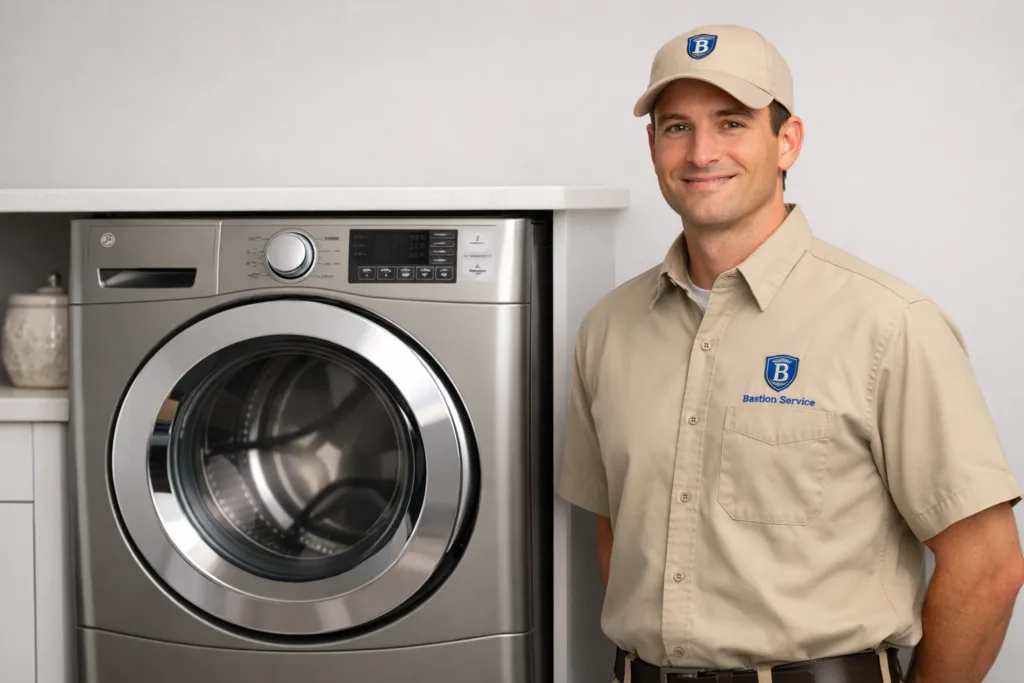
Dryer problems rarely stay minor for long. A GE dryer that leaves towels damp, stops mid-cycle, or starts making new noises usually has a specific failing system behind the symptom, and identifying that system early can prevent added wear on the motor, drum, or heating components.
Common GE dryer symptoms in Manhattan Beach homes
Most service calls fall into a handful of symptom patterns. Looking at what the dryer is doing, and what it is not doing, is often the fastest way to narrow down the likely repair path.
Runs but does not heat
If the drum turns but the load stays cold or barely warm, the problem may be in the heating circuit rather than the motor system. On GE dryers, possible causes include a failed heating element, thermal fuse, thermostat issue, igniter problem on gas models, or a power-related fault. Vent restrictions can also contribute by causing overheating conditions that affect safety components.
This symptom matters because a dryer that tumbles normally can still be unable to dry anything effectively. It is easy to assume the machine is mostly working when, in reality, the part of the appliance that actually removes moisture has failed.
Takes too long to dry
Long dry times often point to airflow issues first. Lint buildup, a partially blocked exhaust path, a crushed vent line, or a weak blower can all reduce performance even when the heater is operating. In some cases, the dryer still gets hot, but moisture cannot escape efficiently, so clothes remain damp at the end of the cycle.
GE dryers can also show this symptom when moisture sensing is inconsistent. That may appear as cycles that end too soon, run too long, or perform differently from one load to the next.
Will not start
When nothing happens after pressing start, the issue may involve the door switch, start switch, thermal fuse, belt safety switch, control problem, or incoming power. Some dryers will light up and appear normal on the panel while still failing to start the motor, which is why testing is more useful than replacing parts based on appearance alone.
Shuts off during the cycle
A dryer that starts normally and then quits may be overheating, losing motor continuity as components warm up, or reacting to a safety fault. If the dryer runs again after cooling down, that often suggests a temperature or motor-related problem rather than a simple user setting issue.
Makes squealing, scraping, thumping, or grinding sounds
Unusual noise commonly comes from worn drum rollers, glides, supports, an idler pulley, a damaged blower wheel, or a belt that is no longer tracking correctly. A light squeal can become a heavier mechanical problem if the machine continues running with worn support parts. Once the drum loses smooth support, other components may begin wearing faster as well.
Overheats or leaves clothes unusually hot
If items come out very hot but still damp, the dryer may not be moving air properly. Poor ventilation can trap heat inside the machine, creating unsafe temperatures without delivering good drying results. Failed thermostats and cycling issues can cause similar complaints, especially when overheating and poor drying happen at the same time.
How overlapping symptoms can point to different failures
One reason dryer repair can be frustrating for homeowners is that different faults can create nearly identical results. No heat, long dry times, and mid-cycle shutoff may all involve the heating system, but they can also stem from restricted airflow, electrical interruptions, or failing safety devices.
For example, a dryer that takes two cycles to finish a load does not automatically need a heating element. If the vent path is restricted, the machine may generate heat but still fail to remove moisture. In another case, a dryer that stops heating after a few minutes may have a component that fails only once it reaches operating temperature.
That is why a practical repair plan starts with the symptom pattern and then confirms which system has actually failed.
Signs the problem should not be ignored
Some dryer issues are inconvenient. Others suggest a condition that can worsen quickly if the appliance keeps running. It makes sense to stop using the dryer and have it checked if you notice any of the following:
- A burning smell during operation
- Scraping, grinding, or heavy thumping sounds
- The dryer shutting off repeatedly before the cycle ends
- Clothes staying damp while the cabinet feels excessively hot
- Intermittent power loss or tripped breakers
- A drum that struggles to turn or turns unevenly
These symptoms can indicate restricted airflow, failing support parts, motor strain, or electrical faults that go beyond ordinary wear.
What homeowners can safely check first
Before scheduling service, there are a few basic checks that can help rule out simple causes without taking the dryer apart:
- Confirm the dryer is receiving proper power and has not tripped a breaker
- Make sure the door is fully closing and latching
- Clean the lint filter completely
- Check for obvious crushing or kinking in the visible vent connection
- Review cycle settings in case the issue appears only on one mode
If those steps do not resolve the problem, further disassembly or electrical testing is usually best left to service. Many GE dryer faults involve safety components, control circuits, and internal parts that require confirmation rather than guesswork.
Repair or replacement: what usually drives the decision
For many Manhattan Beach households, repair makes sense when the issue is limited to one system and the dryer is otherwise in solid condition. That is often true for problems involving heating components, switches, thermostats, belts, rollers, or airflow-related corrections.
Replacement becomes more worth considering when the dryer has multiple wear issues at once, significant drum or cabinet damage, recurring control failures, or a repair cost that is difficult to justify based on the appliance’s age and overall condition.
The most useful decision point is not just whether the dryer failed, but how broadly it failed. A single worn part is different from a machine with several aging systems showing signs of breakdown at the same time.
What a service visit is meant to accomplish
A productive GE dryer service visit should answer three questions clearly: what failed, whether anything else has been affected, and whether the repair is sensible to complete. That means evaluating the symptom in operation, checking the relevant electrical and mechanical systems, and looking for related wear that could change the recommendation.
For homeowners in Manhattan Beach, the goal is simple. You want to know why the dryer is not performing correctly, whether the fix is straightforward or more involved, and what to do next without wasting time on the wrong parts or repeated trial-and-error repairs.