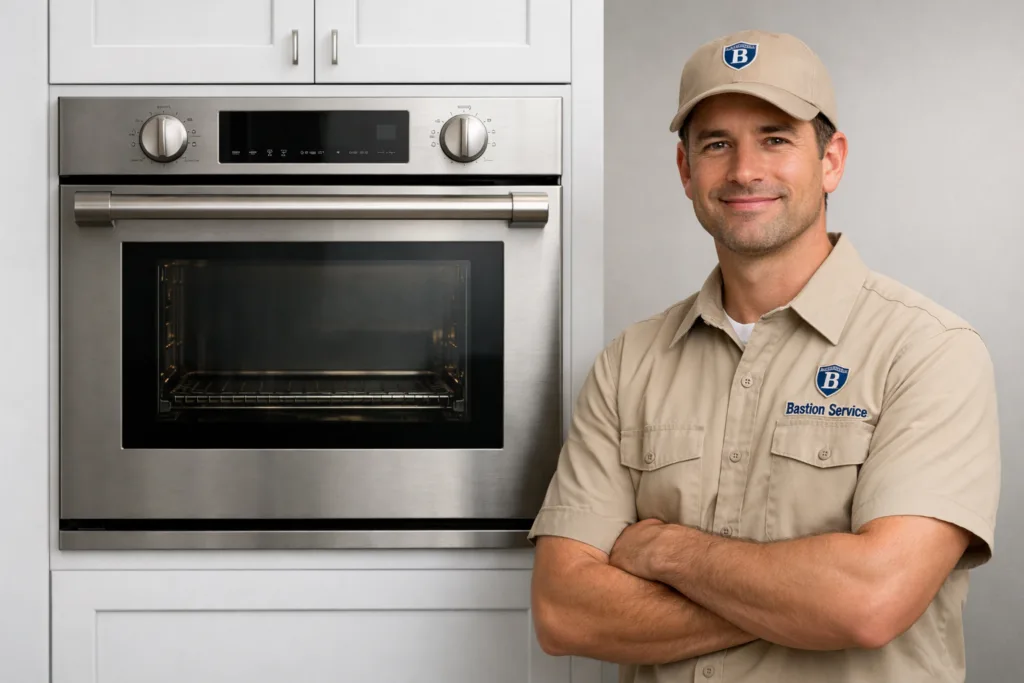
Focused diagnosis for Dacor oven problems

Dacor ovens can fail in ways that look similar at first but come from very different causes. An oven that will not heat, takes too long to preheat, bakes unevenly, or shuts off during use may involve the heating system, temperature sensing, door-related components, controls, wiring, or power supply. Sorting out the actual cause first helps avoid replacing parts that are not responsible for the symptom.
In West Hollywood homes, a wall oven or built-in oven problem affects more than one meal. It can disrupt weeknight cooking, holiday planning, and day-to-day kitchen use. The most effective repair path starts with the specific pattern you are seeing: whether the problem happens every cycle, only at certain temperatures, after self-clean, or intermittently.
Common Dacor oven symptoms and what they may mean
Oven will not heat at all
If the display powers on but the oven never gets hot, the failure may be in the bake element, broil element, igniter, sensor, thermal cutoff, relay, or control board. On some units, normal-looking lights and controls can make the appliance appear functional even when the heating circuit is not working properly.
This symptom is usually straightforward for the homeowner to notice, but the source is not always obvious. A no-heat condition can be constant, or it may appear only in bake mode while broil still works, which can help narrow the fault.
Uneven baking or hot spots
When food browns too quickly on one side, burns on the top, or cooks unevenly from rack to rack, the oven may not be regulating temperature correctly. A weak heating element, drifting sensor, convection fan issue, calibration problem, or control fault can all produce inconsistent results.
These problems often start gradually. Homeowners may first notice recipes taking longer than usual or needing more pan rotation before the issue becomes obvious enough to interrupt normal cooking.
Slow preheat
Long preheat times commonly point to a component that is weakening rather than fully failed. The oven may still eventually reach the set temperature, but it does so inefficiently and may struggle to maintain heat once the door is opened.
Slow preheat is worth addressing early. A partially failing bake element, broil element, or igniter can continue deteriorating until the oven stops heating altogether.
Temperature swings during cooking
If the oven seems too cool one day and too hot the next, the issue may involve sensor feedback, control regulation, or intermittent heating performance. Temperature swings can be especially frustrating because the appliance may appear to work normally during a quick test but still produce unreliable cooking results over a full cycle.
For households that bake frequently, even modest temperature instability can ruin consistency. It can also make it harder to tell whether the problem is with the recipe or the appliance.
Display, keypad, or control issues
A Dacor oven that beeps unexpectedly, resets, shows error codes, ignores input, or has a blank or partial display may have a control panel issue, electronic control failure, wiring problem, or incoming power problem. Intermittent control symptoms can be easy to dismiss at first, but they tend to become more disruptive over time.
If the oven starts and stops unpredictably or loses settings during use, it is best not to assume the problem is minor. Repeated failed cycles can place added stress on other components.
Door not closing, sealing, or locking properly
A damaged hinge, worn gasket, latch fault, or alignment problem can let heat escape and affect both temperature performance and preheat time. If the door does not seal well, the oven may still run, but cooking results may become inconsistent and surrounding components may be exposed to extra heat.
On models with self-clean, trouble that begins right after a cleaning cycle can be related to thermal stress on the latch, controls, or nearby wiring.
When to stop using the oven
Some issues can wait for a scheduled appointment, while others call for immediate shutdown. Stop using the oven if it sparks, trips the breaker repeatedly, produces unusual burning smells unrelated to food residue, overheats on the exterior, or shuts off in the middle of a cycle without explanation.
Those symptoms can indicate an electrical fault, overheating condition, or control problem that should not be ignored. Continued use may increase damage and create a safety concern in the kitchen.
Signs a smaller problem is getting worse
Oven problems often progress in stages. What begins as occasional slow preheat or slight temperature drift can turn into a full no-heat failure, repeated error codes, or unreliable operation during important cooking times. Watching for pattern changes is helpful.
- Preheat takes longer than it used to
- The oven reaches temperature but struggles to hold it
- One cooking mode works better than another
- The display flickers or resets during use
- The door needs pressure to close fully
- Error messages appear only occasionally at first
When those signs begin to stack up, the repair is often easier to manage before the failure becomes complete.
Repair or replace?
Whether repair makes sense depends on the failed part, the age of the oven, overall condition, and how well the unit has been performing aside from the current issue. Many repairs are worthwhile when the problem is limited to a sensor, igniter, element, fan, latch, or a specific control-related component.
Replacement becomes a more serious consideration when multiple systems are failing, the oven has a history of repeated breakdowns, or the cost of repair approaches the value of keeping the appliance in service. Built-in Dacor ovens can also raise fit and installation questions, so the decision is not always as simple as swapping in another unit.
For many West Hollywood homeowners, the best choice comes down to whether the fault is isolated and repairable or part of a broader decline in appliance condition.
What a symptom-based service visit should accomplish
A useful service call should identify what the oven is doing, reproduce or verify the complaint where possible, test the relevant heating and control functions, and explain which component or condition is responsible. That gives the homeowner a practical repair plan based on the actual fault rather than guesswork.
Whether the problem is no heat, uneven baking, slow preheat, temperature instability, or control failure, the goal is the same: restore reliable cooking performance and help you decide the next step with confidence.