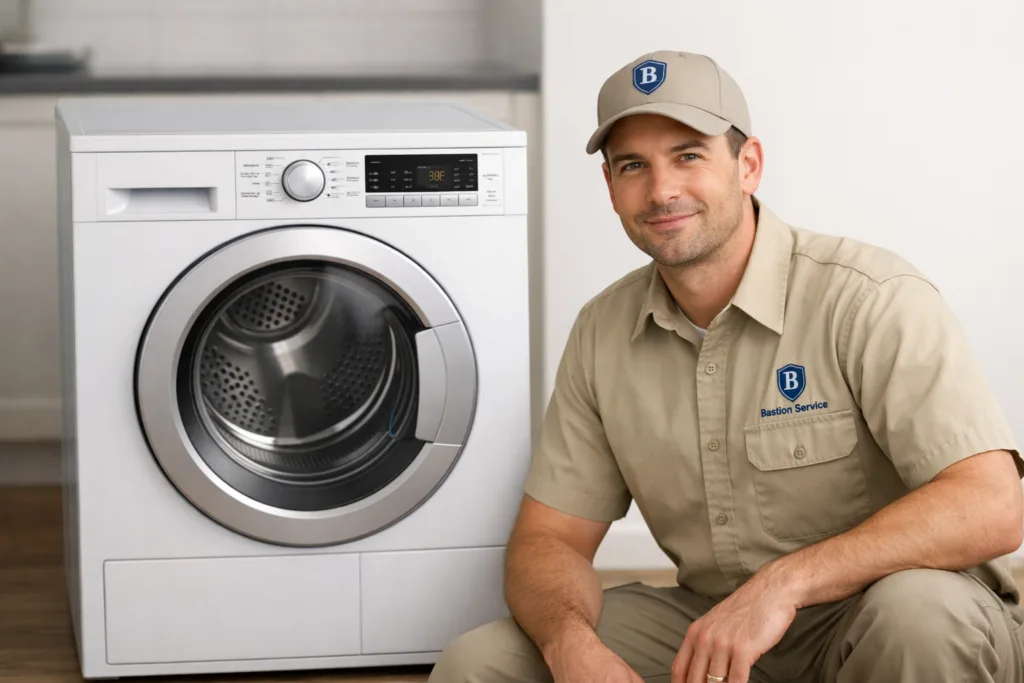
Dryer trouble rarely starts as a complete breakdown. More often, a Blomberg unit begins showing small warning signs such as longer cycle times, inconsistent heat, unusual drum sounds, or shutdowns that seem random. Paying attention to those patterns can help narrow the likely cause before the problem spreads to other components.
How Blomberg dryer issues usually show up
Most dryer failures fall into a few familiar categories: heat problems, airflow problems, starting problems, and mechanical wear. The challenge is that similar symptoms can come from very different faults. A dryer that runs for too long might have weak heat, restricted venting, a moisture-sensor problem, or a blower issue. A dryer that will not start could be dealing with a door switch fault, control problem, motor issue, or power-related failure.
For households in Westwood, the key is not to assume the first visible symptom tells the whole story. A dryer may still tumble even when heating components have failed, and it may still heat even when restricted airflow is slowly creating overheating conditions inside the cabinet.
Common Blomberg dryer symptoms and what they may mean
Clothes take too long to dry
Long dry times often point to one of two things: weak heat or poor airflow. If clothes feel warm but stay damp after a full cycle, the dryer may be producing heat without moving enough air through the drum and exhaust path. Lint buildup, crushed ducting, or internal airflow restrictions can all contribute. This is also one of the most common reasons a dryer seems to be “working” while performance keeps getting worse.
Dryer runs but there is no heat
When the drum turns normally but clothes come out cold and wet, likely causes include a failed heating element, thermal fuse, thermostat, relay, or electronic control issue. On some calls, the loss of heat is the result of overheating that has already triggered a protective component. That is why the cause behind the failed part matters as much as the part itself.
Dryer will not start
If pressing the start button does nothing, diagnosis usually begins with incoming power, the door latch and switch, the user interface, and the start circuit. In some cases, the display may light up while the dryer still refuses to run, which can point toward a motor, belt-switch, or control-related problem rather than a complete loss of power.
Dryer stops during the cycle
Mid-cycle shutdowns often suggest overheating, motor stress, restricted airflow, or an intermittent control fault. If the dryer restarts only after sitting for a while, that cooling-off pattern is a useful clue. It may indicate that the machine is protecting itself from excess heat or that a motor is struggling once it reaches operating temperature.
Dryer is noisy, squealing, or thumping
New sounds usually mean moving parts are wearing down. Rollers, glides, support wheels, idler pulleys, and blower components can all create noise as they age. A repeated thump may come from a drum support problem or an item caught in the drum path. A squeal often points to friction in rotating parts. Ignoring these sounds can lead to extra wear on the belt, motor, or drum supports.
Dryer feels too hot or smells overheated
This is a symptom to take seriously. Excess heat can mean restricted venting, lint buildup, thermostat problems, or cycling failures that prevent the dryer from regulating temperature correctly. If clothing feels unusually hot, the cabinet exterior seems hotter than normal, or there is a burnt smell, it is best to stop using the appliance until the cause is checked.
Why airflow matters more than many homeowners expect
Airflow problems are behind many dryer complaints, including poor drying, overheating, repeated thermal fuse failures, and premature wear on heating parts. Even when the drum tumbles and the heater comes on, the dryer cannot perform properly if hot, moist air is not leaving the system efficiently.
Signs of restricted airflow include:
- Loads needing multiple cycles
- The laundry room becoming hot or humid during operation
- The dryer shutting off before clothes are dry
- Hot clothing with lingering dampness
- A burning-lint smell or scorched fabric odor
Because airflow affects both drying performance and safety, it is one of the first things worth checking when a Blomberg dryer begins acting unpredictably.
What can make a Blomberg dryer stop heating properly
No-heat and low-heat complaints are common, but they are not all the same repair. Some units lose heat completely, while others still warm up but never reach the temperature needed for normal drying. In either case, the underlying problem may involve a failed heating component, a thermal safety device, a control fault, or overheating caused by restricted airflow.
That difference matters because replacing a failed part without addressing the reason it failed can lead to repeat service. A dryer that overheated due to poor venting may damage the replacement part if the airflow issue is left in place.
Signs the problem may be electrical or control-related
Modern dryers do not rely only on simple mechanical timers. When a Blomberg dryer has irregular behavior such as buttons responding inconsistently, cycles not advancing properly, or the machine refusing to start despite normal power at the outlet, the issue may involve the control system or interface components.
Possible signs of a control-related problem include:
- The panel lights up but the cycle will not begin
- The dryer stops without a consistent heat or airflow pattern
- Cycle settings behave unpredictably
- The unit powers on and off inconsistently
These symptoms can overlap with sensor or safety-switch issues, so testing is more useful than guessing based on the display alone.
When a repair is usually worth considering
Repair is often sensible when the problem is limited to a specific part or system and the dryer is otherwise in solid condition. Common examples include isolated heating failures, worn support parts, switch problems, or airflow-related issues that have not caused broader damage. If the cabinet, drum, motor, and controls are still in decent shape, a targeted fix may return the dryer to normal household use.
Replacement becomes more likely when the machine has multiple active problems, heavy overall wear, or repeated failures that suggest declining reliability. Age alone does not decide the answer, but overall condition does.
What to note before scheduling service
A few observations can make diagnosis faster and more accurate. Before a visit, it helps to notice:
- Whether the drum turns normally
- Whether the dryer produces any heat
- If the problem happens on every cycle or only sometimes
- Whether shutdowns happen after the machine warms up
- What type of noise is present and when it starts
- Whether loads are hot, damp, or both at the end of the cycle
These details often reveal whether the likely issue involves airflow, heating, controls, or mechanical wear.
When to stop using the dryer right away
Some symptoms should not be treated as routine inconvenience. It is best to stop running the dryer if you notice a burning smell, scorching on fabric, repeated mid-cycle shutdowns, very high cabinet temperatures, or loud metal-on-metal sounds. Continued use under those conditions can increase damage and may create avoidable safety concerns.
What homeowners in Westwood should expect from service
A useful service visit should do more than name a broken part. It should identify the actual failure, check for contributing issues such as vent restriction or overheating, and explain whether the repair path makes sense for the condition of the appliance. That kind of symptom-based evaluation helps homeowners in Westwood decide whether a Blomberg dryer repair is likely to restore normal performance or whether the machine is reaching the point where replacement deserves consideration.