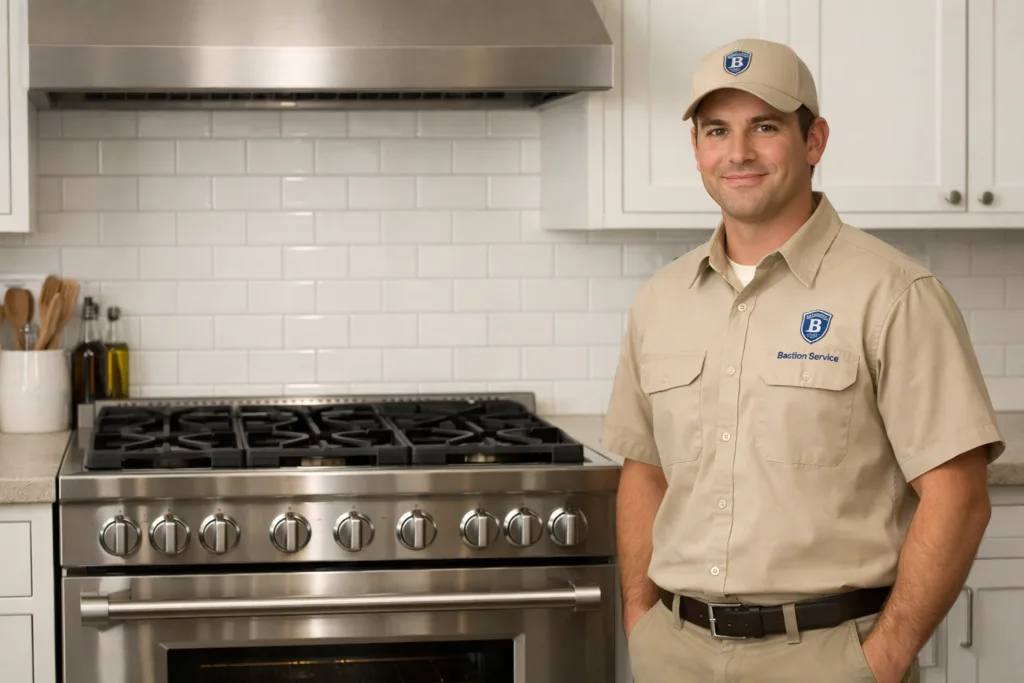
Small changes in range performance usually show up before a complete failure. You might notice a burner that takes several tries to light, an oven that suddenly needs extra time, or temperature swings that make weeknight cooking harder to trust. On a Wolf range, those symptoms often point to specific ignition, heating, sensor, or control issues that should be tested rather than guessed at.
What Playa Vista homeowners commonly notice
Range problems often begin with inconsistent behavior instead of a total shutdown. A surface burner may click repeatedly, the flame may look uneven, or the oven may preheat but still cook unpredictably. In some homes, the issue appears only once in a while at first, which can make it easy to postpone service even though the problem is already developing.
Common early warning signs include:
- Burners that do not ignite on the first try
- Clicking that continues after the flame appears
- Weak flame, poor simmer control, or unusually high heat
- Slow preheating or long cook times
- Food browning unevenly from front to back or top to bottom
- Broil performance that seems weaker than normal
- Unresponsive knobs, erratic displays, or settings that do not match actual performance
Because a single symptom can come from more than one failing part, accurate testing matters. Replacing parts based only on the visible symptom can miss the real cause.
Burner ignition problems and repeated clicking
If a burner clicks but does not light reliably, the cause may be as simple as burner cap misalignment or buildup around the ignition area. It can also involve a worn spark component, switch issue, or another fault affecting normal ignition. When clicking continues after the burner lights, that is a sign the ignition system is not behaving normally and should be inspected.
Homeowners in Playa Vista often first notice this during everyday use when one burner starts acting differently from the others. That difference matters. If one burner is slow to light while the rest work normally, the problem may be localized. If multiple burners begin showing the same symptom, the repair path may involve shared ignition components or controls.
If there is a strong or persistent gas odor, stop using the appliance and address the safety concern before scheduling routine repair.
Weak, uneven, or unstable burner flame
A Wolf range should give predictable burner performance, including controlled simmering and steady high heat when needed. If the flame is too low, flares too high, burns unevenly around the burner, or changes unexpectedly with the knob setting, the issue may involve the burner assembly, gas flow regulation, or control-related components.
This kind of problem is not just about convenience. Uneven flame affects pan heating, boiling time, searing results, and low-heat cooking. Many households keep working around it by switching burners, but that usually does not solve the underlying fault.
Oven not heating, heating slowly, or missing temperature
When the oven does not reach the selected temperature, takes much longer to preheat, or seems to run without producing normal cooking results, several parts may be involved. Depending on the model and fuel configuration, the cause may include an igniter, heating element, temperature sensor, relay, or electronic control issue.
Some ranges do not fail all at once. Instead, they drift out of normal performance. You may notice cookies browning unevenly, casseroles taking longer than expected, or roast times becoming less predictable. Those are often signs that the oven is still operating, but not within a reliable temperature range.
Signs the oven issue is getting worse
- Preheat takes noticeably longer than it used to
- The oven reaches temperature on one day but not the next
- Food repeatedly comes out undercooked in the center
- The broiler works better than the bake function, or the reverse
- You have to raise the set temperature to get normal results
Temperature swings and uneven cooking results
Not every oven complaint is total heat loss. A range can still turn on and appear functional while producing inconsistent results. If one rack cooks faster than another, baked goods finish unevenly, or dishes burn on the outside before the center is done, the problem may involve sensor accuracy, calibration, control faults, or weakened heating performance.
This is one of the most frustrating range issues for households because it creates doubt about every meal. The range may seem fine for one recipe and then fail on the next. A symptom-based diagnosis helps determine whether the issue is a sensor problem, a control problem, or a heating component no longer performing the way it should.
Control and display problems
Modern ranges can show mechanical and electronic symptoms at the same time. If a display flickers, buttons stop responding, a function selector behaves unpredictably, or the oven setting does not match what the appliance actually does, the problem may extend beyond basic heating parts.
Control failures can mimic other issues. For example, a homeowner may assume the oven sensor is inaccurate when the control is actually misreading information or failing to command the heating system properly. That is why control-related complaints should be evaluated as part of the whole range rather than as isolated cosmetic issues.
When to stop using the range
Some problems allow limited operation for a short time, but others should not be ignored. It is wise to stop using the appliance if:
- Ignition is delayed or inconsistent enough to feel unsafe
- Clicking continues abnormally after ignition
- The oven cannot hold a usable temperature
- Controls become unresponsive during cooking
- The range trips power or shows repeated electrical irregularities
- A gas odor is present
Continued use can sometimes worsen wear on ignition parts, controls, or related components. Even if one burner still works, partial operation does not always mean the appliance is safe or stable for normal use.
Repair or replace?
Many Wolf range problems are still worth repairing, especially when the fault is limited to ignition components, switches, sensors, individual heating parts, or a defined control issue. Replacement becomes more likely when the range has several major failures at once, has a long pattern of repeat problems, or needs a repair that no longer makes sense for its overall condition.
The right decision depends on the exact symptom pattern, the model, the age of the appliance, and whether the current issue is isolated or part of broader wear. For many Playa Vista homeowners, the most useful starting point is finding out what actually failed before deciding on the larger investment.
What a thorough service visit should clarify
A good diagnostic appointment should answer the questions that matter most to a homeowner:
- What specific part or system is causing the symptom?
- Is the issue limited, or are multiple problems present?
- Is continued use likely to create more damage?
- Does the repair make sense for the range’s current condition?
That kind of evaluation is especially important on a premium cooking appliance. It helps separate a straightforward repair from a larger decision and gives you a clearer picture of what to expect next.
A practical approach for homes in Playa Vista
Most households do not need a complicated explanation. They need to know why the burner is clicking, why the oven is missing temperature, or why the controls are behaving unpredictably. From there, the repair plan should be based on confirmed symptoms and the actual condition of the range.
If your Wolf range is no longer performing consistently, early service is usually easier than waiting for a complete breakdown. Problems that begin as occasional ignition trouble or minor temperature drift often become more disruptive with time, especially when the range is used daily.