
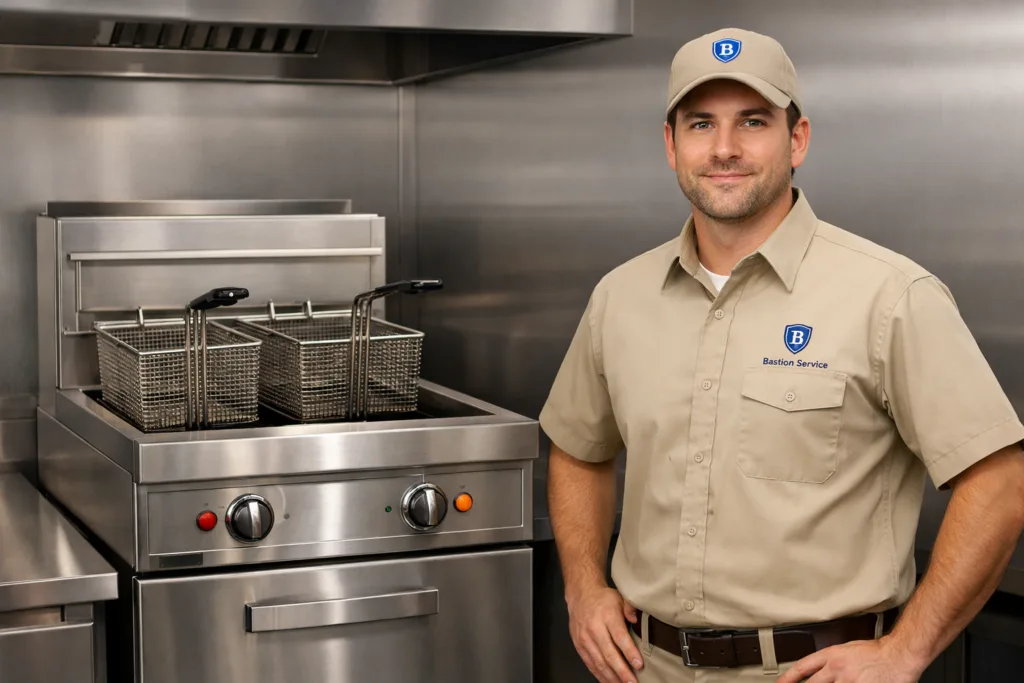




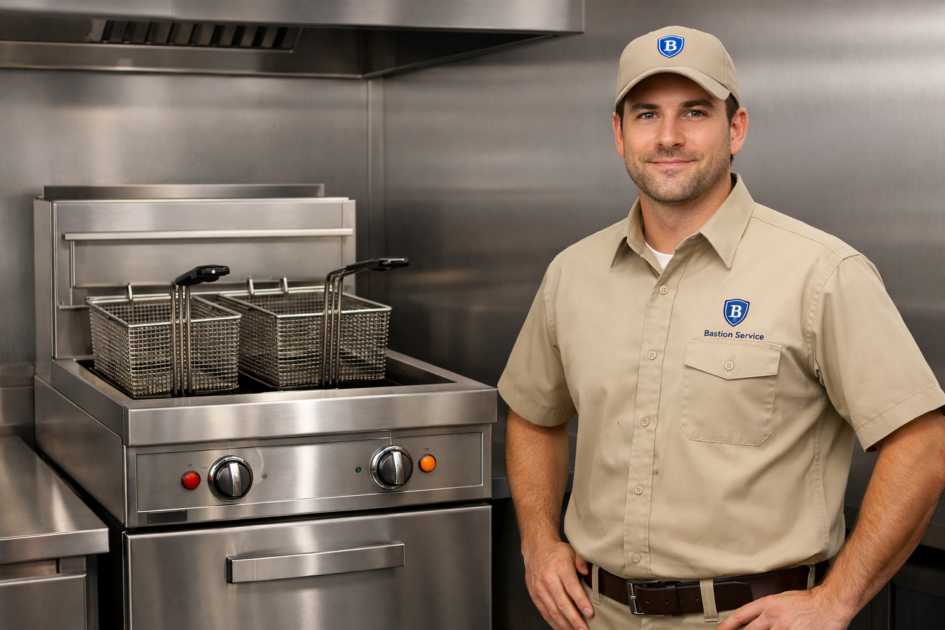
When a Wolf fryer starts missing temperature, recovering too slowly, or shutting down during active production, the issue can affect ticket times, food consistency, and day-to-day kitchen flow. For businesses in Santa Monica, the most useful next step is service that ties the symptom to the actual failed component or circuit, then schedules repair based on urgency, parts needs, and downtime risk. Bastion Service works on Wolf fryer problems with that service-first approach so managers and kitchen teams can make repair decisions based on how the unit is really performing.
Related commercial service paths in Santa Monica include Wolf Commercial Repair in Santa Monica, Commercial Fryer Repair in Santa Monica, and Wolf Oven Repair in Santa Monica.
What Wolf fryer problems usually mean in daily operation
Fryer faults often show up as production problems before they look like an obvious equipment failure. A unit may still power on, display settings, or complete part of a cycle while quietly losing heat accuracy, delaying recovery, or dropping out under load. In a busy kitchen, that can mean longer cook times, uneven color, product waste, and pressure on staff trying to compensate during service.
That is why symptom-based diagnosis matters. The same complaint of “not heating right” can come from different causes, including a failed heating component, a temperature sensor issue, a high-limit problem, a control fault, wiring damage, or an electrical supply problem. The repair path depends on which of those conditions is actually present.
Common Wolf fryer symptoms and what they can indicate
No heat or weak heat output
If the fryer does not heat at all, heats only intermittently, or stalls well below set temperature, the failure may be in the heating circuit, ignition sequence on applicable units, safety limits, control output, or incoming power. In practical terms, kitchens usually notice this first through undercooked product, extended warm-up time, or a fryer that cannot keep pace with normal volume.
This symptom should be checked promptly because repeated restart attempts can hide a worsening electrical or control issue. A unit that occasionally heats is not necessarily a unit that is safe to keep pushing through service.
Slow recovery between batches
When a Wolf fryer reaches temperature eventually but struggles to recover after baskets are dropped, the problem may involve reduced heating performance, inaccurate sensing, failing controls, or a component that weakens once the unit is under sustained demand. Slow recovery can be especially disruptive in kitchens that rely on steady batch output rather than occasional use.
Businesses in Santa Monica often notice this problem as a workflow issue before they describe it as a repair issue. If batch timing starts drifting and staff have to wait longer than normal for oil to recover, the fryer is already affecting production.
Oil temperature swings or overheating
If oil temperature rises above the set point, falls below it, or swings noticeably during operation, likely causes include sensor inaccuracy, calibration drift, control problems, relay or contactor issues, or wiring faults that interrupt temperature feedback. These conditions can shorten oil life, change product quality, and create inconsistent results from one load to the next.
Overheating also deserves immediate attention because what looks like a simple setting problem may actually be a failure in the temperature regulation system.
Unexpected shutdowns during use
A fryer that drops out after preheating, shuts off mid-cycle, or runs for a while and then stops may be dealing with overheating protection, unstable controls, loose connections, failing components, or supply interruptions. Intermittent shutdowns can be difficult to trace without testing the fryer under conditions that match the actual complaint.
These problems rarely improve on their own. In many cases, the shutdown pattern becomes more frequent until the fryer is no longer usable during normal service.
Error codes or unresponsive controls
Display faults, blank screens, settings that do not hold, or buttons that stop responding can point to a failed interface, main control issue, sensor communication problem, or wiring defect. Sometimes the control is not the root failure at all; it may be reacting to bad input from another part of the system.
That distinction matters because replacing a control without confirming the reason for the fault can leave the fryer with the same problem and more downtime.
Why a Wolf fryer may not heat or recover temperature properly
Poor heating and weak recovery usually come down to one of a few categories: the fryer is not generating full heat, it is not reading temperature correctly, or it is not controlling the heat cycle the way it should. From a service standpoint, that means checking the heating path, verifying the temperature feedback system, and confirming that control outputs and safety functions are working in the correct sequence.
In the kitchen, the symptom may look simple: the oil never seems ready, batches take too long, or the fryer falls behind once volume picks up. But the cause can vary widely. A failing sensor can make the control behave as if the oil is hotter than it really is. A weakened heating component may still function, but not at the level needed for normal recovery. A control issue can interrupt proper cycling even when major components appear intact.
Because these failures overlap in the way they present, testing is more useful than guessing. That helps avoid replacing parts based only on the most visible symptom.
Signs service should be scheduled now
Some fryer issues can wait for a planned repair window, but others should be moved up before they cause a full stoppage. If a Wolf fryer is already affecting output or showing unstable behavior, delaying service often turns a limited fault into a larger repair.
- The fryer cannot consistently reach or hold set temperature
- Recovery time is noticeably slower than normal
- The unit shuts down and needs resets to continue operating
- Controls, display functions, or settings behave unpredictably
- Product quality changes without any menu or process change
- Electrical protection trips or the fryer drops power during use
- Oil overheats or temperature swings become easier to notice during production
If one or more of these symptoms is already present, continuing to operate the fryer can increase product loss, strain nearby components, and make the eventual repair more disruptive.
What an effective repair visit should focus on
Useful fryer service is not just about installing parts. It should start with the reported symptom, confirm how the fryer behaves under operation, and identify whether the fault is constant, load-related, or intermittent. From there, the repair can be based on verified failure points rather than assumptions.
For a Wolf fryer, that often means checking:
- Heating performance and temperature rise
- Recovery behavior during normal cooking demand
- Temperature sensing and feedback accuracy
- Safety limits and shutdown conditions
- Control response and output sequence
- Wiring, connections, and supply-related issues
This kind of evaluation is especially important when a fryer seems to work part of the time. Intermittent faults can be the most disruptive in real kitchens because they create uncertainty around whether the unit will hold through the next rush.
Repair or replacement: how to make the right call
Many Wolf fryer problems are repairable when the unit is otherwise in good condition and the failure is isolated to a specific control, heating, sensing, or electrical issue. Replacement becomes a stronger consideration when the fryer has multiple overlapping problems, a pattern of repeat breakdowns, or broader wear that makes another repair less predictable.
For businesses in Santa Monica, the decision usually comes down to a few practical questions:
- Will the repair restore stable day-to-day performance?
- Is the current issue limited, or part of a larger pattern?
- What is the downtime risk if service is postponed?
- Does the cost of repair make sense relative to the fryer’s overall condition?
A proper diagnosis makes that decision clearer. Instead of treating every heat complaint as a major failure, it separates isolated faults from systems that are already showing broader decline.
Preparing for service on a Wolf fryer
Before scheduling repair, it helps to note exactly what the fryer is doing. Useful details include whether the problem happens on startup or only during heavy use, whether the fryer displays any fault information, whether temperature loss is constant or intermittent, and whether the issue affects one cooking period or the whole day. If staff have noticed changes in recovery time, shutdown patterns, or control behavior, those details can shorten the diagnostic process.
It is also helpful to avoid repeated resets or workarounds that keep the fryer limping through service. Those temporary steps can make the underlying problem harder to isolate and may increase the chance of a more complete shutdown.
If your Wolf fryer is no longer heating correctly, recovering as it should, or staying stable through service in Santa Monica, scheduling diagnosis early is usually the best way to limit disruption. A symptom-focused repair visit helps identify the real fault, sets expectations for the repair scope, and gives your team a practical next step before the problem turns into avoidable downtime.




