
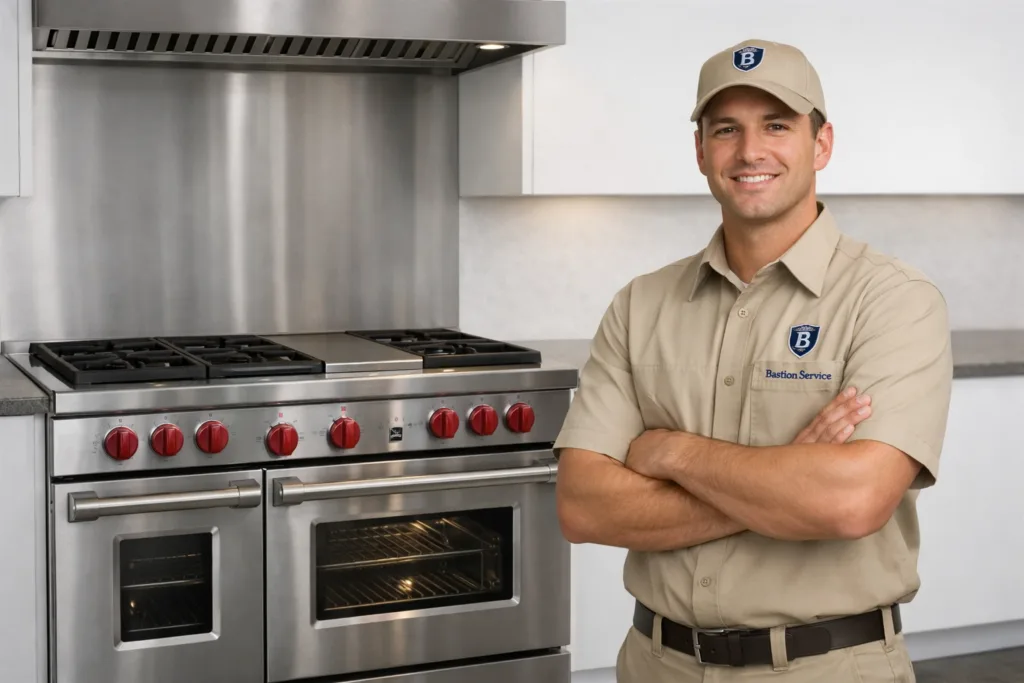




When a Wolf oven, range, or fryer starts missing temperature, failing to ignite, or dropping out during service in Playa Vista, the real issue is not just the bad symptom. It is the effect on output, timing, food quality, and whether the equipment can stay in use without creating a larger interruption. Bastion Service works with businesses in Playa Vista to identify the failed system, assess whether continued operation is reasonable, and schedule repair around actual kitchen demands.
For specific equipment paths in Playa Vista, review Wolf Oven Repair in Playa Vista, Wolf Range Repair in Playa Vista, and Wolf Fryer Repair in Playa Vista.
Many cooking equipment problems look similar at first. An oven that runs cold may have a sensor issue, a control problem, an ignition fault, or trouble in the heating circuit. A fryer with poor recovery may seem like a temperature problem when the underlying cause is a burner or safety-related component. A range that lights inconsistently can involve ignition parts, switches, wiring, or gas control response. That is why repair decisions are usually best made after symptom-based testing instead of guessing from surface behavior alone.
What Wolf cooking equipment problems usually need service?
Most repair calls for Wolf cooking equipment fall into a few operational patterns that affect day-to-day kitchen performance:
- Units that do not heat properly or take too long to recover
- Ignition problems, delayed startup, or failure to light
- Burners that are weak, uneven, or shutting off
- Controls that drift, stop responding, or cause erratic cycling
- Unexpected shutdowns during prep or service
- Inconsistent cooking results that point to unstable temperature control
These issues matter even before total failure. In many kitchens, reduced performance causes just as much disruption as a complete outage because staff have to compensate for slow heat, unreliable ignition, or uneven results while trying to maintain service.
Heating and temperature control problems
Ovens that run too hot, too cold, or unevenly
Temperature complaints are common with business-use ovens, and they are not always straightforward. If a unit overshoots, struggles to reach set temperature, or produces uneven cooking results, the fault may involve the sensor, thermostat logic, relays, ignition sequence, control board behavior, or gas-related heating performance depending on the model. In a working kitchen, that can lead to repeated product inconsistency, longer cook times, and unnecessary waste.
Uneven heat also tends to create confusion because staff may assume the recipe or loading pattern is the problem before realizing the equipment is no longer regulating properly. Service becomes important when the pattern is repeatable, when calibration no longer holds, or when the oven cannot maintain stable operation through normal production cycles.
Fryers with slow recovery or unstable oil temperature
A Wolf fryer that recovers slowly between batches or swings too far above or below target temperature can affect output almost immediately. Food quality changes, ticket flow slows down, and operators may start adjusting workflow around a unit that is no longer keeping up. Common causes include thermostat issues, high-limit components, burner performance faults, sensor problems, or control failures that prevent steady heat management.
If oil temperature is erratic, the unit should not simply be pushed harder to get through service. Slow recovery and unstable heat usually point to a condition that can worsen under continued use, especially during higher-volume periods.
Ignition, burner, and startup faults
Ranges or ovens that click, spark, or fail to light reliably
Startup problems often begin as a minor annoyance and then turn into a full service disruption. A Wolf range or oven may click repeatedly, ignite only after several attempts, light one section but not another, or fail to start at all. Those symptoms can involve igniters, spark modules, flame sensing, switches, wiring, or valve-related response.
From an operations standpoint, the key question is reliability. If staff cannot trust a unit to start normally during prep or service, the equipment is already affecting line planning. Early repair is usually the better choice because repeated ignition attempts can add wear and make the failure less predictable.
Burners that are weak, uneven, or dropping out
On ranges and fryers, burner issues often show up as weak flame, uneven heating, partial burner operation, or burners that shut off unexpectedly. Sometimes the problem is obvious; other times it appears as slow cooking, poor recovery, or inconsistent heat across the equipment. The cause may involve burner assemblies, ignition components, controls, valves, or contamination interfering with normal operation.
Burner faults should be treated as performance and reliability problems, not just convenience issues. When heat is unstable, kitchens lose consistency and throughput, and the equipment may no longer be suitable for normal demand until the problem is confirmed.
Intermittent shutdowns and control-related failures
Some of the most disruptive Wolf cooking equipment problems are intermittent. A unit may work properly in the morning, then stop heating, shut down, or become unresponsive later in the day. It may restart after cooling off or fail only during heavy use. These patterns often point to failing controls, loose electrical connections, heat-sensitive components, or safety devices interrupting operation.
Intermittent faults are especially difficult for kitchen teams because they create uncertainty. Staff cannot plan around the equipment, and managers may not know whether the unit is safe or dependable enough to keep online. A scheduled service visit allows testing around the actual symptom pattern so the repair plan is based on confirmed behavior rather than a one-time workaround.
How symptom patterns affect repair decisions
Not every problem means the equipment is at end of life. In many cases, a Wolf oven, range, or fryer is still a strong repair candidate if the issue is limited to a specific heating, ignition, or control system. The more important question is whether the current symptoms point to an isolated repair or repeated breakdown risk across multiple systems.
Repair usually makes sense when:
- The fault appears confined to one operating system
- The equipment has otherwise been performing well
- The problem was caught before a complete shutdown caused secondary damage
- Restoring consistent heat or ignition will return the unit to normal production use
Replacement becomes a more serious discussion when major failures are stacking up, control problems keep returning, or overall reliability has dropped to the point that downtime remains likely even after individual repairs.
When to stop using the equipment
Businesses should consider taking a unit offline when heating is uncontrolled, ignition is delayed or unreliable, burners are dropping out, controls are not responding properly, or shutdowns are becoming frequent. Continued use under those conditions can increase wear, create unsafe operation concerns, and turn a contained repair into a broader equipment failure.
Even when the unit still runs, reduced trust in the equipment is a valid reason to schedule service. If staff are avoiding a station, adjusting cook times constantly, or treating startup as uncertain, the equipment is already costing the kitchen time and consistency.
Repair scheduling for kitchens in Playa Vista
For businesses in Playa Vista, repair scheduling is about more than fixing a bad component. It is about limiting downtime, protecting production flow, and making sure the equipment returns to use with a realistic understanding of what failed and why. A service appointment should help answer practical questions: whether the unit can remain in use, which system is actually causing the symptom, and what repair path best supports daily operations.
If your Wolf cooking equipment is slowing service, affecting heat consistency, or creating shutdown risk, the next step is to schedule diagnosis before the problem spreads into a larger interruption. That gives your team a direct path from symptom to repair and helps you make informed decisions about continued use, timing, and return to service.


