
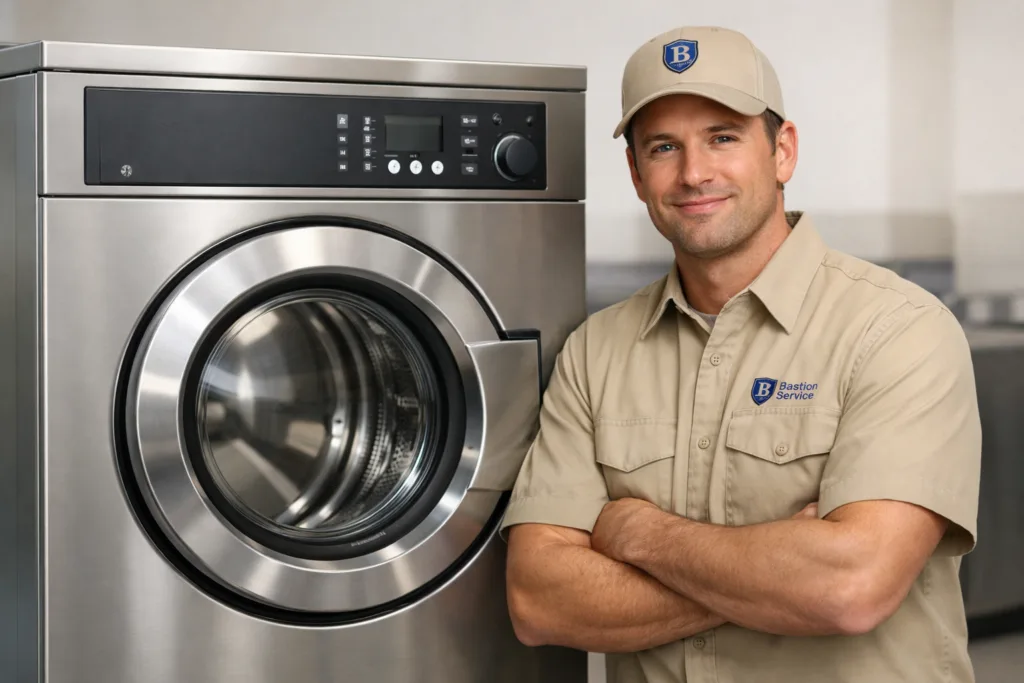




A Wascomat washer problem can quickly disrupt laundry flow, staffing, and turnaround times when the machine is part of daily operations. For businesses in Century City, repair service is most effective when the symptom is traced to the actual failing system rather than treated as a one-time interruption. Bastion Service works with business owners, managers, and facility teams to identify whether the issue is related to controls, drainage, fill performance, extraction, door lock operation, pump function, or mechanical wear so the next repair decision is based on the machine’s real condition.
Related commercial service paths in Century City include Wascomat Commercial Repair in Century City, Commercial Washer Repair in Century City, and Wascomat Dryer Repair in Century City.
What recurring washer problems usually mean
Washers often show patterns before they stop completely. A load that finishes late, water left in the drum, weak extraction, new vibration, or random shutdowns can each point to a different repair path. When those symptoms repeat, the goal is to confirm whether the fault is electrical, mechanical, hydraulic, or installation-related.
That matters because one symptom can have more than one cause. A unit that will not complete a cycle may have a drain problem, a door lock issue, a sensor fault, or a control interruption. A washer that seems to wash poorly may actually be underfilling, failing to heat properly, or cutting the cycle short. Symptom-based diagnosis helps prevent unnecessary parts replacement and short-term fixes that do not hold up under daily use.
Common Wascomat washer symptoms and likely fault areas
Not starting or not completing the cycle
If the washer does not start, pauses during operation, or shuts down before the cycle ends, likely fault areas include the door lock system, control board response, power supply issues, start-command problems, or safety-related input failures. In some cases, the machine appears to accept the cycle but never advances correctly. In others, it stops at the same stage repeatedly. That pattern helps narrow the diagnosis and can show whether the problem is consistent or intermittent.
Repeated restarts by staff may temporarily get the machine moving again, but they usually do not resolve the underlying cause. If the washer is interrupting production or requiring constant operator attention, service should be scheduled before the failure becomes more disruptive.
Not filling, slow fill, or incorrect water temperature
Water fill problems affect wash quality, cycle timing, and balance during extraction. A Wascomat washer that fills too slowly, does not fill at all, or shows inconsistent hot and cold water performance may be dealing with inlet valve issues, water supply restrictions, sensor feedback problems, or control faults. Even when the washer still runs, low or incorrect fill levels can lead to poor cleaning results and repeated cycle complaints.
Temperature-related issues can also affect chemistry performance and cycle consistency. If the machine is supposed to run heated or specific programmed wash temperatures, inaccurate fill or heat behavior should be addressed before it affects multiple loads.
Not draining or leaving water in the drum
Drainage complaints are among the most common washer service calls because they stop the cycle from finishing correctly and can leave laundry trapped in the machine. Slow draining, standing water, or a washer that reaches drain and then stops may indicate a blocked drain path, pump failure, partial obstruction, control issue, or sensor problem.
When drainage is inconsistent, the washer may appear to work on one load and fail on the next. That does not mean the issue has resolved. It often means the restriction or pump problem is getting worse. A washer that repeatedly holds water should be inspected promptly to avoid added strain on connected components and prevent workflow delays.
Weak spin, wet loads, or extraction problems
If loads come out wetter than normal, drying times rise, and productivity drops across the laundry room. Weak spin performance can be caused by imbalance detection faults, drive system problems, worn suspension components, bearing wear, drainage issues that prevent full extraction, or controls that are not allowing the washer to reach proper spin speed.
This symptom has a wider operating impact than many teams expect. Wet loads slow down the next stage of processing, increase dryer demand, and can make the washer appear less reliable than it actually is if the root cause is in only one subsystem. When extraction quality changes suddenly, the machine should be checked before continued use increases wear.
Excessive vibration, banging, or unusual noise
New noise is one of the clearest signs that service should not be delayed. Banging during spin, grinding, scraping, or harsh vibration can point to suspension wear, bearing trouble, mounting issues, drum-related problems, or drive component wear. Some vibration issues are made worse by leveling problems or repeated use after another fault has already developed.
Because noise complaints can move from mild to severe quickly, they should be treated as a warning sign rather than a nuisance. If the washer sounds different under load, especially during acceleration or high spin, it is best to remove guesswork and have the source confirmed.
Leaks during or after the cycle
Leaks can come from hoses, door seal wear, pump components, drain connections, internal routing failures, or oversudsing conditions that mimic a machine leak. Water often travels before it becomes visible, so the wet area on the floor is not always the exact point of failure.
For businesses in Century City, a leaking washer creates more than cleanup work. It can affect safety, surrounding equipment, flooring, and room availability. Even a small recurring leak should be evaluated before it becomes a larger interruption.
Why intermittent faults are easy to underestimate
Some of the most disruptive washer problems do not happen on every cycle. A machine may complete several loads and then suddenly fail to drain, stop before spin, or show a random shutdown. Intermittent behavior often leads teams to keep the unit in use because it is still partly operating, but this can make the pattern harder to track and can allow a manageable repair to turn into a bigger one.
Intermittent issues are especially important to document. If possible, note when the failure happens, what stage of the cycle it occurs in, whether the load size changes the behavior, and whether any unusual noise or water retention appears at the same time. Those details can help shorten diagnosis and reduce repeated downtime.
When to take the washer out of service
It is usually time to stop running the machine and schedule repair if any of the following are happening consistently:
- the washer will not start or repeatedly stops before completion
- water remains in the drum after the cycle
- loads are coming out unusually wet
- the unit is leaking during operation
- new grinding, scraping, or banging noise is present
- staff must reset or restart the machine to finish normal loads
- cycle times are becoming unpredictable
Continuing to run a washer in this condition can increase damage, create avoidable delays, and make the eventual repair more involved than it needed to be.
What a useful service visit should determine
Effective washer repair starts with confirming the complaint under actual operating conditions whenever possible. That usually includes checking fill behavior, drain performance, lock engagement, control response, spin function, vibration, and visible signs of wear or leakage. A fault code can be helpful, but it is only part of the picture. The machine’s recent behavior and the exact symptom pattern are just as important.
For a Wascomat washer used in daily operations, diagnosis should help answer a few practical questions: what failed, whether additional parts may be affected, whether the machine can stay in rotation safely, and whether repair is likely to restore stable operation. That information matters when downtime affects staffing and schedule planning.
Repair versus replacement decisions
Many washer problems are repairable when the machine is otherwise in solid condition and the failure is limited to a specific subsystem. Pumps, valves, door lock components, control-related faults, drain obstructions, and some drive-related issues can often be addressed without replacing the unit.
Replacement becomes a more serious consideration when the washer has multiple major problems at the same time, shows repeated breakdown patterns across different systems, or has widespread wear that makes continued investment harder to justify. The deciding factor is not usually a single symptom alone. It is the combination of repair scope, machine condition, operating demands, and how much downtime risk remains after service.
Preparing for a washer repair appointment
Before service is scheduled, it helps to gather a few details about the machine’s recent performance. Useful information includes whether the issue happens every cycle or only sometimes, whether the unit reaches fill, wash, drain, and spin normally, whether any water is left behind, and whether there has been a change in noise, vibration, or leak behavior.
If the washer is in a shared laundry room or business facility, it is also helpful to know how urgently the machine needs to be returned to service and whether the problem is affecting related workflow. That context can help prioritize the repair path and reduce unnecessary delays once the issue has been identified.
Service-focused support for washer downtime in Century City
When a Wascomat washer starts failing in Century City, the best next step is to schedule service based on the exact symptom pattern rather than continue running the unit and hope the issue stays manageable. Whether the problem involves drainage, weak extraction, leaks, fill faults, cycle interruptions, or unusual mechanical behavior, a targeted repair process helps protect uptime and keeps the disruption from spreading through the rest of the laundry operation.


