
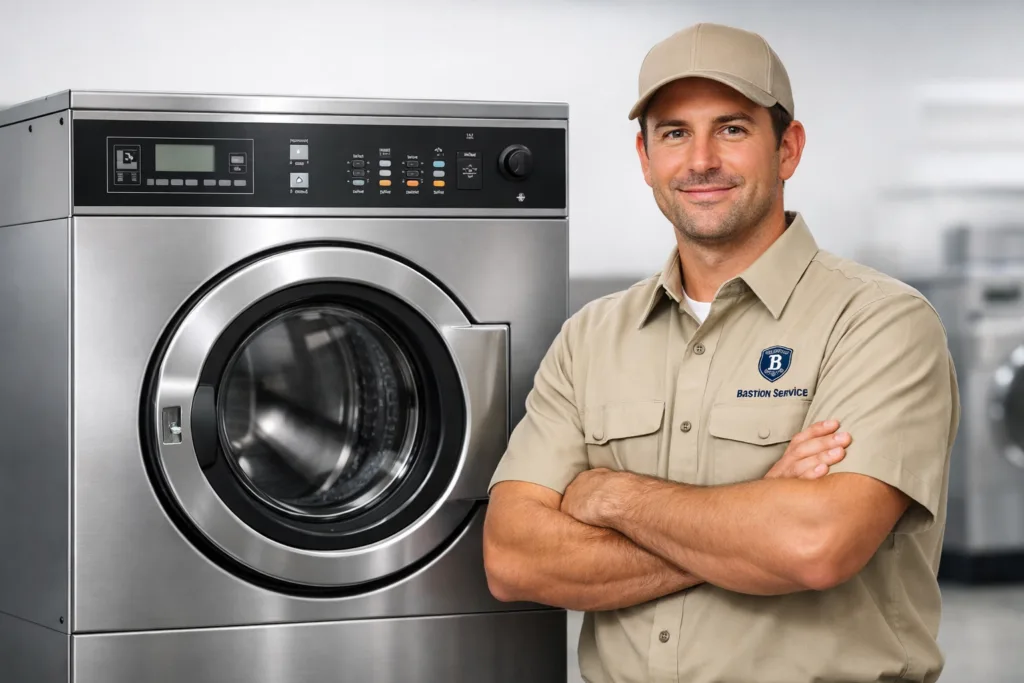




Washer downtime can quickly create backlog, wet-load delays, and staff workarounds that affect daily operations. For businesses in Century City, the most useful next step is service that starts with the actual symptom pattern, confirms the failed system, and helps determine whether repair should be scheduled immediately or planned around workflow. Bastion Service handles Speed Queen washer issues with that service-focused approach so decisions are based on machine condition rather than guesswork.
Related commercial service paths in Century City include Speed Queen Commercial Repair in Century City, Commercial Washer Repair in Century City, and Speed Queen Dryer Repair in Century City.
What a symptom-based washer diagnosis should cover
A Speed Queen washer can show one obvious problem while the root cause is somewhere else in the cycle. A unit that will not spin may actually have a drain problem. A washer that stops mid-cycle may be dealing with a door-lock fault, water-level issue, or control failure. An accurate inspection helps identify whether the problem involves the pump, inlet components, motor system, suspension, controls, or wear across multiple assemblies.
That matters for businesses in Century City because repair planning is not only about restoring one load. It also affects scheduling, parts approval, labor planning, and whether the machine is likely to return to stable operation after service.
Common Speed Queen washer problems and what they often indicate
Washer not starting or not completing the cycle
If the washer does not begin a cycle, pauses unexpectedly, or shuts down before completion, likely causes include door or lid lock problems, control-board faults, user-interface issues, power-supply interruptions, or failed start components. In some cases, the machine may appear to start normally and then stop once it reaches a point in the cycle that depends on a sensor or safety circuit.
Repeated resets, intermittent starts, or random cycle cancellation usually point to a condition that needs inspection rather than continued trial-and-error use.
Fills with water but does not wash properly
When the washer fills but agitation or wash action is weak, inconsistent, or absent, the issue may involve the drive system, motor, belt, transmission-related wear, or a control fault that is preventing normal operation. If the basket movement sounds strained or uneven, the machine may be operating with developing mechanical wear that can worsen under load.
Not draining or leaving standing water
Slow draining, a stalled drain phase, or water left in the tub often points to a blocked pump path, a failing drain pump, hose restriction, debris buildup, or a control problem interrupting the drain sequence. In a busy laundry setting, this symptom should be addressed promptly because repeat operation with standing water can increase strain on the pump and delay the next loads behind it.
Not spinning or leaving loads too wet
Spin complaints can be caused by imbalance conditions, drain faults, worn suspension parts, motor or drive issues, or control-related interruptions. A washer that reaches the end of the cycle with heavy residual moisture may still seem partly functional, but poor extraction often creates bottlenecks in the rest of the laundry process and can signal a larger mechanical or control problem.
Leaking during fill, wash, or drain
Leaks may come from hoses, inlet connections, pump components, door or tub seals, internal plumbing, or movement-related wear. The timing of the leak often helps narrow the source. A leak during fill may suggest an inlet-side issue, while leakage during drain or spin may point toward pump or tub-related components. Water around the machine should be taken seriously because it can affect flooring, nearby equipment, and safe operation.
Excessive vibration, banging, or unusual noise
Heavy shaking, impact noise, scraping, grinding, or rumbling can indicate suspension wear, bearing issues, support problems, an out-of-balance condition, or internal mechanical damage. If the washer is striking the cabinet or moving excessively, continued use can increase wear and turn a localized repair into a broader rebuild decision.
Why the same symptom can lead to different repair decisions
One reason washer problems can be frustrating is that similar symptoms may come from entirely different failures. A machine that will not complete the cycle could have a lock issue, a pressure-sensing problem, or an electronic control fault. A no-spin complaint could be caused by poor draining rather than a failed spin assembly. A leak could be a simple hose issue or a sign of deeper wear around seals or internal components.
This is why repair approval should follow inspection findings, not assumptions. Once the failed system is confirmed, it becomes easier to decide whether the machine is a strong repair candidate, whether additional wear is present, and whether the expected result supports continued use in a business setting.
When service should be scheduled promptly
It is usually time to schedule washer service when you notice any of the following:
- The machine will not start or regularly stops before the cycle ends
- Standing water remains in the tub
- Loads come out unusually wet after the final cycle
- The washer leaks onto the floor
- The unit vibrates aggressively or produces new mechanical noise
- Error behavior or repeated resets have become part of normal operation
These are operating faults, not minor inconveniences. In businesses that rely on consistent laundry throughput, even partial washer performance loss can create delays that spread across the rest of the day.
Signs continued use may cause more damage
Some washers can limp through a few more cycles, but that does not always mean they should. Continued operation becomes risky when the machine is grinding, overheating, failing to lock properly, leaking during use, or repeatedly stopping under load. A washer that bangs hard during spin or struggles to drain can place additional stress on connected parts each time it runs.
Removing a clearly failing unit from active use until it is inspected is often the better choice for Century City businesses trying to limit avoidable downtime and prevent secondary damage.
Repair or replace: what usually matters most
Repair is often the sensible option when the washer is otherwise in solid condition and the failure is limited to a specific component group. Replacement becomes a more serious consideration when the unit has recurring breakdowns, significant wear across multiple systems, or repair cost that does not match the machine’s remaining value and expected reliability.
The best comparison is not just the cost of one part. It is the total effect on uptime, staff workarounds, cycle reliability, and the chance of another near-term failure. A diagnosis that identifies both the primary fault and any surrounding wear gives a more realistic basis for that decision.
How to prepare for a washer repair visit
Before service is scheduled, it helps to note exactly what the machine is doing and when the problem occurs. Useful details include whether the washer fills, drains, locks, spins, leaks, or stops at a specific point in the cycle. If the problem is intermittent, noting whether it happens under heavier loads, during extraction, or only after multiple back-to-back cycles can also help narrow the cause faster.
If water leakage or severe vibration is present, limiting use until inspection is usually the safest course. A short symptom history often helps the visit stay focused and supports a faster repair decision once the machine is evaluated.
Service decisions should support daily operations
Speed Queen washer repair in Century City is most effective when it is handled as an operations issue as well as an equipment issue. The goal is not just to address one fault code or one failed cycle, but to restore dependable function, reduce repeat interruptions, and give the business a realistic next step based on the condition of the machine. If a Speed Queen washer is disrupting throughput, leaking, failing to drain, or not completing cycles, scheduling service is the practical move to define the problem and move toward repair with confidence.


