
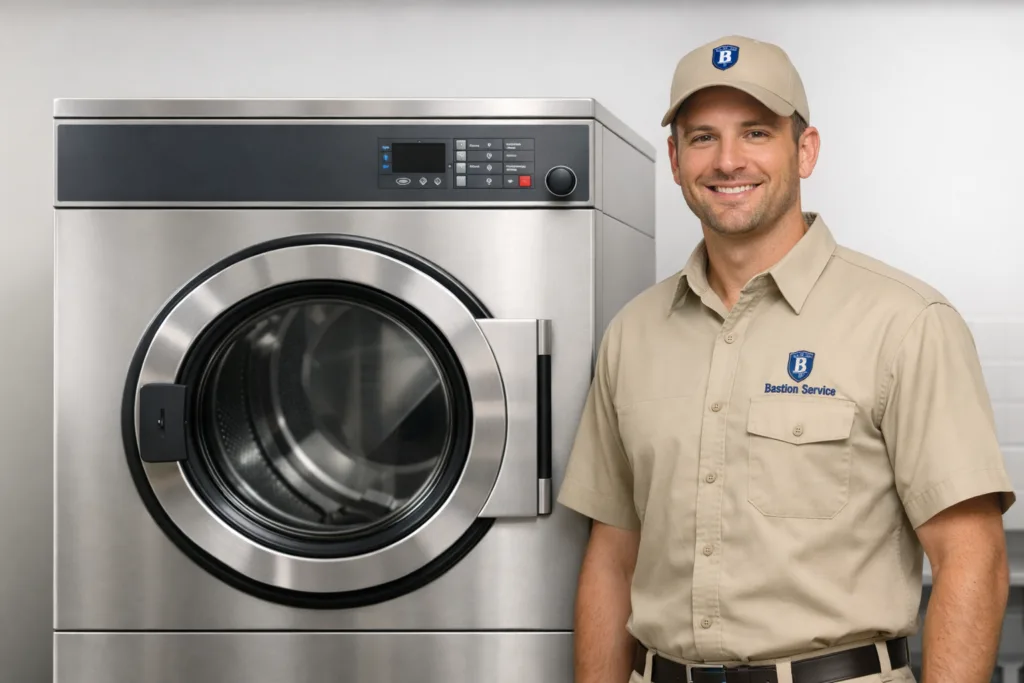





Dryer problems can disrupt sorting, wash-to-dry flow, labor planning, and customer turnaround faster than many teams expect. When a Wascomat unit starts running cold, taking too long, shutting down, or making new noise, the best next step is to verify the cause before approving parts or pushing the machine through another day of use. Bastion Service works with businesses in Del Rey to inspect symptom patterns, identify the failed system, and schedule repair based on downtime risk, safety concerns, and the condition of the machine overall.
Related commercial service paths in Del Rey include Wascomat Commercial Repair in Del Rey, Commercial Dryer Repair in Del Rey, and Wascomat Washer Repair in Del Rey.
How Wascomat dryer problems affect day-to-day operations
A dryer issue is rarely just a dryer issue. In laundromats, hotels, care facilities, and shared laundry rooms, one underperforming machine can create a backlog that spreads through the rest of the shift. Loads stay in rotation longer, staff spends more time re-running cycles, and customers or residents notice slower turnaround.
That is why symptom-based service matters. A drum that turns without heat may point to a heating failure, but it can also involve airflow restriction, controls, sensing problems, or supply issues. A noisy machine may still finish loads today while quietly damaging rollers, supports, or the blower system. Looking at the full operating condition helps prevent repeat breakdowns and wasted repair spend.
Common Wascomat dryer symptoms and what they may mean
No heat or weak heat
If the dryer tumbles normally but clothes remain damp, the problem may involve heating elements, igniters, gas or electric heat delivery, thermostats, temperature sensors, wiring, relays, or the control system. In some cases, the heat is present but too weak or too inconsistent to finish the load on time.
This symptom should be tested rather than guessed at. Heat complaints often overlap with airflow issues, and replacing a heat-related part without checking venting, lint buildup, and temperature behavior can leave the root cause in place.
Long dry times
Longer cycle times usually mean the dryer is no longer moving heat and moisture efficiently. Common causes include restricted airflow, clogged lint paths, weak heating performance, poor moisture sensing, blower problems, or vent limitations that reduce drying efficiency under normal load.
For businesses in Del Rey, this issue can look manageable at first because the dryer still operates. The bigger problem is that throughput drops while energy use and wear increase. If loads that used to finish in one cycle now need extra time, service is often worth scheduling before the machine begins overheating or dropping out mid-cycle.
Overheating or repeated high-limit trips
A dryer that gets unusually hot, smells scorched, or stops while handling a normal load may be dealing with blocked airflow, sensor problems, a stuck heating condition, or internal buildup affecting normal heat transfer. Overheating can also trigger protective shutdowns that seem intermittent until the unit fails completely.
Continued operation in this condition can affect wiring, belts, drum supports, and nearby components. Heat-related faults are worth addressing quickly because the original failure can spread into a larger repair if the unit stays in rotation.
Grinding, thumping, squealing, or scraping
Unusual sounds often come from worn rollers, idler assemblies, bearings, belts, motor strain, blower wheel problems, or drum support wear. A noisy dryer may still produce heat and finish cycles, but that does not mean the issue is minor.
When noise grows progressively worse, the repair often becomes more involved. A support problem caught early may be contained. A support problem ignored for too long can affect the drum, cabinet, drive components, or motor load.
Stops mid-cycle or will not start
Intermittent shutdowns can be caused by overheating protection, door switch issues, motor problems, timer or control failures, power supply irregularities, or internal electrical faults. A complete no-start complaint may come from several of the same systems.
These problems are especially disruptive because they are hard for staff to work around. A dryer that sometimes starts and sometimes does not can create constant rechecking, repeated resets, and uncertainty about whether a load will finish at all.
Why a proper diagnosis matters before repair approval
Dryers often show one visible symptom while the actual fault sits elsewhere in the system. For example, no heat may start with a failed component but also reveal poor airflow that caused excess thermal stress. A shutdown complaint may look electrical but actually begin with overheating from blocked exhaust flow. A vibration call may point to one worn support part while related components are already close behind.
Inspection and testing help answer the questions that matter most to operations:
- What failed first
- Whether the dryer can continue running safely
- Whether additional parts are likely to be involved
- Whether the repair is likely to hold up under normal daily use
- Whether the machine is still a good candidate for targeted repair
That information helps managers and facility teams make repair decisions with a clearer view of downtime, cost, and risk.
When to stop using the dryer and schedule service
Some symptoms justify immediate attention because continued use can make the final repair more expensive or create unsafe operating conditions. Service should move higher on the priority list when the dryer shows any of the following:
- No heat during a normal cycle
- Dry times that are increasing week over week
- Repeated shutdowns during operation
- Burning smells or signs of overheating
- Sudden scraping, grinding, or heavy thumping
- Frequent resets or inconsistent starts
- Noticeable drop in airflow performance
Even if the machine still runs, these signs usually indicate a problem that will not resolve on its own. Scheduling service early can help avoid a full outage during busy periods.
Airflow issues are often bigger than they appear
Airflow problems are one of the most common reasons a dryer begins underperforming. Reduced airflow can lead to long dry times, poor heat distribution, overheating, nuisance shutdowns, and premature failure of heat-related parts. It also changes how the dryer behaves under load, which can make diagnosis confusing if the unit is only checked briefly.
When airflow is restricted, the dryer may seem to have a heat problem, a sensor problem, or an intermittent control problem. In reality, the machine may be reacting to trapped heat and poor moisture removal. That is why airflow and vent conditions are an important part of evaluating Wascomat dryer complaints in Del Rey.
Repair or replacement: what makes sense?
Many dryer issues are repairable when the machine is otherwise structurally sound and the fault is limited to a defined system such as heating, controls, switches, support components, or drive parts. In those cases, targeted repair can restore normal performance without turning the situation into a larger equipment project.
Replacement becomes a more realistic discussion when the dryer has multiple active problems, a long history of repeat outages, signs of broad wear, or repair needs that extend well beyond the original complaint. The right decision depends less on one part failure and more on the overall condition of the machine, expected workload, and how much unplanned downtime the operation can absorb.
How to prepare for a service visit
Before service is scheduled, it helps to note what the dryer is doing and when the issue appears. Useful details include whether the drum turns, whether heat is present at any point in the cycle, whether the problem happens with every load, whether staff has noticed odor or unusual noise, and whether the shutdown happens at a predictable stage.
Helpful information for the visit includes:
- The model details if available
- How long the symptom has been happening
- Whether performance is getting gradually worse or failed suddenly
- Any recent error behavior, resets, or breaker trips
- Whether one dryer or several units are showing similar issues
That kind of information can speed up troubleshooting and make it easier to decide whether the issue is isolated to the machine or connected to airflow, utility, or installation conditions.
Service-focused next steps for Del Rey businesses
When a Wascomat dryer starts affecting production, waiting for a complete failure usually creates more disruption than scheduling repair while the symptoms are still manageable. If the unit is not heating, running too long, making new noise, shutting down, or showing signs of overheating, the most useful next step is to have the machine evaluated and the failure narrowed down to the system actually causing the problem. That gives Del Rey businesses a sound basis for repair scheduling, parts planning, and reducing downtime before the issue grows into a larger outage.


