
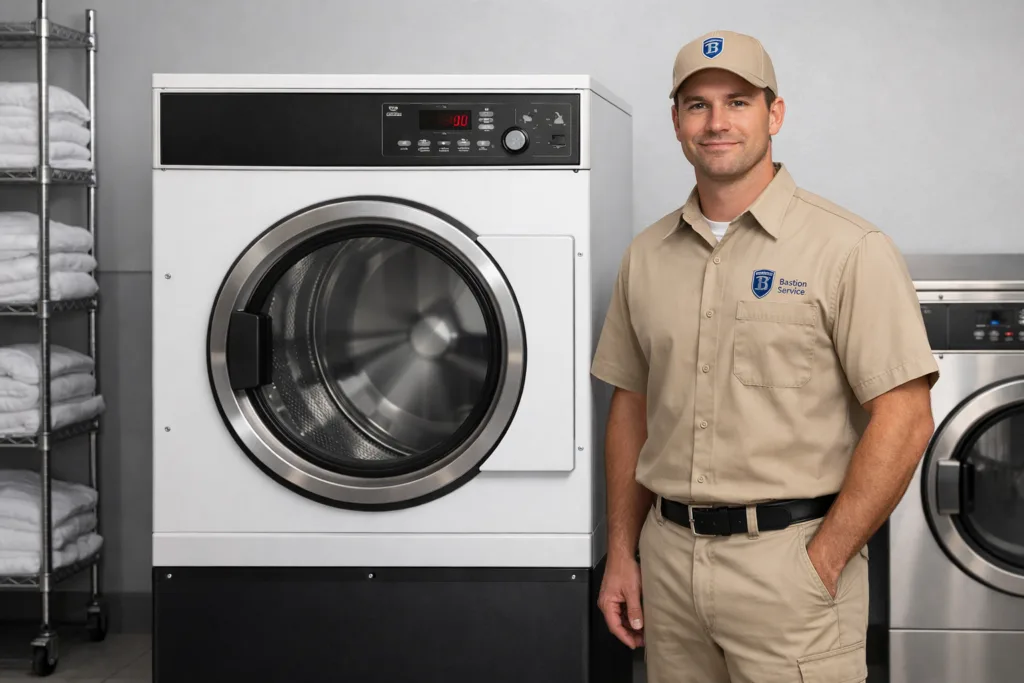





When a Speed Queen dryer starts falling behind, the issue affects more than one machine. Delayed dry times, repeat loads, shutdowns, and temperature problems can slow turnover, create extra handling for staff, and put pressure on the rest of the laundry workflow. For businesses in Del Rey, the best next step is service that identifies the actual fault before repair decisions are made, especially when similar symptoms can come from airflow, heat, controls, drive components, or site power conditions.
Related commercial service paths in Del Rey include Speed Queen Commercial Repair in Del Rey, Commercial Dryer Repair in Del Rey, and Speed Queen Washer Repair in Del Rey.
Bastion Service works with businesses in Del Rey to diagnose and repair Speed Queen dryer problems based on how the machine is failing in real use. That approach helps reduce unnecessary parts replacement, shortens avoidable downtime, and gives operators a better sense of whether the problem is isolated or part of a larger wear pattern.
Common Speed Queen Dryer Problems
No heat or weak heat
If the drum turns but loads remain damp, the cause may involve heating elements, gas ignition components, thermostats, temperature sensing, relays, airflow restriction, or incoming voltage issues. In daily operation, this usually shows up as longer dry times, inconsistent results between loads, or a dryer that seems to run normally without actually finishing the job.
This symptom matters because repeated low-heat operation often leads staff to rerun cycles, increasing energy use and slowing output. It can also hide the real issue if the machine appears partially functional but never reaches proper drying performance.
Long dry times and poor airflow
A Speed Queen dryer that takes too long to dry may not have a failed heater at all. Restricted exhaust flow, lint buildup, blower problems, crushed venting, or sensor-related issues can all produce extended cycle times. In business settings, airflow problems are especially disruptive because they affect both drying quality and temperature control.
When airflow is compromised, the dryer may overheat, trip protective limits, or shut down before the load is finished. That is why long dry times should be evaluated as a system problem rather than assumed to be a simple heat failure.
Dryer stops mid-cycle or shuts down unexpectedly
Unexpected shutdowns can point to overheating, motor overload, safety circuit trips, door switch issues, control faults, or unstable electrical supply. Some units restart after cooling down, while others stop at roughly the same point in the cycle. That pattern is useful during diagnosis because it helps narrow whether the interruption is heat-related, electrical, or mechanical.
If shutdowns are happening repeatedly, continued operation can worsen wear on motors, controls, and heat-related components. It also makes scheduling harder because staff cannot rely on cycle completion.
Drum will not turn or turns inconsistently
A no-tumble condition may involve a broken belt, worn idler, seized support parts, motor failure, switch issues, or drag in the drum assembly. Sometimes the dryer hums but does not start turning. In other cases, it runs empty but stalls under a normal load.
Those details matter because they often separate a drive-system fault from a deeper motor or electrical problem. A dryer that cannot maintain drum movement should be checked promptly to avoid added strain on the motor and related parts.
Noise, vibration, or burning odor
Squealing, scraping, thumping, rattling, or excessive vibration usually indicates wear in support rollers, bearings, belt components, motor mounts, or drum-related hardware. A burning smell may come from friction, overheated lint, wiring damage, or components operating beyond normal temperature.
These symptoms are not just nuisances. In a busy laundry room, they are often early warning signs that a repairable issue is becoming a larger mechanical or safety concern.
Controls, timer, or start function problems
If the dryer will not start, does not respond correctly to settings, ends cycles too early, or behaves inconsistently from one load to the next, the problem may involve the control board, timer, interface, door switch circuit, moisture sensing, or power input. Control-related symptoms can overlap with heat and motor faults, which is why testing matters before parts are approved.
Why Symptom Patterns Matter
Two Speed Queen dryers can appear to have the same problem while requiring very different repairs. A machine that is not heating may actually be shutting down on airflow restriction. A unit that seems to have a bad control may be reacting to an overheating condition. A drum that stops mid-cycle may point to motor overload instead of a simple belt issue.
Looking at the full symptom pattern helps answer the questions that matter to a business: whether the dryer is safe to keep using, whether the repair is likely to be straightforward, whether multiple faults are present, and whether the problem is likely to spread into more costly downtime if left alone.
Why a Speed Queen Dryer May Not Heat or Finish the Cycle
When a dryer runs without finishing properly, the root cause is often one of a few common paths:
- Failed heating components or ignition-related parts
- Restricted exhaust flow causing poor drying or limit trips
- Temperature control problems leading to inconsistent heat
- Moisture sensing or cycle-control issues ending the load too soon
- Motor or drive strain causing shutdown during operation
- Power supply problems affecting heat or control behavior
What matters in service is not just identifying one failed part, but confirming why the dryer is behaving that way under load. That is often the difference between a repair that holds and a machine that returns to the same problem after a short period of use.
When to Schedule Service
Schedule repair when dry times increase, the dryer starts producing uneven results, cycles stop unexpectedly, temperatures become inconsistent, or the machine begins making new noises. These changes usually mean the unit is no longer operating within normal conditions, even if it still starts and runs.
More urgent service is appropriate when the dryer produces a burning odor, overheats, fails to turn the drum, repeatedly shuts down, or cannot complete loads needed for daily operations. In those cases, taking the unit out of regular use until the fault is identified is often the safer choice.
Repair or Replacement Considerations
Whether repair makes sense depends on the condition of the machine, the parts involved, the severity of the fault, and how important that dryer is to daily volume. Repair is often the better path when the issue is isolated and the rest of the unit remains in solid operating condition.
Replacement becomes more likely when there are multiple compounding failures, a history of repeated downtime, major heat-related wear, or repair cost that no longer aligns with the machine’s role in the business. The real question is not only whether the dryer can be made to run again, but whether it can return to steady use without creating recurring interruptions.
What a Thorough Dryer Repair Visit Should Address
Effective Speed Queen dryer service should account for the full operating path of the machine, including heat production, airflow, drum rotation, control response, temperature regulation, and safety shutoff behavior. It should also consider how the dryer performs during an actual cycle rather than treating the problem as a single isolated symptom.
For Del Rey businesses, that means looking beyond basic restart attempts and focusing on the conditions that affect uptime: whether the dryer is heating correctly, moving air properly, maintaining drum motion, completing cycles as expected, and operating without signs of overheating or unstable controls.
Preparing for a Service Appointment
Before scheduling, it helps to note what the dryer is doing and when the problem appears. Useful details include whether the unit heats at all, whether the drum turns, whether the issue happens on every load, whether noise changes as the dryer warms up, and whether the machine stops at a consistent point in the cycle. If staff have noticed a burning smell, rising room heat, or a pattern of rerunning loads, that information can also help narrow the fault faster.
If your Speed Queen dryer in Del Rey is leaving loads damp, overheating, failing to start, stopping mid-cycle, or making abnormal noise, service should be treated as an operational decision rather than a wait-and-see issue. Prompt diagnosis, sensible repair planning, and scheduling based on the actual symptom pattern can help restore output and prevent a single dryer problem from disrupting the rest of the workflow.


