
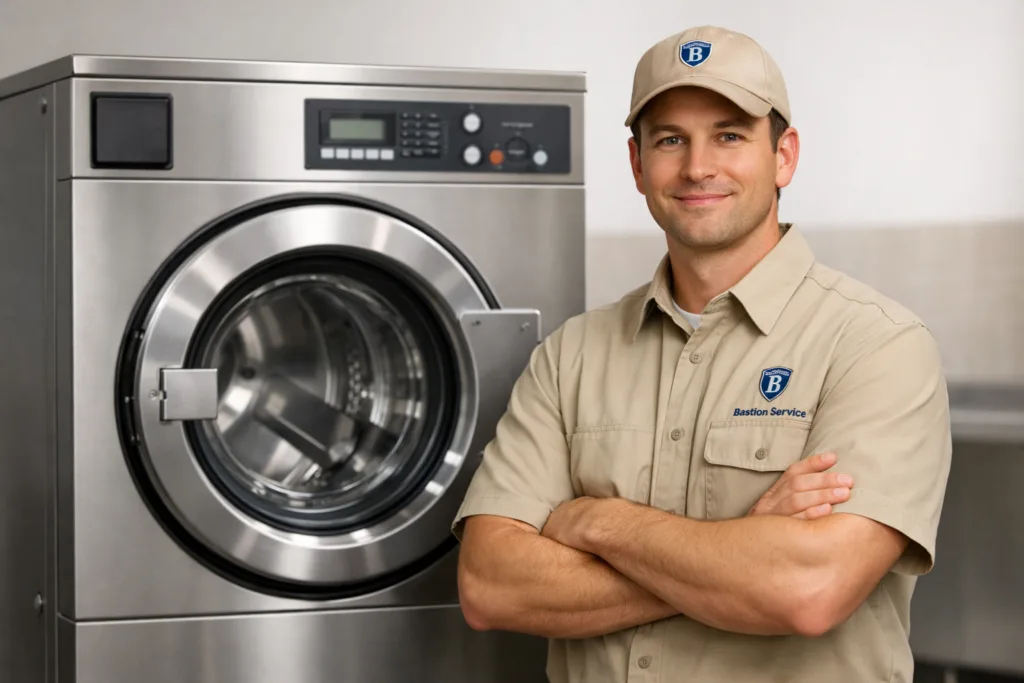




Downtime on Wascomat laundry equipment can quickly disrupt load turnaround, staffing, and customer expectations. When washer or dryer performance changes, the most useful next step is service that identifies the failed system, explains whether the unit should remain in operation, and helps you schedule repair around business needs in Del Rey. Bastion Service works with local businesses that need symptom-based repair decisions instead of trial-and-error part replacement.
For specific equipment paths in Del Rey, review Wascomat Washer Repair in Del Rey, Wascomat Dryer Repair in Del Rey, and Commercial Appliance Repair in Del Rey.
Washer and dryer symptoms that usually mean service is needed
Laundry equipment often shows smaller warning signs before a full shutdown. A washer may begin leaving water behind, stopping before spin, or developing vibration that was not present before. A dryer may still run but lose heat consistency, take much longer to finish loads, or create unusual noise. In busy laundry rooms, these changes affect throughput long before a machine goes completely out of service.
Scheduling repair is usually the right move when symptoms become repeatable, staff have to restart cycles, or one machine problem starts putting extra demand on the rest of the equipment lineup. Early diagnosis can help prevent secondary damage and reduce the chance of a more disruptive outage.
Common Wascomat washer problems
Washer not starting or stopping mid-cycle
If a Wascomat washer will not start, locks inconsistently, or stops with a load unfinished, the issue may involve the door lock system, controls, power delivery, drainage, or another internal fault. A washer that pauses at the same point in the cycle is usually giving a useful clue about which system is failing. In a business setting, repeated resets are rarely a reliable workaround.
This is especially important when the machine stops with water still inside, will not advance to spin, or shows recurring faults. Those conditions can increase delays for staff and may place added stress on other components if the unit continues to be run.
Drainage, spin, and extraction problems
Slow draining, standing water, weak extraction, or loads coming out too wet can all point to problems that need inspection. Depending on the symptom pattern, the cause may involve the drain path, pump-related issues, control problems, or drive and balance concerns. For laundromats, hotels, and shared laundry facilities, poor extraction usually creates a second bottleneck by pushing wetter loads into dryers and extending total cycle time.
If the washer is failing to drain consistently or cannot complete spin without interruption, it makes sense to pull it from use until the reason is confirmed. Continuing operation under those conditions can turn one repair into several.
Leaks, vibration, and unusual washer noise
Leaks around the machine, banging during spin, grinding sounds, or excessive movement should not be treated as normal wear. Washer vibration can be related to internal support components, load handling, mounting issues, or rotating-part wear. Water where it should not be can also indicate a problem that affects nearby equipment, flooring, or safe operation of the laundry area.
When vibration becomes severe or noise changes suddenly, service should be scheduled promptly. These symptoms often worsen with continued use and can lead to more expensive repairs if adjacent parts are damaged.
Common Wascomat dryer problems
Dryer not heating or taking too long to dry
A Wascomat dryer that tumbles but does not produce enough heat can slow daily output immediately. Long dry times may come from heating system faults, airflow restrictions, sensor issues, controls, or wear in supporting components. Because several different failures can create the same symptom, replacing a single part without diagnosis does not always restore dependable drying.
For business operators, the practical warning sign is not only no heat. It is also when loads begin taking noticeably longer, staff start rerunning cycles, or the dryer falls behind expected production.
Overheating, hot spots, or shutdowns during drying
If the dryer overheats, smells unusually hot, shuts down during operation, or produces inconsistent results from one load to the next, the issue should be addressed quickly. Overheating can point to airflow problems, control faults, sensor-related issues, or internal component failure. These conditions affect both equipment reliability and safe day-to-day use.
Any sign of overheating, burning odor, or repeated thermal interruption is a strong reason to stop using the machine until it has been evaluated.
Squealing, scraping, or drum movement issues
Dryers often become noisy before a more serious failure occurs. Squealing, scraping, thumping, or rattling can indicate wear in drum support components, rollers, belts, motor-related parts, or other moving assemblies. If the drum does not turn smoothly, the machine may still appear to run while performance continues to decline.
Addressing mechanical dryer noise early can help prevent a small wear issue from becoming a larger repair involving multiple damaged parts.
How symptom patterns affect repair decisions
The same visible problem can come from different causes. A washer that will not complete a cycle might have a drain-related issue, a lock problem, or a control fault. A dryer with poor drying results might have a heat problem, an airflow issue, or both. That is why symptom pattern matters more than guessing from one visible outcome.
Useful service should connect the symptom to the failed system, explain whether continued use is reasonable, and outline what the repair path is likely to involve. That helps operators decide how to manage staffing, machine availability, and customer impact while the repair is scheduled.
When equipment should be taken out of service
Some problems should be treated as immediate stop-use conditions. These typically include:
- Water leaks that spread beyond the machine area
- Burning smells or signs of overheating
- Failure to drain with water left inside the washer
- Severe banging, grinding, or metal-on-metal noise
- Electrical irregularities, repeated tripping, or intermittent power loss
- Dryers that become excessively hot or shut down unpredictably
In these cases, keeping the unit running may increase repair cost and create a larger interruption for the business.
Repair planning for Del Rey businesses
In Del Rey, repair planning is not just about fixing one machine. It is also about protecting daily operations. A washer that leaves loads too wet increases dryer demand. A dryer with long run times backs up the entire laundry flow. When one Wascomat unit begins underperforming, the operational impact often reaches beyond that single machine.
A productive service visit should help answer practical questions: what system failed, whether the unit can stay in limited use, what the likely scope of repair looks like, and how soon the work should be scheduled to reduce disruption. That kind of information is especially important for laundromats, hotels, apartment laundry rooms, and other local businesses that rely on steady equipment availability.
Choosing the next step when performance drops
If your Wascomat washer or dryer is showing repeat faults, leaks, drainage issues, vibration, no-heat conditions, or longer cycle times, the right next step is to schedule repair before the problem affects more of your operation. Symptom-based service can clarify whether the machine should stay in service, whether the issue is likely isolated or expanding, and how to move forward with the least disruption to daily laundry volume in Del Rey.


