
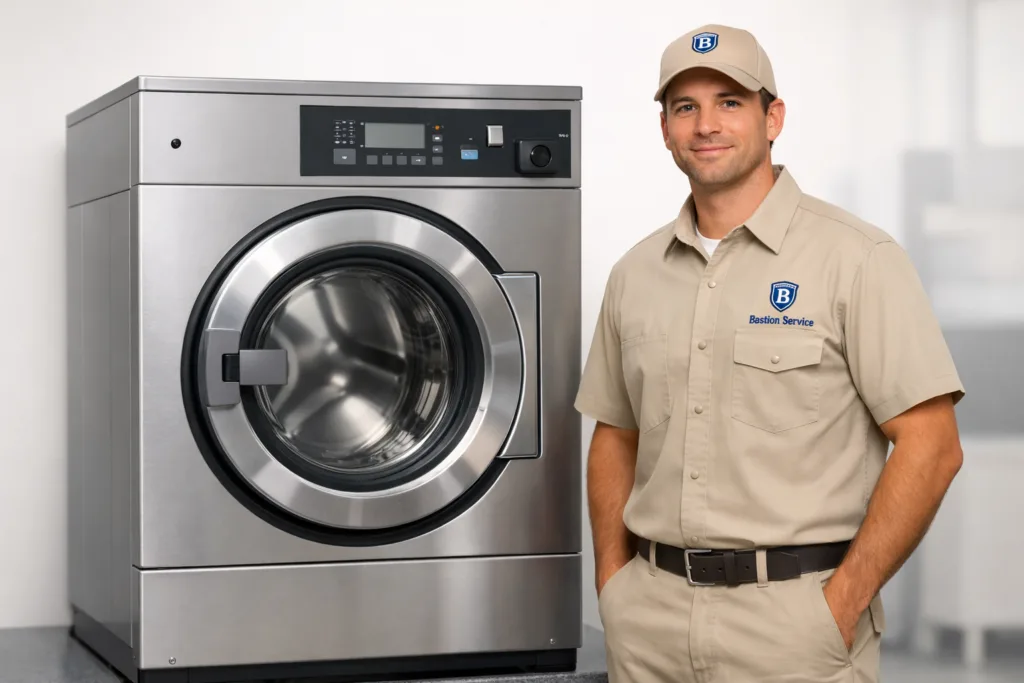




Wascomat laundry equipment problems can disrupt wash flow, delay guest or tenant service, and reduce the number of loads your team can finish in a day. When a washer stops draining or a dryer starts taking too long to dry, the real issue is not just the failed cycle. It is the effect on scheduling, labor, customer experience, and whether the machine should stay in use until repair is completed. Bastion Service helps businesses in Santa Monica assess those symptoms, identify the likely fault path, and schedule repair based on urgency and operating impact.
For specific equipment paths in Santa Monica, review Wascomat Washer Repair in Santa Monica, Wascomat Dryer Repair in Santa Monica, and Commercial Appliance Repair in Santa Monica.
What Problems Usually Lead to Service Calls
Most equipment issues show up first as performance changes rather than total failure. A washer may begin leaving loads too wet, pause before final spin, drain slowly, leak, or shake more than normal. A dryer may still run but produce weak heat, stop before the cycle finishes, overheat, or require much longer run times than usual. These symptoms matter because one failing machine can quickly affect the rest of the laundry process.
Service is often the right next step when staff are resetting units repeatedly, moving loads around to compensate for one weak machine, or noticing that the same problem returns after temporary workarounds. Early attention can help prevent a smaller fault from turning into a larger outage.
Wascomat Washer Symptoms That Need Attention
Washer Will Not Fill, Advance, or Complete the Cycle
If a washer stalls at the start of a load, stops mid-cycle, or fails to move through wash, rinse, or spin stages correctly, the cause may involve controls, door-lock issues, water intake problems, sensors, or other component faults. From an operations standpoint, incomplete cycles create immediate bottlenecks and often lead to rewash volume, wasted staff time, and uncertainty about whether the unit can be trusted for the next load.
Drainage Problems and Wet Loads After Spin
A Wascomat washer that drains slowly or leaves laundry unusually wet can cause a chain reaction across the room. Dryers take longer, queues build up, and staff may assume the issue is only on the dryer side when the wash cycle is actually the source. Drain pump problems, blockages, control faults, or spin-related issues can all show up in similar ways, which is why symptom-based diagnosis matters before repair decisions are made.
Leaks, Excessive Movement, and Noise
Water on the floor, banging during high-speed spin, scraping sounds, or visible machine movement should be treated as service issues rather than normal wear. These conditions can point to imbalance problems, worn internal parts, mounting concerns, or other mechanical faults. In a business setting, leaks and vibration also create safety and facility concerns, so a unit showing these symptoms may need to be taken out of service until it is evaluated.
Wascomat Dryer Symptoms That Affect Throughput
No Heat, Weak Heat, or Long Dry Times
When a dryer tumbles but does not dry effectively, the problem may involve heating components, sensors, controls, airflow restriction, or other system issues. Long dry times are easy to underestimate because the machine is still running, but reduced output often means fewer completed loads per shift and more pressure on the remaining equipment. If loads are consistently coming out damp or drying times keep increasing, repair scheduling usually makes more sense than continued wait-and-see operation.
Dryer Stops Mid-Cycle or Shuts Down Repeatedly
A dryer that starts normally but shuts off before completing the load may be reacting to overheating, airflow problems, control issues, or failing parts that become more obvious under load. Repeated shutdowns should not be treated as a minor nuisance. They are often a sign that the machine is no longer operating reliably enough for routine use.
Overheating, Burning Odors, and Unusual Mechanical Sounds
If the dryer cabinet feels unusually hot, if there is an abnormal smell during operation, or if the machine produces squealing, grinding, or thumping sounds, it is best to stop relying on that unit until it is checked. Overheating and mechanical noise can worsen quickly under daily use and may lead to broader damage if ignored.
How Symptom Patterns Help Prioritize Repair
Not every problem carries the same level of urgency. Some symptoms point to a machine that may be declining but still manageable for a short period, while others suggest a unit should be pulled from service right away. In general, these conditions deserve prompt attention:
- Active water leaks
- Repeated error conditions or cycle failures
- Overheating or safety shutoffs
- Grinding, scraping, or heavy banging sounds
- Loads consistently coming out soaked or under-dried
- Frequent operator resets just to finish normal cycles
When those patterns are present, the question is not only what part failed. It is also whether continued operation risks more damage, more downtime, or added strain on the rest of the laundry equipment.
Repair Decisions for Businesses in Santa Monica
For businesses in Santa Monica, the best repair plan usually depends on how the affected machine fits into the overall laundry workflow. A single problem unit may be manageable in a larger equipment lineup for a short time, but in smaller laundry rooms even one washer or dryer running below capacity can change staffing needs and turnaround times. That is why repair planning should account for machine condition, recurrence of the issue, parts needs, and how much daily output is being lost.
In some cases, a targeted repair is the practical answer. In others, repeated breakdowns, worsening performance, or broader wear may make replacement planning worth discussing. The most useful service visit helps clarify both the fault itself and the operational decision that follows.
When to Schedule Service Instead of Waiting
It is usually time to book repair when the same symptom appears across multiple days, when staff are working around a machine instead of relying on it, or when a unit has become unpredictable from one load to the next. Waiting too long can turn a partial-function machine into a full outage at a busier moment, which is often harder on scheduling than addressing the problem sooner.
If your Wascomat washer or dryer is leaking, stopping mid-cycle, failing to heat, draining poorly, vibrating heavily, or slowing daily production, the next step is to schedule service and review whether the equipment should remain in use, be limited temporarily, or be taken offline until repair is completed.


