
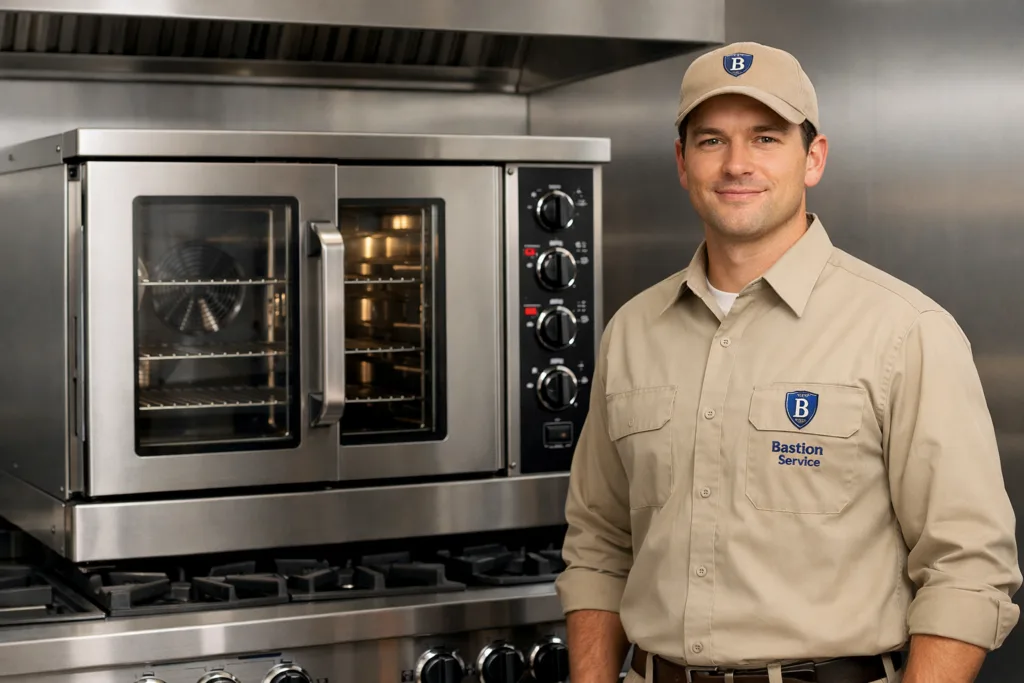




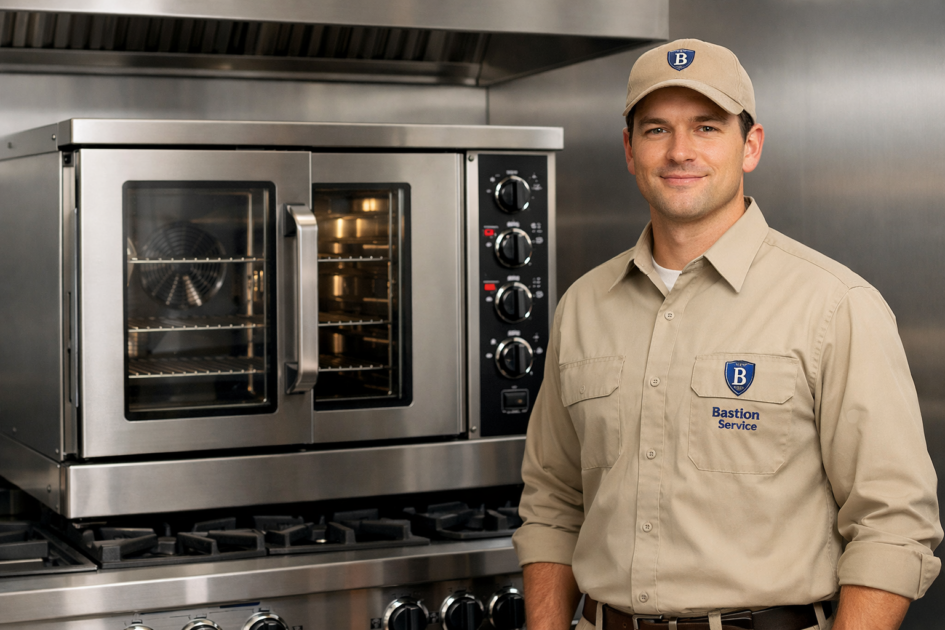
When a Vulcan oven starts missing temperature, heating unevenly, or dropping out during service, the most useful next step is symptom-based testing rather than guessing at parts. In busy kitchens, the same complaint can come from very different faults, and that affects both repair scope and downtime. Bastion Service works with businesses in West Hollywood to identify what is actually failing, explain how that failure affects daily production, and schedule oven repair based on urgency and operating impact.
Related commercial service paths in West Hollywood include Vulcan Commercial Repair in West Hollywood, Commercial Oven Repair in West Hollywood, and Vulcan Range Repair in West Hollywood.
How Vulcan oven problems usually show up in daily operations
Oven issues often first appear as workflow problems before staff describe them as equipment failures. Tickets take longer, bake times drift, pans need constant rotation, or one rack finishes differently from another. In other cases, the oven starts normally but cannot recover heat between loads, or it shuts down mid-cycle and interrupts prep.
On Vulcan ovens, those symptoms may be tied to ignition components, temperature sensors, thermostatic control issues, burner performance, convection airflow problems, relays, wiring faults, or worn door seals that allow heat loss. Because several systems can create similar results, a service call should focus on the exact pattern: whether the problem happens on startup, during preheat, under load, or after the oven has been running for a period of time.
Why your Vulcan oven may not heat evenly or reach set temperature
If a Vulcan oven is not heating evenly or is struggling to reach the programmed temperature, the cause is not always the same from one unit to the next. Some ovens heat slowly because ignition is weak or inconsistent. Others do reach temperature eventually, but sensor drift or control problems cause the displayed temperature to differ from the actual cavity temperature.
Uneven baking can also come from airflow imbalance on convection models, deteriorated door gaskets, fan issues, internal heat distribution problems, or burner performance that is strong on one cycle and weak on the next. In practice, kitchens often notice this as inconsistent color, longer cook times, or products that need to be moved from one shelf position to another to finish correctly.
When an oven appears functional but cannot maintain stable heat, replacing a single visible part without confirming sensor accuracy, control response, and heat output can leave the main fault unresolved. That is why temperature complaints are best handled through measured diagnosis instead of part swapping.
Common Vulcan oven symptom groups and what they can point to
No heat or partial heat
An oven that powers on but does not produce heat, or only produces weak heat, may have an ignition fault, burner issue, control problem, sensor circuit failure, or another interruption in the heating sequence. Partial heat can be especially disruptive because the unit may appear usable while still causing slow production and unreliable results.
Slow preheat and poor temperature recovery
If preheat times are getting longer or the oven struggles to recover after the door opens, the issue may involve heat delivery, control response, airflow, or heat loss through worn seals. This symptom often becomes more obvious during peak periods when the oven is cycled frequently and consistency matters most.
Ignition delay or burner instability
Delayed lighting, intermittent startup, or unstable burner operation should be taken seriously. These problems may be related to igniters, flame sensing, gas valve behavior, contamination, or associated control faults. What starts as an occasional delayed start can turn into a repeated no-heat condition if left unaddressed.
Temperature swings during normal use
Some ovens overshoot, then cool too far before cycling back on. Others hold temperature for part of the day but drift once the unit is fully hot. These patterns often suggest sensor inaccuracy, thermostat or control issues, relay problems, or a fault that only appears once components are under sustained heat load.
Control errors, shutdowns, or inconsistent response
If the control panel shows errors, drops settings, or behaves unpredictably, the problem may be electronic rather than mechanical. Wiring, relays, boards, interfaces, and sensor feedback all affect how the oven responds. Seemingly random shutdowns are often easier to diagnose when the service history includes when they occur, how long the oven has been running, and whether the issue happens during preheat or production use.
When continued operation can increase downtime
It is common for staff to keep using an oven that still produces some heat, especially when service is busy. But continued use is not always the best business decision. If the oven is short-cycling, overheating, failing to ignite consistently, or running far off the set temperature, additional strain can spread the problem to connected components and make the repair more involved.
Service should move higher on the schedule when the oven is affecting food consistency, forcing workarounds, delaying output, or dropping out often enough that staff can no longer trust it. A unit that fails once may be manageable. A unit that needs constant monitoring is already affecting productivity.
What helps speed up diagnosis before service
Useful details from kitchen staff can shorten the path to the right repair. It helps to note:
- whether the oven fails on startup or after it has been running
- if the issue is no heat, low heat, slow preheat, or uneven cooking
- whether the problem affects every cycle or only some loads
- any error messages, clicking, delayed ignition, or unusual shutdown behavior
- if staff have noticed hot spots, weak browning, or temperature drift at specific rack positions
These details can help separate a control issue from a heat-delivery issue and can make repair planning more accurate from the start.
Repair decisions for businesses in West Hollywood
Not every Vulcan oven problem leads to the same recommendation. If the fault is isolated and the unit is otherwise in solid working condition, repair is often the most practical path. If the oven has multiple failing systems, repeated interruptions, structural wear, and a growing pattern of lost production time, replacement may deserve consideration.
The decision usually comes down to more than age. Businesses in West Hollywood often weigh current symptom severity, service history, parts condition, heat performance, and how much disruption the oven is causing in day-to-day operations. A targeted repair makes sense when it restores stable performance without creating recurring downtime risk.
What service should accomplish
Good oven service should do more than address a surface symptom. It should identify the active fault, confirm why the symptom is happening, and define the next step in a way that fits the kitchen’s schedule and workload. For a Vulcan oven, that may mean confirming whether the problem is ignition-related, control-related, sensor-related, or tied to heat circulation and retention.
If your oven is slowing output, affecting consistency, or becoming unreliable during production in West Hollywood, scheduling repair before the next major interruption is usually the best move. A focused diagnosis helps determine whether the problem is straightforward, whether continued use risks added damage, and what repair plan will return the unit to stable service with the least disruption possible.


