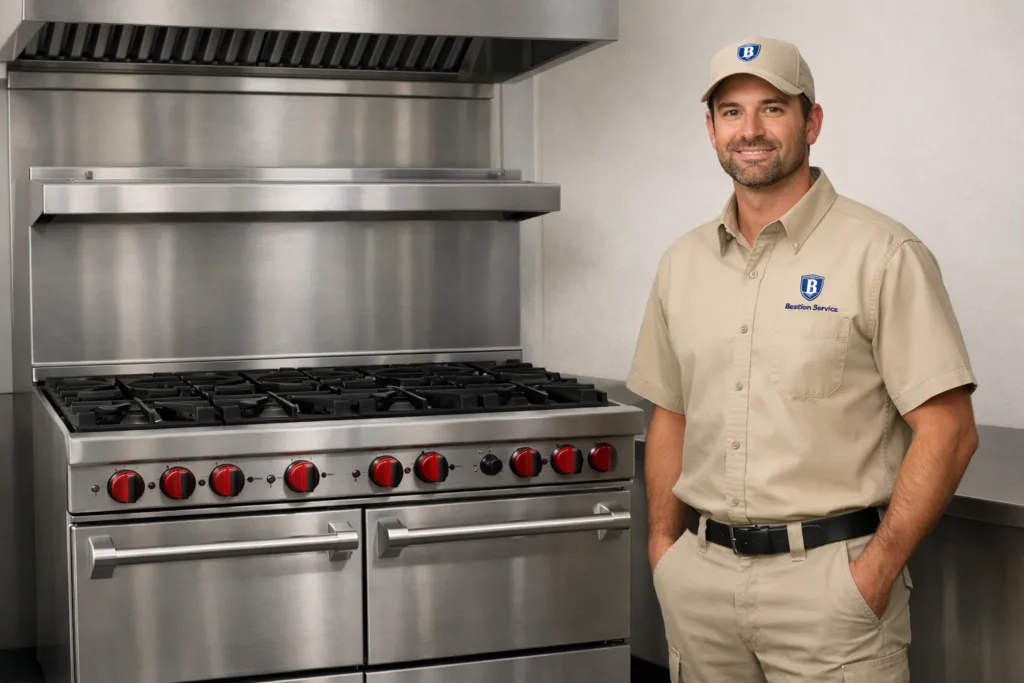




When a Vulcan fryer, oven, or range starts missing temperature, failing to ignite, or slowing production, the next step should be service-focused: identify the fault, determine whether continued operation is increasing risk, and schedule repair based on how the problem is affecting output. For Beverly Hills kitchens, delays caused by unstable heat, shutdowns, or poor recovery can quickly turn into ticket backups, waste, and staff workarounds.
For specific equipment paths in Beverly Hills, review Vulcan Oven Repair in Beverly Hills, Vulcan Range Repair in Beverly Hills, and Vulcan Fryer Repair in Beverly Hills.
Bastion Service helps businesses evaluate Vulcan cooking equipment issues with attention to uptime, repair timing, and whether the unit should stay in use while service is arranged. That matters when the same symptom could come from very different causes, from a single ignition component to a broader control, burner, or safety-related failure.
What Vulcan cooking equipment problems do you troubleshoot?
Most service calls fall into a few operating patterns that interrupt daily kitchen flow. With Vulcan cooking equipment, those patterns often involve heating performance, ignition, temperature regulation, recovery speed, burner function, and units that stop during operation.
- Equipment that heats too slowly or never reaches set temperature
- Temperatures that overshoot, drift, or vary from one cycle to the next
- Burners or pilots that do not light reliably
- Ignition systems that click repeatedly, hesitate, or fail to start
- Fryers with poor recovery during busy periods
- Ovens producing uneven results or long preheat times
- Ranges with weak flame, unstable heat, or inoperative burners
- Controls that do not respond normally or display intermittent faults
- Units that shut down, reset, or lock out during service
These symptoms are not just inconveniences. In a business kitchen, they affect batch timing, consistency, labor pacing, and confidence in the equipment. Early repair is often less disruptive than waiting until the unit becomes unusable in the middle of service.
Heating and temperature problems that affect food quality
Temperature-related complaints are some of the most important to address because they influence both throughput and consistency. A fryer that cannot recover between loads slows production. An oven that runs colder or hotter than the control setting can change cooking times and results. A range that cycles unevenly can interfere with prep and finishing work across the line.
Possible causes may include thermostat issues, sensors, burner performance problems, ignition faults, safety limits, or electronic control failures. The equipment type changes how the problem shows up, but the business impact is similar: more monitoring by staff, more adjustments during production, and more variability from one order to the next.
Service is worth scheduling when staff have started compensating for the machine by extending cook times, lowering batch size, rotating pans more often, or avoiding certain burners or temperature settings. Those workarounds usually indicate the issue has moved beyond a minor nuisance.
Signs the temperature issue is getting worse
- Longer preheat than normal
- Frequent setpoint adjustments during the shift
- Food finishing unevenly or inconsistently
- Recovery slowing under normal volume
- Heat dropping off after startup
- Visible difference between one burner or zone and another
Ignition, burner, and flame stability issues
If a unit struggles to light, lights only sometimes, or loses flame during use, the problem should be checked before it disrupts a full shift. Ignition issues can stem from pilot problems, flame sensing, burner contamination, gas delivery issues, wiring faults, or failing controls. What looks like a simple startup complaint may actually be a repeat fault condition that is becoming more frequent.
Ranges often show this as one or more burners that click but do not light, or a flame that is too weak or unstable for normal cooking. Fryers may show delayed ignition, inconsistent burner operation, or heat that cuts in and out. Ovens can present ignition trouble through delayed startup, unreliable heating cycles, or repeated attempts to fire.
Repeated failed ignition attempts also create avoidable delays for staff. If startup has become unpredictable, it is usually better to book repair than keep resetting, relighting, or shifting production to other stations.
Unexpected shutdowns and intermittent operation
Intermittent failures are often the most disruptive because the equipment may appear normal for part of the day and then stop under load. A unit that runs for twenty minutes and then shuts off, locks out, or needs to be reset can be difficult to judge without testing the machine in operating conditions.
This symptom pattern may be related to overheating, electrical faults, safety trips, wiring issues, or control failures that only show up after the equipment has been running. For kitchens in Beverly Hills with timed prep windows or peak service pressure, intermittent operation can be more damaging than a total failure because it creates uncertainty around every batch and every order period.
If staff cannot trust the unit to stay on through a normal cycle, that is usually the point to stop relying on it for core production and move ahead with repair scheduling.
How these problems show up by equipment type
Vulcan fryer repair concerns
Fryer issues tend to affect speed first. Slow heat-up, poor recovery, inaccurate oil temperature, ignition faults, and nuisance shutdowns all reduce batch capacity. In a busy kitchen, even a modest recovery problem can create a ripple effect across ticket times. If oil temperature is not tracking the control setting, the result can be inconsistent output, excessive hold time, or food quality complaints.
Fryer service becomes especially important when the unit needs repeated resets, falls behind during normal volume, or starts cycling in a way that staff can predict but cannot correct.
Vulcan oven repair concerns
Oven problems often show up as uneven cooking, extended preheat, hot and cold spots, poor temperature hold, or doors that allow heat loss. Some issues are tied to calibration or sensors, while others point to heating system or control problems. Because ovens are often used for repeatable menu items, even small performance changes can create waste and inconsistency over the course of a day.
If pans need rotating more than usual, recipes require constant timing changes, or product color and finish are no longer consistent, the equipment should be inspected before the problem affects larger production runs.
Vulcan range repair concerns
Range problems tend to disrupt line organization quickly. A single burner with weak flame or failed ignition may force cooks to shift pans, crowd the remaining burners, or alter sequence timing. As more burners become unreliable, the issue turns from an inconvenience into a line-capacity problem.
Service is typically warranted when burners fail to light reliably, flame height is unstable, controls are not responding correctly, or normal heat output is no longer available across the top.
When to stop using the equipment
Some symptoms justify immediate service rather than continued use. Equipment should not be pushed through a busy schedule when it is overheating, shutting down unpredictably, failing ignition repeatedly, or showing major temperature error that affects safe and consistent cooking. Continued operation in that condition can increase repair scope and create more downtime later.
For gas cooking equipment, a persistent or strong gas odor should be treated as a safety issue first. Stop using the appliance, clear the area if needed, and contact the gas utility or emergency responders before arranging equipment repair. Even without a gas odor, repeated ignition failure or unstable burner operation should be evaluated before the unit returns to normal production.
Repair or replace: how businesses usually decide
Replacement is not always the right first move. Many Vulcan cooking equipment problems can be resolved with a targeted repair once the actual failure is confirmed. The better question is whether the current issue is isolated or part of a broader pattern involving repeated breakdowns, multiple failing components, or ongoing performance loss that is already affecting service.
Factors that often shape the decision include:
- How often the unit has needed recent service
- Whether the present issue is limited or tied to multiple systems
- The effect on production if the equipment remains unreliable
- The age and overall condition of the unit
- Whether temporary continued use could worsen damage
A proper diagnosis helps operators compare repair cost against expected uptime rather than deciding under pressure in the middle of an outage.
Scheduling service in Beverly Hills
For Beverly Hills businesses using Vulcan cooking equipment every day, repair decisions are usually about continuity as much as mechanics. If an oven is drifting off temperature, a fryer is recovering too slowly, or a range is losing usable burners, the sensible next step is to schedule diagnosis, confirm the repair scope, and plan service around the operational impact. That approach helps reduce avoidable downtime and gives the kitchen a clearer path forward than continuing to work around unreliable equipment.