
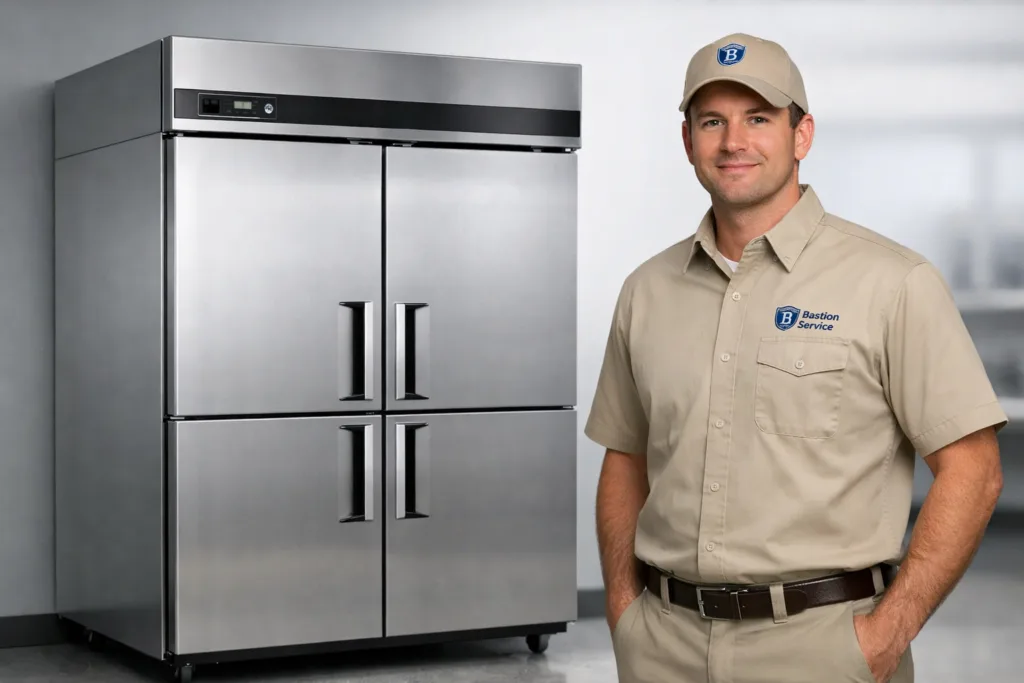




Freezer trouble usually shows up first as a workflow problem: product softening at the edges, longer pull-down times after loading, recurring frost, puddling near the base, or staff noticing that the unit sounds different than usual. For businesses in Hermosa Beach, those symptoms should be treated as repair signals rather than routine inconvenience. Bastion Service diagnoses Turbo Air freezer issues by matching the complaint to actual operating behavior so the next step is based on the fault, not guesswork.
Related commercial service paths in Hermosa Beach include Turbo Air Commercial Repair in Hermosa Beach, Commercial Freezer Repair in Hermosa Beach, and Turbo Air Refrigerator Repair in Hermosa Beach.
What a Turbo Air freezer problem often looks like in daily use
Some failures are obvious, but many start as small performance changes that gradually affect storage reliability. A freezer may still run, lights may still work, and the control may still display a normal setting while the cabinet itself struggles to stay cold enough. In busy kitchens, prep areas, and other business settings, that gap between what the panel says and what the freezer is actually doing can lead to product risk and unnecessary strain on major components.
Service is usually worth scheduling when you notice one or more of the following:
- Temperature recovery is slow after the door has been opened
- Product feels softer than expected even though the unit is running
- Frost keeps returning on shelves, liners, or around the evaporator area
- The door does not seal tightly or needs extra force to close
- Fans get louder, airflow seems weak, or the cabinet develops hot and cold spots
- The freezer runs for long stretches without reaching a stable temperature
- Water appears around the unit or inside the cabinet
Why a Turbo Air freezer may not be staying cold enough
When a freezer is not holding temperature, the cause is not always a major refrigeration failure. In many cases, the problem begins with airflow restriction, evaporator ice buildup, a worn gasket, a fan motor issue, a control or sensor fault, or a condenser section that is no longer shedding heat properly. Those issues can all produce similar symptoms, which is why the best repair decision starts with confirming what the machine is doing under load.
If the cabinet warms during busy periods and then struggles to recover, the unit may be dealing with both normal door traffic and an underlying performance problem. If it never gets close to target temperature at all, that points to a more serious cooling deficiency. If some product remains frozen while other sections soften, uneven airflow or ice-related circulation problems may be involved.
Common symptoms and what they can indicate
Frost buildup that keeps coming back
Heavy frost often means warm air is getting into the cabinet or the freezer is not completing defrost as it should. Door gasket wear, door alignment problems, repeated infiltration, or a defrost component issue can all cause frost to build faster than normal. As ice accumulates, airflow drops, fan performance can suffer, and temperatures become less consistent across the cabinet.
Constant running with weak freezing results
A Turbo Air freezer that rarely cycles off is often working harder than it should. Dirty heat exchange surfaces, poor ventilation, airflow restrictions, door leakage, and control problems can all keep the unit in a near-constant run state. If it is running continuously and still not freezing effectively, continued operation may increase compressor stress without solving the temperature problem.
Fan noise, rattling, or scraping sounds
Changes in sound are often early clues. Scraping may point to ice contact or fan obstruction. Rattling can come from loose mounting or vibration. Buzzing or clicking may indicate electrical or motor-related issues. Noise does not always mean the freezer is close to failure, but when the sound change is paired with poor temperature control, it should be checked promptly.
Water leaks or thaw-refreeze signs
Water under or inside the freezer can come from drain issues, defrost problems, or temperature instability. Partial thawing and refreezing are especially important warning signs because they suggest the cabinet is not maintaining a consistent freezing environment. For businesses in Hermosa Beach, that can quickly turn into a storage and quality-control concern.
Door gasket and closing problems
A door that does not seal properly allows warm air to enter every time the unit runs. That can lead to excess frost, longer run times, moisture problems, and uneven cabinet temperature. Even a freezer with otherwise healthy cooling performance can struggle if the door is not sealing tightly or closing squarely.
Why diagnosis matters before parts are replaced
The visible symptom is not always the failed part. A warm cabinet might look like a refrigeration problem, but the root cause could be poor airflow, a fan failure, a sensor issue, ice blockage, or a door leak. Replacing parts based only on the complaint can increase downtime and cost while leaving the main fault unresolved.
A proper service visit should identify the affected system, confirm whether the freezer is safe to keep using in the short term, and outline what repair is most likely to restore stable operation. That is especially important when the unit supports daily production, inventory, or back-of-house storage.
When service should be scheduled right away
Prompt repair is usually the better decision when any of these conditions are present:
- The cabinet cannot maintain a stable freezing temperature
- Frost buildup is restricting shelves, panels, or airflow
- The freezer is running nearly nonstop
- Product condition is becoming difficult to trust
- Staff are repeatedly adjusting settings to compensate
- Door sealing problems are obvious
- There are new noises along with temperature drift
- Water leakage or recurring ice accumulation is getting worse
Waiting too long can turn a manageable fan, gasket, control, or defrost issue into wider component wear and longer downtime.
How to prepare for a Turbo Air freezer repair visit
A little preparation can make diagnosis faster and more accurate. Before service, it helps to note when the problem began, whether the temperature issue is constant or intermittent, whether frost appears in a specific area, and whether noise changes happen at startup, during run cycles, or after defrost. If staff have noticed the door not sealing, slower recovery after loading, or error behavior on the controls, that information is useful during troubleshooting.
It is also helpful to avoid repeated setting changes before the appointment unless product protection requires immediate action. Constant adjustments can make the original symptom pattern harder to confirm.
Repair or replacement: what usually drives the decision
Many Turbo Air freezer problems are repairable when the cabinet is still in good condition and the fault is tied to serviceable components such as fans, controls, sensors, gaskets, wiring, or defrost-related parts. Replacement becomes a more serious consideration when the freezer has a history of repeated breakdowns, poor temperature reliability after prior work, or overall condition that no longer supports dependable use.
The right call depends on the nature of the failure, the age and condition of the equipment, and how much downtime the business can absorb. The goal is not just to get the unit running again for the moment, but to restore stable freezing performance with a realistic expectation of reliability.
Service support for businesses in Hermosa Beach
For Hermosa Beach businesses, freezer repair needs to be tied to uptime, product protection, and a sensible scheduling decision. When a Turbo Air freezer shows temperature drift, frost buildup, fan noise, leaks, or slow recovery, the most useful next step is to have the fault confirmed and the repair scope explained clearly. That makes it easier to decide whether the unit should be repaired immediately, used cautiously for the short term, or evaluated for replacement before the problem disrupts operations further.


