





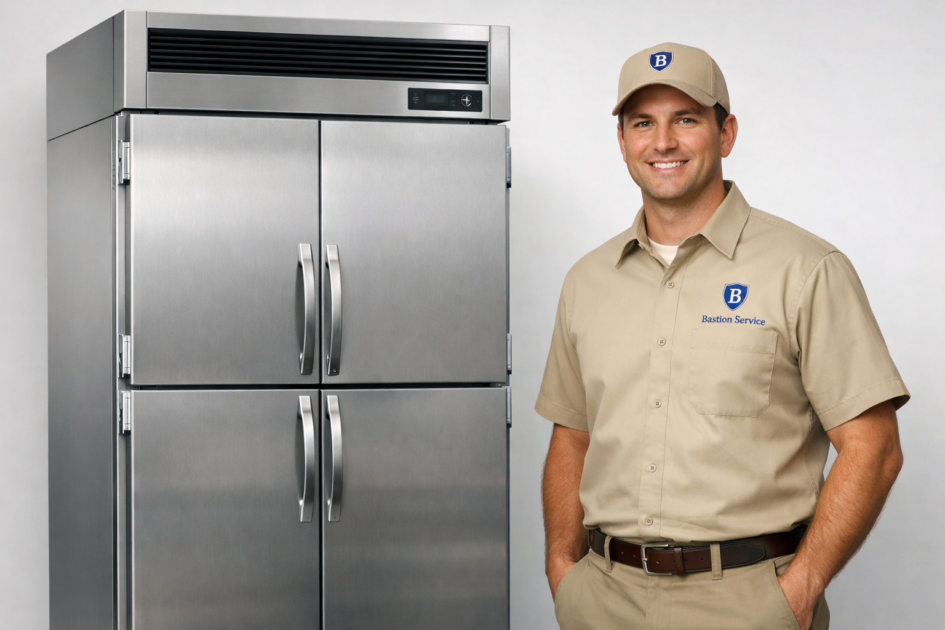
Freezer downtime can disrupt prep, storage, inventory control, and daily workflow fast, especially when temperatures start drifting before the cause is obvious. For businesses in Mid-City, service is most useful when it focuses on the exact symptom pattern, confirms the failing component or system, and helps determine whether the unit can stay in limited use or needs immediate repair scheduling to prevent a larger loss.
Related commercial service paths in Mid-City include Traulsen Commercial Repair in Mid-City, Commercial Freezer Repair in Mid-City, and Traulsen Refrigerator Repair in Mid-City.
Bastion Service works on Traulsen freezer issues with that service mindset first: identify what is causing the temperature problem, icing, noise, leak, or alarm condition, then outline the repair path based on urgency, equipment condition, and operating risk.
Common Traulsen freezer problems and what they often mean
Freezer not staying cold enough
If the cabinet is warmer than normal, slow to recover after door openings, or struggling to hold the set temperature, several faults may be involved. Airflow restrictions, dirty condenser surfaces, failing evaporator fans, sensor or control problems, door gasket leakage, frost-covered coils, and sealed-system issues can all produce similar symptoms. What matters during diagnosis is separating a correctable airflow or control fault from a deeper refrigeration problem before the unit is pushed too long.
Frost buildup inside the cabinet
Excess ice on panels, around the evaporator section, or near the door opening usually points to warm-air intrusion or a defrost-related issue. Damaged gaskets, doors not closing fully, alignment problems, failed defrost components, or fan issues can all contribute. On a busy freezer, frost buildup does more than reduce space. It can block circulation, slow pull-down, increase run time, and eventually cause uneven temperatures from one section of the cabinet to another.
Water leaks or melting around the unit
Water near a freezer can come from a defrost drainage problem, partial thawing, door sealing issues, or heavy ice accumulation that is beginning to melt in the wrong place. In some cases, the unit still appears to be cooling while the underlying issue is worsening. That combination often means the problem should be checked before it turns into a full temperature failure.
Fan noise, buzzing, or repeated alarms
Unusual sounds can point to fan blade interference from ice, worn motors, loose hardware, compressor-start issues, or electrical problems. Alarm conditions may relate to high temperature, door-open conditions, sensor drift, or faults in the control system. If the noise or alarm is intermittent, that does not make it minor. Intermittent freezer problems are often early warning signs that the unit is no longer operating consistently under load.
Freezer runs constantly or cycles abnormally
A freezer that seems to run all the time may be compensating for heat gain, blocked airflow, dirty coils, frost-covered evaporator sections, or declining refrigeration performance. Short cycling may point to controls, sensors, fan motors, start components, or compressor-related stress. Either pattern increases wear and usually means efficiency and temperature control are already slipping.
Why symptom-based diagnosis matters on Traulsen freezers
On Traulsen equipment, the same complaint can come from very different causes. A “not freezing” call may trace back to a door issue and ice obstruction on one unit, while another may have a sensor problem, failed defrost component, or refrigeration circuit fault. Replacing parts based on guesswork can waste time and still leave the freezer unstable.
A better service approach is to evaluate how the freezer is actually behaving: whether the temperature rise is constant or intermittent, whether frost is concentrated in one area, whether recovery is slow after loading, whether alarms return after resets, and whether airflow feels reduced inside the cabinet. Those details help narrow the fault and guide the repair decision more accurately.
Signs the freezer should be scheduled for service soon
Some freezer problems begin gradually enough that staff work around them for a while. The risk is that a unit can move from “slightly off” to product-threatening with little warning. Service is worth scheduling promptly when performance changes are noticeable, even if the cabinet is still cooling.
- Cabinet temperature is higher than normal or inconsistent
- Recovery after door openings is slower than usual
- Frost or ice keeps returning after being cleared
- Doors are not sealing tightly or require extra force to close
- Fans are louder, weaker, or sounding irregular
- Water appears near the unit or under the cabinet
- Alarms repeat, even after being acknowledged or reset
- The freezer has had the same issue more than once
These symptoms usually mean the unit is not operating normally, even if it has not completely stopped cooling yet.
Why continued operation can make the repair worse
When a struggling freezer is left to run through repeated shifts, the system may be forced to operate under higher stress for longer periods. Restricted airflow, ice-covered coils, poor door sealing, or weak component performance can lead to extended run times and added strain on motors and the refrigeration system. What begins as a repairable control, gasket, or fan issue can become more expensive once temperature instability starts affecting other parts of the freezer.
The risk is higher when warm temperatures and frost appear together, when the cabinet cannot recover after normal door traffic, or when alarms return after temporary resets. Those are signs the freezer is no longer holding a stable operating pattern.
Repair decisions businesses in Mid-City often have to make
Not every freezer problem points to replacement. Many Traulsen freezer issues are still good repair candidates when the cabinet is in solid overall condition and the problem is limited to gaskets, controls, fans, sensors, defrost parts, drainage, or isolated electrical failures. In other cases, the discussion changes when the unit has repeated breakdowns, major cooling decline, or multiple aging components failing close together.
Most repair decisions come down to a few practical questions:
- Is the issue isolated or part of a repeated pattern?
- Can the freezer be stabilized quickly enough to protect stored product?
- Does the repair cost make sense for the unit’s condition and expected service life?
- How much disruption will another breakdown cause to daily operations?
- Is the current problem affecting one part of the system or the freezer more broadly?
Those questions are easier to answer after testing confirms whether the fault is relatively contained or a sign of deeper system decline.
Preparing for a Traulsen freezer service visit
Before service, it helps to note how long the problem has been happening and whether it is constant or intermittent. Staff observations can be useful, especially if the freezer warms during heavy use, ices over after deliveries, leaks during defrost, or becomes noisy at certain times of day. If available, recent temperature readings, alarm history, and notes about whether the door has been sealing properly can speed up diagnosis.
Businesses can also prepare by checking whether stored product should be moved, whether access around the unit is clear, and whether the freezer is still operating well enough to stay powered until the technician arrives. Those steps help reduce downtime and make it easier to move from diagnosis to repair without unnecessary delay.
Service-focused next steps for Mid-City businesses
If a Traulsen freezer is warming, icing up, leaking, alarming, or making new noises, the most useful next step is to schedule service before the condition becomes a full shutdown. For businesses in Mid-City, timely diagnosis can help protect inventory, reduce disruption, and clarify whether the repair is straightforward or part of a larger equipment decision.


