
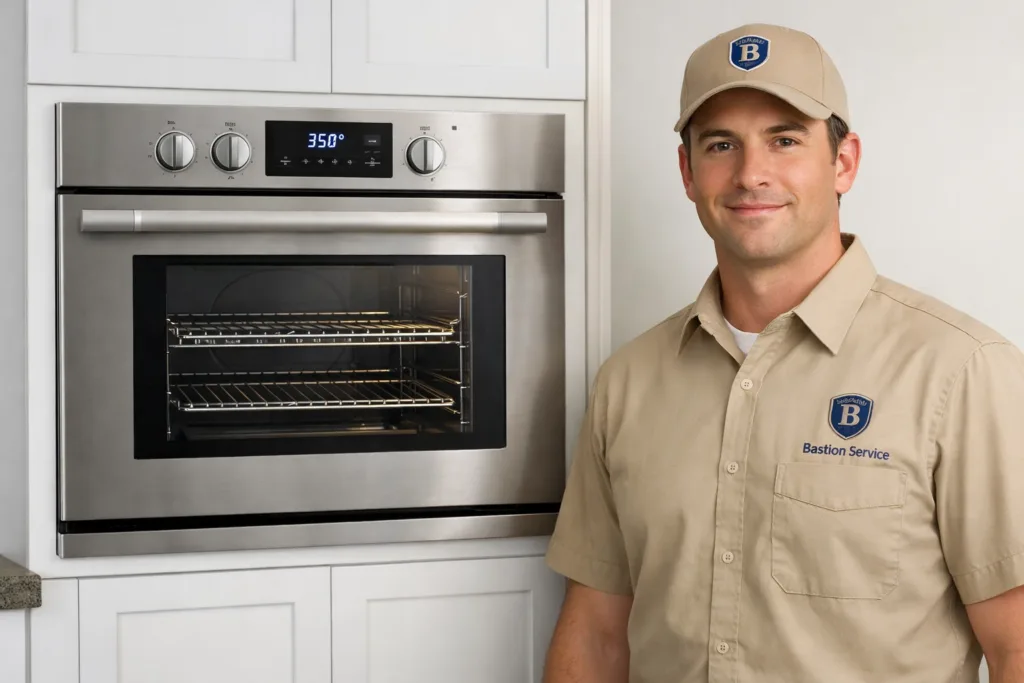




Built-in wall ovens tend to show problems in patterns. One household may notice longer preheat times and pale baking results, while another sees a flashing error code or a door that will not unlock after a cycle. With Summit units, the symptom matters because the same complaint can trace back to very different causes inside the oven.
Related Summit and wall oven service paths in Cheviot Hills include Summit Appliance Repair in Cheviot Hills, Wall Oven Repair in Cheviot Hills, and Summit Refrigerator Repair in Cheviot Hills.
In Cheviot Hills homes, it helps to look at what the oven is doing before assuming which part failed. An oven that appears completely dead may have a power or thermal protection issue, while one that turns on normally but cooks poorly may be dealing with a temperature sensor, relay, or heating circuit problem.
Signs your Summit wall oven needs attention
Some oven issues are obvious right away, and others show up gradually over a few weeks. Paying attention to the pattern can make the next repair decision much easier.
- No heat at all: the display may work, but bake or broil never produces usable heat.
- Slow preheating: the oven eventually warms up, but much more slowly than normal.
- Uneven baking: food browns too much on one side, stays raw in the center, or comes out inconsistently from rack to rack.
- Temperature swings: dishes overcook one day and undercook the next even at the same setting.
- Control problems: buttons stop responding, the display resets, or settings do not hold.
- Error codes: the oven interrupts operation and repeatedly displays a fault.
- Door lock trouble: the door will not latch, unlock, or complete a clean-cycle transition properly.
- Breaker trips: the circuit opens during preheat or while the oven is under load.
What common symptoms often mean
Oven will not heat
If a Summit wall oven powers on but never heats, the failure may involve the bake element, broil element, control relay, temperature sensor, thermal fuse, or incoming power. Because built-in ovens rely on the full electrical supply to heat correctly, partial power can create confusing symptoms where lights and display still work but cooking performance does not.
Preheat takes too long
Long preheat times often point to a weak element, inaccurate temperature feedback, or a control issue that is not driving the heating circuit properly. In some cases, the oven is heating on only one side of the bake-broil cycle, which makes it feel functional while still taking far too long to reach a usable temperature.
Food cooks unevenly
Uneven results usually suggest a regulation problem rather than a complete failure. A drifting sensor, intermittent relay, damaged door gasket, or partially failed heating element can all lead to hot spots, weak browning, and unreliable bake times. This is especially noticeable with casseroles, cookies, and anything that depends on stable heat.
Display or touch controls act erratically
When the panel is blank, unresponsive, or resetting itself, the problem may involve the user interface, main control, wiring connections, or power supply instability. If the oven starts a cycle and then stops taking commands, the issue is often more than a simple setting error.
Error codes keep returning
A repeated fault code usually means the oven is detecting the same problem over and over. That can involve sensor readings out of range, communication faults between controls, latch problems, or temperature conditions the unit cannot correct on its own. Clearing the code without addressing the source rarely solves the issue for long.
Why diagnosis matters on a built-in wall oven
Wall ovens are not ideal guess-and-replace appliances. Access can be tighter, components may require more involved disassembly, and different failures can imitate one another. A bad sensor can look like a bad control. A relay problem can look like a failed element. A door sealing issue can be mistaken for a temperature calibration problem.
That is why proper testing matters before ordering parts or deciding the oven is beyond repair. On a Summit wall oven, finding the actual cause helps avoid repeat service and makes it easier to judge whether the repair is sensible based on the unit’s age, condition, and overall performance.
When continued use is risky
Some wall oven problems are inconvenient but manageable for a short time. Others should be treated as stop-using conditions until the appliance is checked. If the oven is showing electrical symptoms or visible signs of heat damage, continued use can make the repair more expensive.
- Arcing, popping, or sparking inside the oven cavity
- A burning odor that persists beyond normal food residue
- Breaker trips that happen more than once
- Fault codes that return immediately after reset
- A door that remains locked unexpectedly after a cycle
- Visible damage to an element or signs of overheating
Practical repair guidance by symptom
If baking results are suddenly unreliable
When favorite recipes stop turning out the way they used to, the first suspect is often temperature accuracy. In reality, the issue may be calibration drift, weak heat output, poor cycling, or heat escaping at the door. If the problem developed gradually, that usually points to a component weakening rather than a complete electrical loss.
If the oven shuts off mid-cycle
An oven that starts normally and then turns off can indicate overheating protection, control failure, unstable power, or a component that fails once it gets hot. This symptom is particularly frustrating because the oven may appear normal again after cooling down, making the problem seem random even when it is repeatable.
If broil works but bake does not, or the reverse
That split behavior usually narrows the issue. It can suggest a failed heating element, a relay that is not closing on one function, or a control-side problem affecting only one heating path. This is one of the more useful symptom patterns because it helps separate full power issues from function-specific failures.
If the oven temperature seems only slightly off
Mild temperature inaccuracy does not always mean major repair. Some cases involve calibration adjustment, while others reveal a sensor beginning to drift out of range. If the offset is consistent and small, the fix may be simpler than expected. If the variance is large or changes from cycle to cycle, deeper testing is usually warranted.
Repair or replace?
Not every Summit wall oven problem leads to the same recommendation. If the appliance has one isolated failure and the rest of the oven is in solid condition, repair is often reasonable. That is especially true for issues involving sensors, elements, switches, latches, or other clearly defined faults.
Replacement starts to make more sense when there are multiple failures at once, recurring control problems, signs of overheating damage, or a repair estimate that does not align with the condition of the appliance. For homeowners in Cheviot Hills, the best choice usually comes down to three things: what failed, what else may be affected, and whether the oven has otherwise been reliable.
What to note before scheduling service
A few details can make a wall oven problem easier to pinpoint. Before service, it helps to note whether the issue happens during preheat, only during baking, after self-clean, or only on one cooking mode. If an error code appears, write it down exactly as shown. If the breaker trips, notice whether it happens immediately or only after the oven has been heating for several minutes.
Those observations can help narrow the problem faster and lead to more useful Summit Wall Oven Repair in Cheviot Hills when the goal is to restore normal cooking without unnecessary part replacement.


