
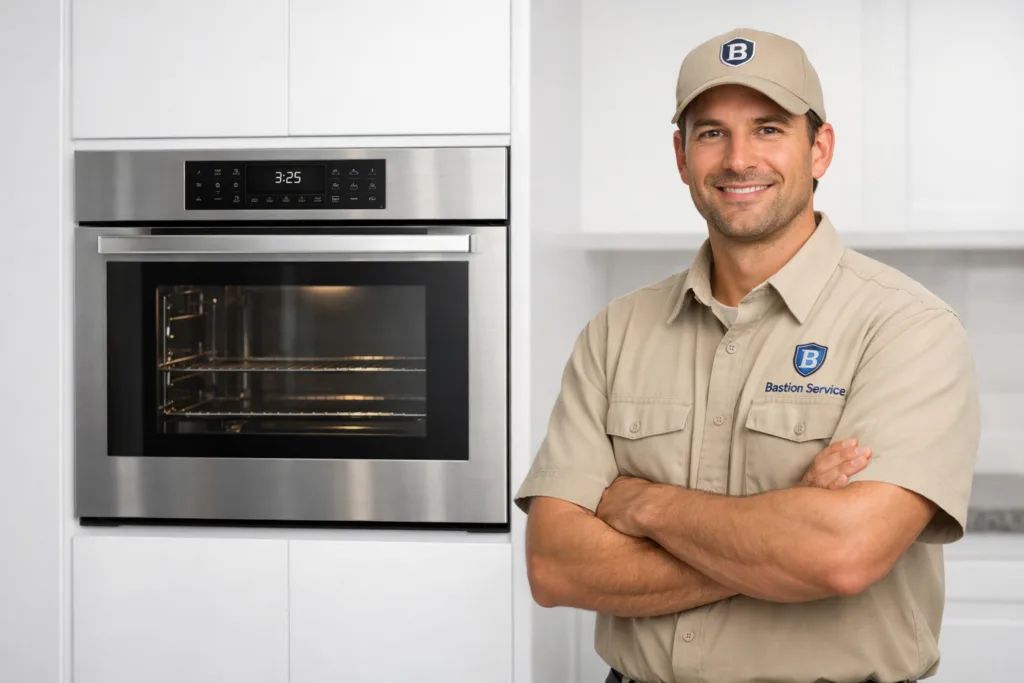




Common Bosch wall oven problems in Cheviot Hills homes
A Bosch wall oven can fail in ways that seem similar on the surface but have very different causes. One oven may struggle to preheat because of a weak heating circuit, while another shows the same symptom because the temperature sensor is reading incorrectly or the control is not cycling heat as it should. Looking at the exact behavior of the oven usually says more than the display alone.
Related Bosch and wall oven service paths in Cheviot Hills include Bosch Appliance Repair in Cheviot Hills, Wall Oven Repair in Cheviot Hills, and Bosch Refrigerator Repair in Cheviot Hills.
In Cheviot Hills homes, the most common complaints tend to involve heating performance, cooking consistency, display or control problems, and door or latch issues. Catching these patterns early can help prevent a minor fault from turning into a complete loss of cooking function.
Oven not heating or heating too slowly
If the oven stays cool, preheats very slowly, or never reaches the selected temperature, the problem may be tied to the bake circuit, broil circuit, sensor, thermal protection component, wiring, or electronic control. Some ovens still appear to heat, but the actual cavity temperature remains well below the setting, which leads to long cook times and unreliable results.
This symptom is especially frustrating because it can come and go. An oven may work normally one day and then fail during the next use, making it important to test the system instead of assuming the first suspected part is the problem.
Uneven baking and temperature swings
When cookies brown faster on one side, casseroles take longer than expected, or recipes that used to be reliable suddenly come out inconsistent, the issue may involve calibration, a weak element, sensor drift, poor heat circulation, or a convection fan problem. In a Bosch wall oven, even a modest temperature error can show up quickly in baking results.
Repeated hot-and-cold swings during a cycle can also point to a control issue rather than a basic cooking adjustment. If pans and rack positions are not the real cause, the oven may need service to restore stable temperature performance.
Error codes, flashing display, or controls that stop responding
A Bosch wall oven may display fault codes for temperature faults, communication problems, latch issues, or electronic failures. In other cases, the panel lights up but will not start a cycle, buttons respond intermittently, or the unit resets unexpectedly.
These symptoms do not always mean the control board itself has failed. A sensor problem, loose connection, damaged wiring, or door-lock issue can also interfere with normal operation and trigger confusing control behavior.
Door, latch, and self-clean problems
If the door will not close fully, does not seal well, will not unlock, or becomes hard to open after a self-clean cycle, the problem may involve hinges, latch components, alignment, or heat-related stress on nearby parts. A poor seal can cause longer preheat times and uneven cooking because heat is escaping during use.
Self-clean complaints are also worth taking seriously. Excess heat during that cycle can expose weak components that were already beginning to fail, especially in the lock system or electronic controls.
What the symptom pattern can reveal
The way a Bosch wall oven acts before, during, and after a cycle often helps narrow down the likely repair path. Homeowners can usually give a more useful description by focusing on what the oven actually does instead of only saying it is “not working.”
- Fails during preheat: often points toward heating, sensor, or control regulation issues.
- Works on bake but not broil: may suggest a problem isolated to one heating circuit.
- Runs hot or burns food unexpectedly: can indicate a sensor or control problem.
- Shuts off mid-cycle: may involve overheating protection, wiring, or intermittent electronic failure.
- Only acts up after extended cooking: sometimes suggests a component that fails once heat builds up.
These details matter because they help distinguish a straightforward repair from a more involved electrical or control problem.
When service should not wait
Some oven problems are inconvenient but manageable for a short time. Others should be addressed quickly because continued use can damage additional components or create a safety concern.
It is wise to stop using the oven and schedule service if you notice any of the following:
- The oven trips the breaker repeatedly.
- There is a burning smell, sparking, or visible overheating.
- The display behaves erratically or the unit starts and stops on its own.
- The door will not latch, unlock, or stay closed properly.
- The oven temperature becomes far hotter than the selected setting.
Even if the appliance still works part of the time, intermittent faults usually worsen rather than resolve on their own.
Repair or replace: what usually makes sense
For many Cheviot Hills homeowners, repair is still the practical choice when the problem is limited to a sensor, latch assembly, fan motor, heating component, or an isolated electrical fault. Built-in appliances are not as simple to swap out as freestanding units, so keeping a properly fitted wall oven in place can save time and avoid additional kitchen disruption.
Replacement becomes more worth considering when the oven has multiple major failures, severe control problems, repeat breakdowns, or parts costs that do not make sense for the appliance’s age and condition. The layout of the kitchen also matters. If the existing Bosch wall oven fits the cabinet opening well and the issue is clearly repairable, fixing the current unit may be the simpler route.
What a useful service visit should focus on
A productive appointment should center on the exact complaint: slow preheat, uneven baking, temperature swings, a flashing error, a locked door, or a control that will not respond. From there, the inspection should verify temperature behavior, heating circuit performance, sensor readings, control response, and door or lock operation where relevant.
That kind of symptom-based evaluation helps homeowners in Cheviot Hills understand whether the problem is isolated and repairable or part of a larger electronic failure. The goal is straightforward: identify the fault accurately, avoid unnecessary parts replacement, and restore normal cooking performance with the least disruption to the household.


