
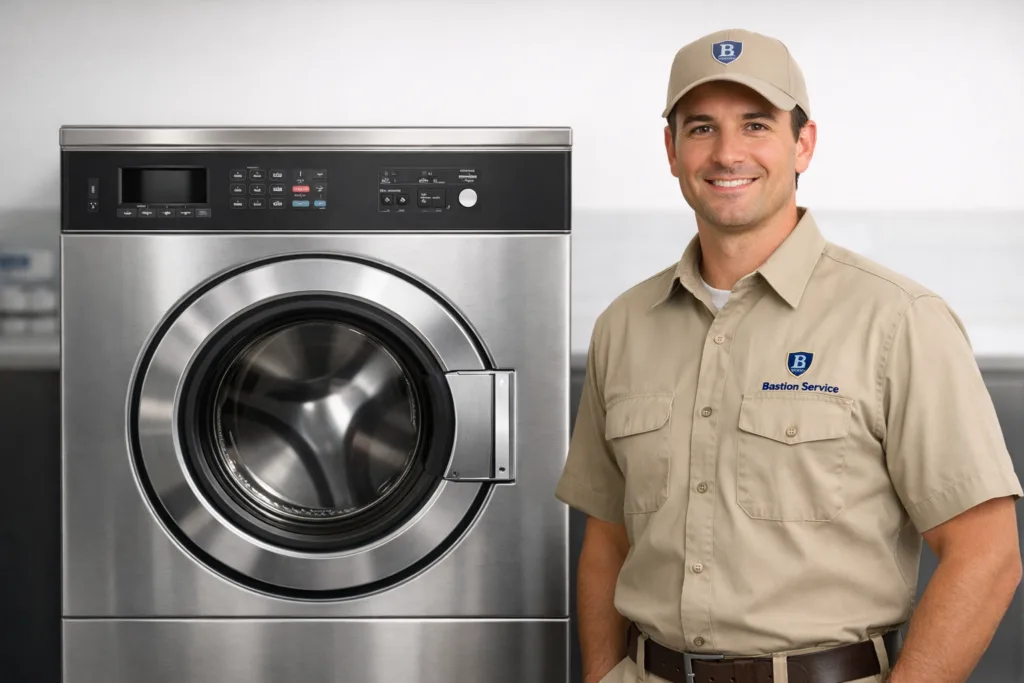





Washer downtime can disrupt linen turnover, uniforms, tenant support, and back-of-house workflow faster than many teams expect. When a Speed Queen unit starts stopping mid-cycle, leaving loads wet, leaking, or failing to fill correctly, service is most effective when it begins with the exact symptom pattern and how the machine is behaving under normal business use. Bastion Service works with businesses in Manhattan Beach to identify the cause, outline the repair path, and help reduce avoidable downtime.
Related commercial service paths in Manhattan Beach include Speed Queen Repair in Manhattan Beach, Commercial Washer Repair in Manhattan Beach, and Speed Queen Dryer Repair in Manhattan Beach.
How Speed Queen washer problems usually show up in daily operations
Some failures are immediate, such as a washer that will not power into a cycle or one that leaves water standing in the tub. Others build gradually and are easier to miss at first, including slower fills, weaker spin performance, intermittent stopping, or vibration that gets worse over time. In a business setting, these symptoms often affect more than one load. Staff may need to rerun items, shift work to other machines, or delay downstream drying and folding.
Because the same complaint can come from different components, symptom-based testing matters. A cycle that will not finish might involve the lid or door switch, drain system, control, motor circuit, or a condition that prevents the machine from advancing normally. A leak may come from a hose, pump area, overfill issue, or a seal that only fails during certain parts of the wash process.
Common Speed Queen washer symptoms and what they may indicate
Not starting or not completing the cycle
If the washer does nothing when started, pauses without finishing, or shuts down before the final spin, likely causes can include switch failures, timer or control faults, wiring problems, or interruptions in the power path. Intermittent cycle failure can be especially disruptive because the machine may appear usable, then stall under load or stop at a repeat point in the program.
For businesses, this often leads to partial loads, lost labor time, and uncertainty about whether the unit can be trusted for the next run. Testing usually focuses on whether the machine is receiving the proper signals to lock, fill, agitate, drain, and advance through the cycle stages.
Not draining or leaving clothes too wet
A Speed Queen washer that will not drain fully or produces poor extraction can point to a blocked drain path, weak or failed pump, belt or drive issue, or a control problem that interrupts the drain-and-spin portion of the cycle. In some cases, the machine is not truly a spin problem first; it may be prevented from spinning because water has not been removed as expected.
This symptom is important to address quickly because wet loads increase pressure on dryers, slow turnaround, and can create backup across the laundry process.
Slow fill, no fill, or incorrect water levels
When water enters too slowly, does not enter at all, or the washer fills to the wrong level, inspection often centers on inlet valves, supply restrictions, clogged screens, pressure sensing parts, or the control system managing fill timing. These issues can cause poor wash results, repeated cycle interruptions, and inconsistent performance from one load to the next.
If staff are seeing incomplete saturation, unusual pauses before agitation, or loads that finish with visible detergent or soil, water delivery should be evaluated rather than assumed to be a simple supply issue.
Excessive shaking, banging, or walking during spin
Heavy vibration may indicate leveling problems, worn suspension components, mounting issues, unbalanced loading conditions, or developing internal wear. The longer this continues, the greater the chance of added damage to nearby parts, faster wear on the washer structure, or disruption to adjacent equipment.
In shared laundry rooms or busy work areas, strong vibration is also a workflow and safety concern, especially when it causes repeated shutdowns or requires staff intervention to keep the machine operating.
Leaks, odors, and visible residue
Water on the floor can come from hose connections, a drain issue, pump leakage, overfill conditions, door or lid-related sealing problems, or internal failures that only appear during agitation or spin. Odors and residue can point to incomplete draining, buildup in the wash system, repeated interrupted cycles, or water flow issues that prevent proper rinsing.
These are not just housekeeping concerns. They can affect floor safety, wash quality, and confidence in the machine’s condition.
Why accurate diagnosis matters before replacing parts
Replacing a part based only on the surface symptom can lead to repeat calls and extended downtime. A washer that will not spin may actually have a drain problem. A no-start complaint may trace back to a switch or connection issue rather than the main control. A leak may be isolated and repairable, or it may reflect a larger wear pattern that changes the service recommendation.
A proper repair decision depends on confirming the failed component, checking for related wear, and understanding whether the issue is isolated or part of a broader decline in performance. That is especially important for businesses in Manhattan Beach that rely on consistent throughput and need realistic expectations for scheduling, parts, and return to service.
When washer issues should be scheduled for service
Service should be scheduled when the machine starts showing repeat cycle failures, unusual noise, poor draining, weak spin performance, fill problems, leaks, or controls that require resets to keep operating. Even if the washer is still running some loads, recurring symptoms usually mean the fault is becoming less predictable.
- Stops at the same point in multiple cycles
- Leaves standing water or overly wet loads
- Shakes harder than normal during extraction
- Shows inconsistent fill behavior from load to load
- Leaks during wash, drain, or spin
- Requires staff workarounds to complete normal use
If the washer is leaking onto the floor, tripping power, or producing severe vibration, continued use can increase the scope of the repair and create a larger interruption for the business.
Repair or replacement: what usually drives the decision
Many Speed Queen washer problems are repairable when the machine is otherwise structurally sound and the issue is limited to a pump, valve, switch, belt, control-related component, or drain-system fault. In those cases, targeted service can restore reliable operation without the larger cost and disruption of replacing the unit.
Replacement becomes more likely when there is major bearing or tub damage, extensive wear across multiple systems, chronic repeat failures, or a repair total that does not make sense relative to the condition of the washer. The best comparison is not just the immediate part cost. It is the effect on uptime, labor, wash quality, and whether the unit is likely to return to stable day-to-day service.
What helps prepare for a Speed Queen washer service visit
Useful details from staff can shorten the diagnostic process. It helps to note whether the washer fails at the beginning, during wash, during drain, or at final spin; whether the problem happens on every load or only some loads; and whether there are visible leaks, error indicators, odors, or unusual sounds.
- When the failure happens in the cycle
- Whether the problem is constant or intermittent
- If the load remains wet, soapy, or unfinished
- Any recent changes in noise, movement, or fill time
- Whether staff have been resetting or retrying cycles
That information helps focus testing on the systems most likely involved and supports a faster repair decision.
Service support for businesses in Manhattan Beach
For businesses in Manhattan Beach, washer service is usually about restoring dependable operation with as little workflow disruption as possible. Whether the issue involves draining, cycle completion, vibration, leaking, or control behavior, the most useful next step is to schedule service around the exact symptom, confirm the cause, and move forward with the repair that fits the machine’s actual condition. When a Speed Queen washer starts affecting daily operations, a timely diagnosis and repair plan can help prevent small failures from turning into longer downtime.


