





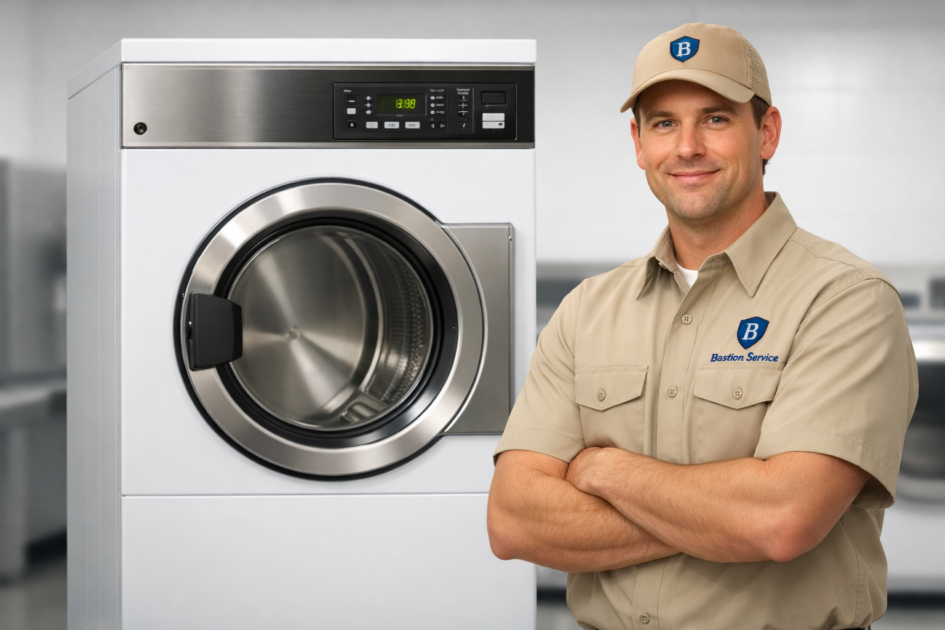
Dryer failures tend to show up first as workflow problems: loads backing up, staff rerunning cycles, heat becoming inconsistent, or a machine dropping out of rotation at the worst time. For Manhattan Beach businesses that rely on Speed Queen laundry equipment, service should focus on the exact symptom pattern, how often it happens, and whether the issue points to heat, airflow, controls, drum movement, or an electrical fault. Bastion Service provides Speed Queen dryer repair for businesses in Manhattan Beach with troubleshooting that helps determine what failed and what should be addressed before downtime spreads.
Related commercial service paths in Manhattan Beach include Speed Queen Repair in Manhattan Beach, Commercial Dryer Repair in Manhattan Beach, and Speed Queen Washer Repair in Manhattan Beach.
What a service visit should identify
Two dryers can appear to have the same problem while failing for completely different reasons. A unit that tumbles without heat may have a heater problem, but it may also be shutting down on a safety limit because airflow is restricted. A dryer with long cycle times may have weak heating, poor exhaust movement, sensor issues, or a control problem that prevents the cycle from finishing normally.
A useful repair visit should confirm:
- whether the dryer is producing proper heat
- whether airflow is strong enough to carry moisture out of the machine
- whether the drum system is rotating smoothly under load
- whether controls and safety devices are operating normally
- whether continued use risks additional damage
Why a Speed Queen dryer may not heat or finish the cycle
When a Speed Queen dryer is not heating or keeps running without drying properly, the cause is often traced to one of several systems working together. Heating components can fail outright, but drying performance can also drop when thermostats, thermal cutoffs, igniters, relays, sensors, or control functions stop responding correctly. In other cases, the machine generates heat but cannot move enough air through the drum and exhaust path to remove moisture efficiently.
From an operations standpoint, this matters because a no-heat complaint and a long-dry-time complaint can overlap. If the dryer is only partially heating, cycling incorrectly, or overheating and shutting the burner or element down, staff may simply notice that loads are still damp at the end of the cycle.
No heat or weak heat
If the drum turns but items stay wet, technicians typically check the heating circuit, temperature controls, safety devices, and power supply conditions. Weak heat can be especially disruptive because the dryer still appears to run, leading staff to keep using it while output declines. That often means longer drying times, repeated cycles, and rising wear on the machine.
Cycles that run too long
Long dry times are often tied to restricted airflow, lint buildup in key passages, poor exhaust movement, moisture-sensing issues, or heat that cycles off too early. In a busy laundry setting, this symptom reduces throughput even before the dryer fails completely. If one machine starts taking noticeably longer than others on similar loads, that is usually a sign the unit needs inspection rather than more frequent use.
Dryer stops before the load is done
A machine that shuts down early may be overheating, tripping a protective device, losing motor performance, or experiencing an intermittent control or wiring problem. Early shutdowns should be taken seriously because they can point to a condition that worsens with continued operation, especially when heat and airflow are already compromised.
Airflow problems often look like heater problems
One of the most common reasons a Speed Queen dryer underperforms is poor air movement. Even when heat is present, the dryer still needs to move moisture out of the drum efficiently. If air cannot circulate or vent properly, loads stay damp, internal temperatures may become erratic, and safety limits can interrupt normal operation.
Symptoms that often suggest airflow trouble include:
- clothes, towels, or linens that stay damp after a full cycle
- longer dry times than normal for the same load type
- hot cabinet surfaces or excessive heat buildup
- a burning lint smell
- repeated thermal shutdowns
Because airflow issues can affect temperature readings and safety controls, they are often part of the repair decision even when another part has also failed.
No-start and intermittent shutdown issues
If a Speed Queen dryer will not start at all, the problem may involve the door switch, start circuit, control board, motor, timer function, or incoming power. A dryer that starts sometimes but not others can be harder to diagnose because the failure may be tied to heat buildup, vibration, intermittent wiring, or a component that fails only once the machine has been running for a while.
For businesses in Manhattan Beach, intermittent problems usually create more disruption than total failures because staff lose confidence in the machine. Loads may need to be watched manually, restarted, or transferred, which slows normal workflow and makes scheduling less predictable.
Drum noise, vibration, and mechanical wear
Unusual noise is often the first sign that a repair should be scheduled before a larger breakdown develops. Squealing, scraping, rumbling, or thumping can point to worn rollers, idlers, belts, glides, bearings, or drum support issues. A dryer may continue to run for a time with these conditions, but friction and misalignment can increase damage to surrounding parts.
Mechanical symptoms worth addressing promptly include:
- drum movement that feels rough or uneven
- new vibration during the cycle
- repetitive scraping or metal-on-metal sounds
- a belt smell or overheated odor
- the drum failing to turn even though the machine powers on
When these symptoms are ignored, repair scope can expand from a wear-part replacement into motor, drum, or support-system damage.
Control and temperature problems that affect consistency
Some Speed Queen dryer issues are less obvious than a complete shutdown. The machine may appear to work, but temperature control becomes inconsistent, cycle lengths no longer match the load, or the dryer behaves differently from one run to the next. In a business setting, that inconsistency is a problem on its own because staff cannot rely on normal turnaround times.
Control-related problems may show up as:
- cycles ending too early
- cycles continuing too long
- heat levels that feel erratic
- buttons or selections that do not respond normally
- intermittent stopping without a clear pattern
These faults often require more than a quick parts guess, since sensors, boards, relays, wiring, and safety devices can all influence cycle behavior.
When continued use can make the repair worse
Some dryer problems mainly reduce performance, while others create a real risk of added damage. If the unit is overheating, producing a burning smell, making severe mechanical noise, or repeatedly shutting down, it is usually better to pause use until the problem is inspected. Continuing to run the dryer in that condition may increase wear on the motor, drum supports, heater components, or controls.
This is especially important when staff are already compensating by rerunning loads, reducing load size, or monitoring the machine manually to get through the day. Those workarounds often indicate the problem has moved beyond normal wear and into an active repair need.
How to prepare for a repair appointment
Before service is scheduled, it helps to gather a few details about how the dryer is failing in daily use. That information can shorten diagnosis time and help isolate whether the problem is constant or tied to certain conditions.
- Note whether the dryer tumbles, heats, both, or neither.
- Track whether the issue happens on every load or only sometimes.
- Write down any unusual sounds, odors, or shutdown behavior.
- Identify whether dry times changed gradually or all at once.
- Observe whether the problem appears with normal-size loads only or with all loads.
The more specific the symptom history, the easier it is to distinguish between an isolated part failure and a broader airflow, electrical, or mechanical problem.
Repair or replacement: how businesses usually decide
Many Speed Queen dryer problems are repairable when the machine is otherwise in solid condition. A targeted repair often makes sense when the issue is limited to heating components, controls, wear parts, or airflow-related faults that can be corrected without extensive rebuild work. Replacement becomes more likely when the dryer has multiple major failures at the same time, serious structural wear, or recurring problems that continue to interrupt operations.
The best decision usually depends on current condition, expected reliability after repair, parts scope, and how much downtime the business can absorb. In many cases, the right answer comes from inspecting the unit first rather than assuming age alone should determine the next step.
Scheduling service for a Speed Queen dryer in Manhattan Beach
If a Speed Queen dryer in Manhattan Beach is no longer heating properly, taking too long to dry, failing to start, making noise, or shutting down mid-cycle, scheduling service early is usually the best way to limit disruption. A symptom-based diagnosis helps determine whether the problem is isolated, whether related wear should be handled at the same time, and what the next repair step should be so the machine can return to reliable daily use.


